 Add to Chrome
 Add to Firefox
 Add to Edge
GEditBench v2: A Human-Aligned Benchmark for General Image Editing
Mar 30, 2026
Recent advances in image editing have enabled models to handle complex instructions with impressive realism. However, existing evaluation frameworks lag behind: current benchmarks suffer from narrow task coverage, while standard metrics fail to adequately capture visual consistency, i.e., the preservation of identity, structure and semantic coherence between edited and original images. To address these limitations, we introduce GEditBench v2, a comprehensive benchmark with 1,200 real-world user queries spanning 23 tasks, including a dedicated open-set category for unconstrained, out-of-distribution editing instructions beyond predefined tasks. Furthermore, we propose PVC-Judge, an open-source pairwise assessment model for visual consistency, trained via two novel region-decoupled preference data synthesis pipelines. Besides, we construct VCReward-Bench using expert-annotated preference pairs to assess the alignment of PVC-Judge with human judgments on visual consistency evaluation. Experiments show that our PVC-Judge achieves state-of-the-art evaluation performance among open-source models and even surpasses GPT-5.1 on average. Finally, by benchmarking 16 frontier editing models, we show that GEditBench v2 enables more human-aligned evaluation, revealing critical limitations of current models, and providing a reliable foundation for advancing precise image editing.

RealRestorer: Towards Generalizable Real-World Image Restoration with Large-Scale Image Editing Models
Mar 26, 2026Image restoration under real-world degradations is critical for downstream tasks such as autonomous driving and object detection. However, existing restoration models are often limited by the scale and distribution of their training data, resulting in poor generalization to real-world scenarios. Recently, large-scale image editing models have shown strong generalization ability in restoration tasks, especially for closed-source models like Nano Banana Pro, which can restore images while preserving consistency. Nevertheless, achieving such performance with those large universal models requires substantial data and computational costs. To address this issue, we construct a large-scale dataset covering nine common real-world degradation types and train a state-of-the-art open-source model to narrow the gap with closed-source alternatives. Furthermore, we introduce RealIR-Bench, which contains 464 real-world degraded images and tailored evaluation metrics focusing on degradation removal and consistency preservation. Extensive experiments demonstrate our model ranks first among open-source methods, achieving state-of-the-art performance.
Adversarial Graph Fusion for Incomplete Multi-view Semi-supervised Learning with Tensorial Imputation
Sep 19, 2025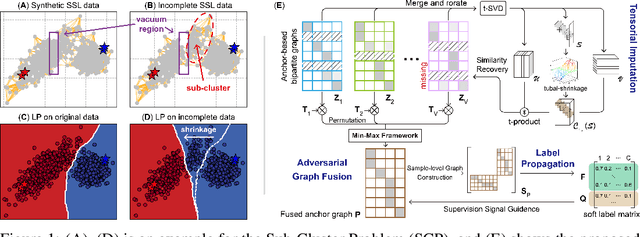
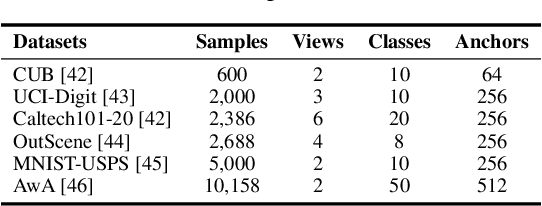
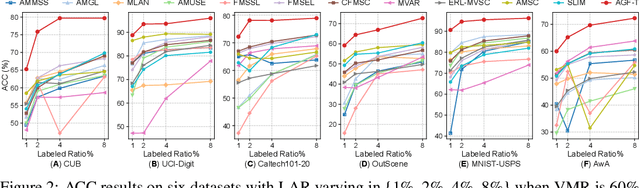
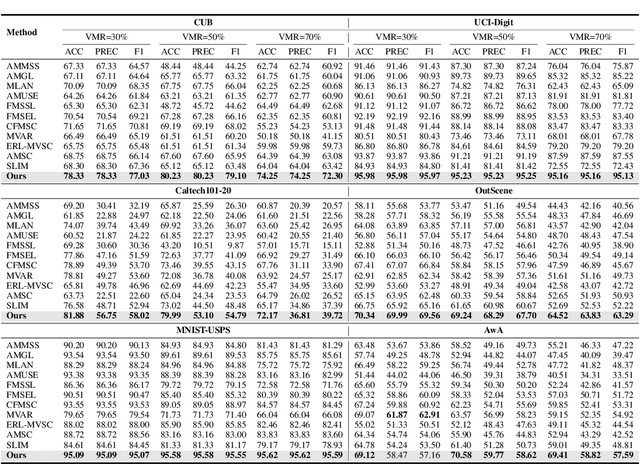
View missing remains a significant challenge in graph-based multi-view semi-supervised learning, hindering their real-world applications. To address this issue, traditional methods introduce a missing indicator matrix and focus on mining partial structure among existing samples in each view for label propagation (LP). However, we argue that these disregarded missing samples sometimes induce discontinuous local structures, i.e., sub-clusters, breaking the fundamental smoothness assumption in LP. Consequently, such a Sub-Cluster Problem (SCP) would distort graph fusion and degrade classification performance. To alleviate SCP, we propose a novel incomplete multi-view semi-supervised learning method, termed AGF-TI. Firstly, we design an adversarial graph fusion scheme to learn a robust consensus graph against the distorted local structure through a min-max framework. By stacking all similarity matrices into a tensor, we further recover the incomplete structure from the high-order consistency information based on the low-rank tensor learning. Additionally, the anchor-based strategy is incorporated to reduce the computational complexity. An efficient alternative optimization algorithm combining a reduced gradient descent method is developed to solve the formulated objective, with theoretical convergence. Extensive experimental results on various datasets validate the superiority of our proposed AGF-TI as compared to state-of-the-art methods. Code is available at https://github.com/ZhangqiJiang07/AGF_TI.
Devils in Middle Layers of Large Vision-Language Models: Interpreting, Detecting and Mitigating Object Hallucinations via Attention Lens
Nov 23, 2024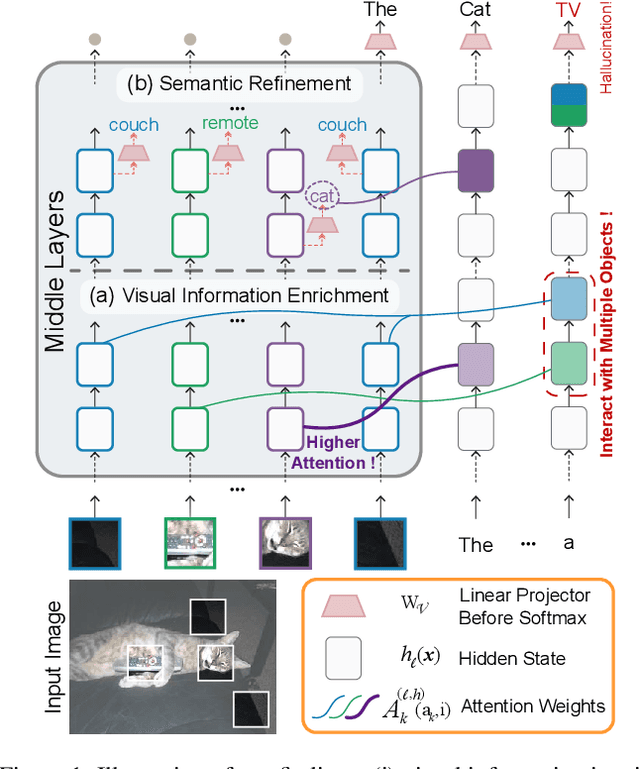
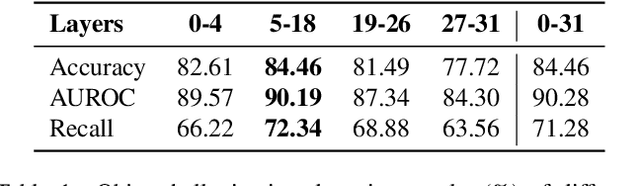

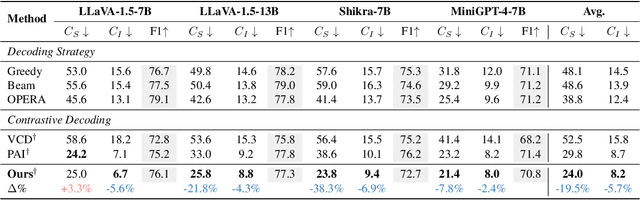
Hallucinations in Large Vision-Language Models (LVLMs) significantly undermine their reliability, motivating researchers to explore the causes of hallucination. However, most studies primarily focus on the language aspect rather than the visual. In this paper, we address how LVLMs process visual information and whether this process causes hallucination. Firstly, we use the attention lens to identify the stages at which LVLMs handle visual data, discovering that the middle layers are crucial. Moreover, we find that these layers can be further divided into two stages: "visual information enrichment" and "semantic refinement" which respectively propagate visual data to object tokens and interpret it through text. By analyzing attention patterns during the visual information enrichment stage, we find that real tokens consistently receive higher attention weights than hallucinated ones, serving as a strong indicator of hallucination. Further examination of multi-head attention maps reveals that hallucination tokens often result from heads interacting with inconsistent objects. Based on these insights, we propose a simple inference-time method that adjusts visual attention by integrating information across various heads. Extensive experiments demonstrate that this approach effectively mitigates hallucinations in mainstream LVLMs without additional training costs.