 Add to Chrome
 Add to Firefox
 Add to Edge
SpaceSense-Bench: A Large-Scale Multi-Modal Benchmark for Spacecraft Perception and Pose Estimation
Mar 10, 2026
Autonomous space operations such as on-orbit servicing and active debris removal demand robust part-level semantic understanding and precise relative navigation of target spacecraft, yet collecting large-scale real data in orbit remains impractical due to cost and access constraints. Existing synthetic datasets, moreover, suffer from limited target diversity, single-modality sensing, and incomplete ground-truth annotations. We present \textbf{SpaceSense-Bench}, a large-scale multi-modal benchmark for spacecraft perception encompassing 136~satellite models with approximately 70~GB of data. Each frame provides time-synchronized 1024$\times$1024 RGB images, millimeter-precision depth maps, and 256-beam LiDAR point clouds, together with dense 7-class part-level semantic labels at both the pixel and point level as well as accurate 6-DoF pose ground truth. The dataset is generated through a high-fidelity space simulation built in Unreal Engine~5 and a fully automated pipeline covering data acquisition, multi-stage quality control, and conversion to mainstream formats. We benchmark five representative tasks (object detection, 2D semantic segmentation, RGB--LiDAR fusion-based 3D point cloud segmentation, monocular depth estimation, and orientation estimation) and identify two key findings: (i)~perceiving small-scale components (\emph{e.g.}, thrusters and omni-antennas) and generalizing to entirely unseen spacecraft in a zero-shot setting remain critical bottlenecks for current methods, and (ii)~scaling up the number of training satellites yields substantial performance gains on novel targets, underscoring the value of large-scale, diverse datasets for space perception research. The dataset, code, and toolkit are publicly available at https://github.com/wuaodi/SpaceSense-Bench.

LuSNAR:A Lunar Segmentation, Navigation and Reconstruction Dataset based on Muti-sensor for Autonomous Exploration
Jul 09, 2024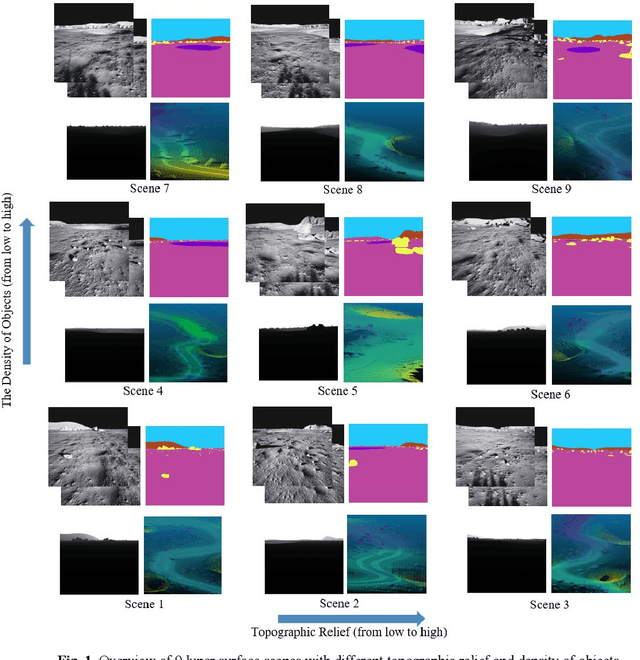
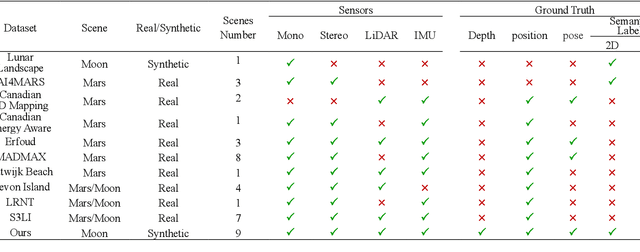
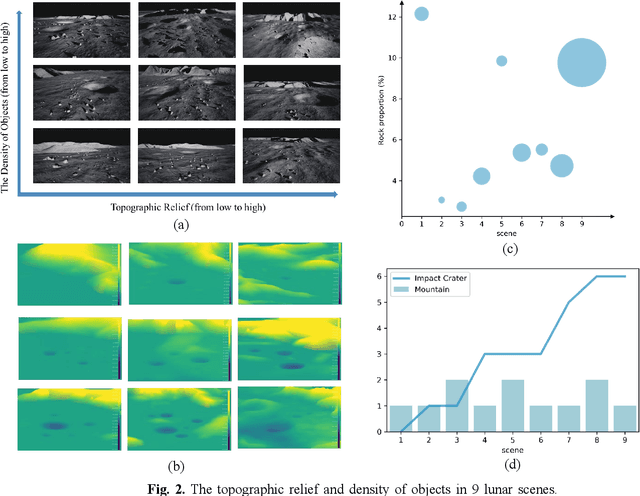
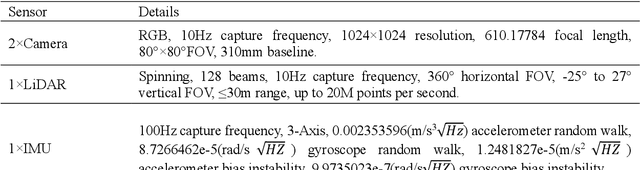
With the complexity of lunar exploration missions, the moon needs to have a higher level of autonomy. Environmental perception and navigation algorithms are the foundation for lunar rovers to achieve autonomous exploration. The development and verification of algorithms require highly reliable data support. Most of the existing lunar datasets are targeted at a single task, lacking diverse scenes and high-precision ground truth labels. To address this issue, we propose a multi-task, multi-scene, and multi-label lunar benchmark dataset LuSNAR. This dataset can be used for comprehensive evaluation of autonomous perception and navigation systems, including high-resolution stereo image pairs, panoramic semantic labels, dense depth maps, LiDAR point clouds, and the position of rover. In order to provide richer scene data, we built 9 lunar simulation scenes based on Unreal Engine. Each scene is divided according to topographic relief and the density of objects. To verify the usability of the dataset, we evaluated and analyzed the algorithms of semantic segmentation, 3D reconstruction, and autonomous navigation. The experiment results prove that the dataset proposed in this paper can be used for ground verification of tasks such as autonomous environment perception and navigation, and provides a lunar benchmark dataset for testing the accessibility of algorithm metrics. We make LuSNAR publicly available at: https://github.com/autumn999999/LuSNAR-dataset.
Exploiting Latent Attribute Interaction with Transformer on Heterogeneous Information Networks
Nov 06, 2023Heterogeneous graph neural networks (HGNNs) have recently shown impressive capability in modeling heterogeneous graphs that are ubiquitous in real-world applications. Due to the diversity of attributes of nodes in different types, most existing models first align nodes by mapping them into the same low-dimensional space. However, in this way, they lose the type information of nodes. In addition, most of them only consider the interactions between nodes while neglecting the high-order information behind the latent interactions among different node features. To address these problems, in this paper, we propose a novel heterogeneous graph model MULAN, including two major components, i.e., a type-aware encoder and a dimension-aware encoder. Specifically, the type-aware encoder compensates for the loss of node type information and better leverages graph heterogeneity in learning node representations. Built upon transformer architecture, the dimension-aware encoder is capable of capturing the latent interactions among the diverse node features. With these components, the information of graph heterogeneity, node features and graph structure can be comprehensively encoded in node representations. We conduct extensive experiments on six heterogeneous benchmark datasets, which demonstrates the superiority of MULAN over other state-of-the-art competitors and also shows that MULAN is efficient.
Resist Label Noise with PGM for Graph Neural Networks
Nov 03, 2023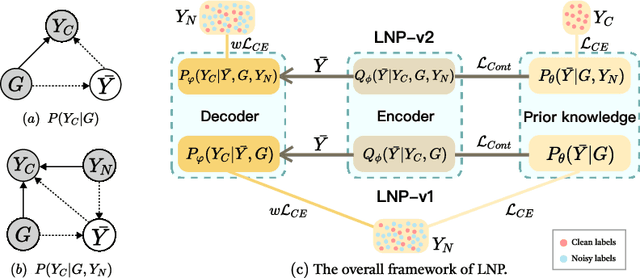
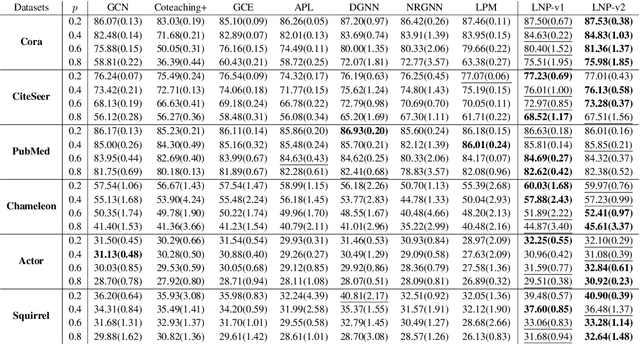
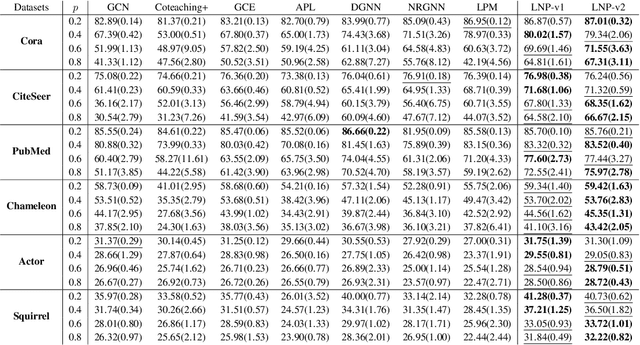
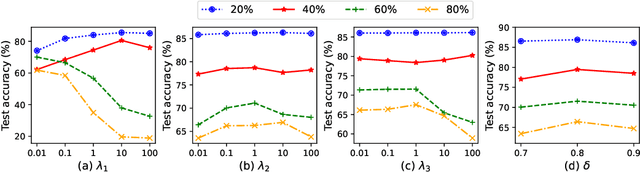
While robust graph neural networks (GNNs) have been widely studied for graph perturbation and attack, those for label noise have received significantly less attention. Most existing methods heavily rely on the label smoothness assumption to correct noisy labels, which adversely affects their performance on heterophilous graphs. Further, they generally perform poorly in high noise-rate scenarios. To address these problems, in this paper, we propose a novel probabilistic graphical model (PGM) based framework LNP. Given a noisy label set and a clean label set, our goal is to maximize the likelihood of labels in the clean set. We first present LNP-v1, which generates clean labels based on graphs only in the Bayesian network. To further leverage the information of clean labels in the noisy label set, we put forward LNP-v2, which incorporates the noisy label set into the Bayesian network to generate clean labels. The generative process can then be used to predict labels for unlabeled nodes. We conduct extensive experiments to show the robustness of LNP on varying noise types and rates, and also on graphs with different heterophilies. In particular, we show that LNP can lead to inspiring performance in high noise-rate situations.
Enhancing Graph Neural Networks with Structure-Based Prompt
Oct 26, 2023Graph Neural Networks (GNNs) are powerful in learning semantics of graph data. Recently, a new paradigm "pre-train, prompt" has shown promising results in adapting GNNs to various tasks with less supervised data. The success of such paradigm can be attributed to the more consistent objectives of pre-training and task-oriented prompt tuning, where the pre-trained knowledge can be effectively transferred to downstream tasks. However, an overlooked issue of existing studies is that the structure information of graph is usually exploited during pre-training for learning node representations, while neglected in the prompt tuning stage for learning task-specific parameters. To bridge this gap, we propose a novel structure-based prompting method for GNNs, namely SAP, which consistently exploits structure information in both pre-training and prompt tuning stages. In particular, SAP 1) employs a dual-view contrastive learning to align the latent semantic spaces of node attributes and graph structure, and 2) incorporates structure information in prompted graph to elicit more pre-trained knowledge in prompt tuning. We conduct extensive experiments on node classification and graph classification tasks to show the effectiveness of SAP. Moreover, we show that SAP can lead to better performance in more challenging few-shot scenarios on both homophilous and heterophilous graphs.