 Add to Chrome
 Add to Firefox
 Add to Edge
OneReason Technical Report
Jun 04, 2026
Generative recommendation models in the OneRec family have been widely deployed in many real-world services, such as short-video, live-streaming, advertising, and e-commerce. However, these generative models can only benefit from the scaling advantage, while their reasoning ability is hard to activate, since we cannot construct meaningful Chain-of-Thought (CoT) sequences consisting of itemic tokens only. Inspired by the success of the reasoning-style ``think before answer'' paradigm in the LLM field, we conduct preliminary studies (i.e., OneRec-Think, OpenOneRec) to explore reasoning capability in generative recommendation. Nevertheless, we notice an unexpected phenomenon: the thinking mode does not show advantages over the non-thinking mode. Drawing insights from recent findings on CoT robustness in multi-modal language models, we argue that effective reasoning in recommendation rests on two factors: perception, the ability to ground itemic tokens in their underlying language semantics, and cognition, the ability to reorganize a user's behavior sequence into coherent latent interest points. We therefore propose OneReason, which includes: (1) strong itemic token perception in pre-training, (2) a three-level cognition-enhanced CoT format for recommendation tasks in SFT, and (3) a specialize-then-unify training recipe in RL to enhance the thinking ability.

Context-Aware Personality Inference in Dyadic Scenarios: Introducing the UDIVA Dataset
Dec 28, 2020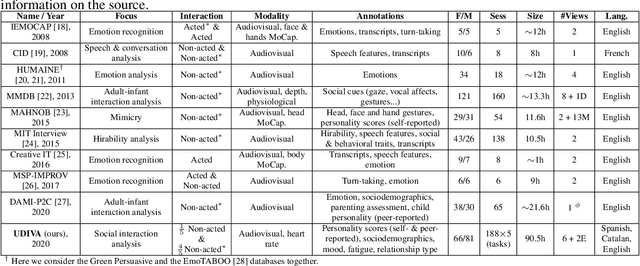
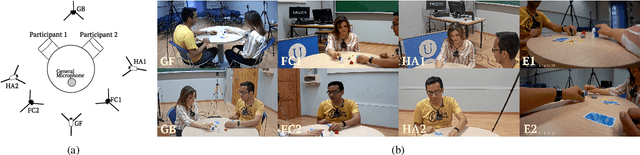

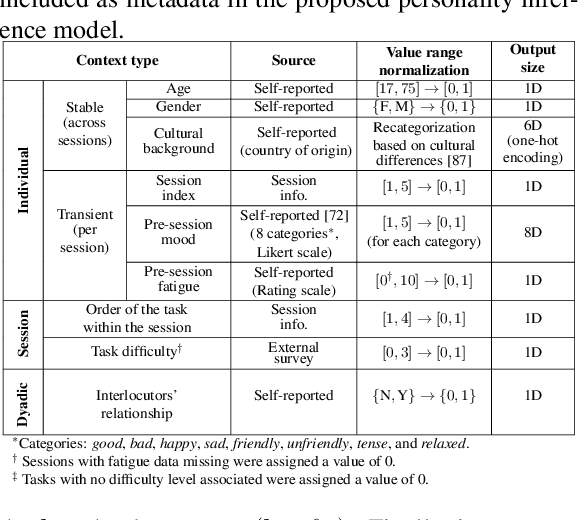
This paper introduces UDIVA, a new non-acted dataset of face-to-face dyadic interactions, where interlocutors perform competitive and collaborative tasks with different behavior elicitation and cognitive workload. The dataset consists of 90.5 hours of dyadic interactions among 147 participants distributed in 188 sessions, recorded using multiple audiovisual and physiological sensors. Currently, it includes sociodemographic, self- and peer-reported personality, internal state, and relationship profiling from participants. As an initial analysis on UDIVA, we propose a transformer-based method for self-reported personality inference in dyadic scenarios, which uses audiovisual data and different sources of context from both interlocutors to regress a target person's personality traits. Preliminary results from an incremental study show consistent improvements when using all available context information.