 Add to Chrome
 Add to Firefox
 Add to Edge
Robot Trajectron V3: A Probabilistic Shared Control Framework for SE(3) Manipulation
Jul 10, 2026
We aim to address the challenge of teleoperating robotic arms for high-degree-of-freedom (high-DoF) manipulation tasks, which is cognitively demanding and error-prone, particularly when relying on low-bandwidth interfaces. We propose Robot Trajectron V3 (RT-V3), a probabilistic shared control framework designed for $SE(3)$ grasping tasks. RT-V3 formulates shared control as Bayesian inference by learning a prior over user intent and combining it with real-time user commands to estimate the posterior intent distribution. The prior models user intent as a distribution over future trajectories conditioned on past robot dynamics and visual scene context. The intent prior is parameterized by a transformer-based conditional generative model that reasons over point clouds and candidate grasp poses, together with a factorized translation-rotation representation that improves learning efficiency in high-dimensional action spaces. During execution, RT-V3 continuously estimates the posterior distribution over future trajectories by combining the learned intent prior with a user-command likelihood derived from the observed control input, enabling continuous intent refinement and shared assistance. Comprehensive experiments demonstrate that RT-V3 achieves high accuracy in trajectory prediction and competitive performance in reactive planning. Furthermore, real-world user studies indicate that RT-V3 significantly outperforms baseline methods in terms of success rate and efficiency, while substantially reducing the user's physical and mental workload.

Assistron: Bayesian Shared Autonomy with Off-the-shelf Vision-Language-Action Models
Jun 22, 2026We propose Assistron, a shared autonomy model that leverages Vision-Language-Action (VLA) models to assist the user in daily activities. Our approach is grounded in two core principles: (1)~minimizing human cognitive and physical effort by leveraging VLA-driven autonomy for macro-movements, and (2)~prioritizing human intervention specifically at critical failure points. Driven by the user's verbal language commands, Assistron utilizes the VLA to autonomously execute macro-reaching trajectories, saving users' effort. In contact-rich interactions where VLAs tend to fail, Assistron employs a phase-aware interaction detection mechanism and solicits the user to intervene, in turn adjusting the VLA's action generation via flow matching guidance. Critically, our formulation eliminates the need for VLA fine-tuning, protecting its broad behavioral priors from catastrophic forgetting and ensuring the model does not become a narrow specialist. We validate our approach on a comprehensive multi-task scene recovery benchmark encompassing diverse daily manipulation skills. Empirical results demonstrate that Assistron significantly improves task success rates over pure autonomous baselines while significantly reducing human cognitive and physical workload compared to traditional teleoperation, offering a scalable, smooth, and effortless paradigm for assistive manipulation. The code is available in https://github.com/mousecpn/Assistron.git.
Swing Leg Motion Strategy for Heavy-load Legged Robot Based on Force Sensing
Sep 03, 2023The heavy-load legged robot has strong load carrying capacity and can adapt to various unstructured terrains. But the large weight results in higher requirements for motion stability and environmental perception ability. In order to utilize force sensing information to improve its motion performance, in this paper, we propose a finite state machine model for the swing leg in the static gait by imitating the movement of the elephant. Based on the presence or absence of additional terrain information, different trajectory planning strategies are provided for the swing leg to enhance the success rate of stepping and save energy. The experimental results on a novel quadruped robot show that our method has strong robustness and can enable heavy-load legged robots to pass through various complex terrains autonomously and smoothly.
TrafficMCTS: A Closed-Loop Traffic Flow Generation Framework with Group-Based Monte Carlo Tree Search
Aug 31, 2023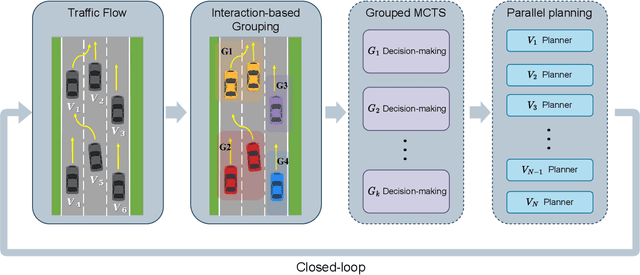
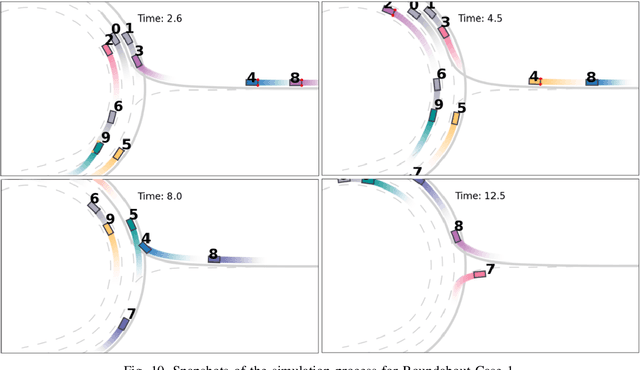
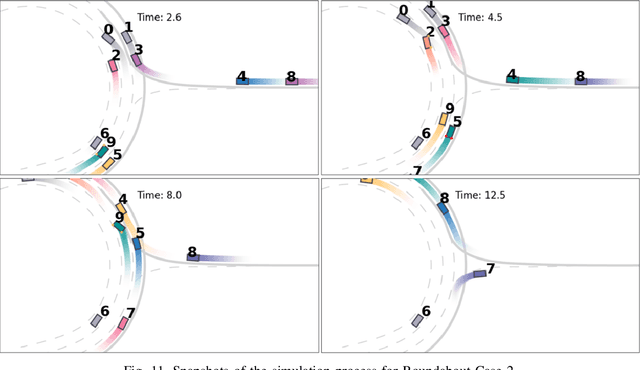
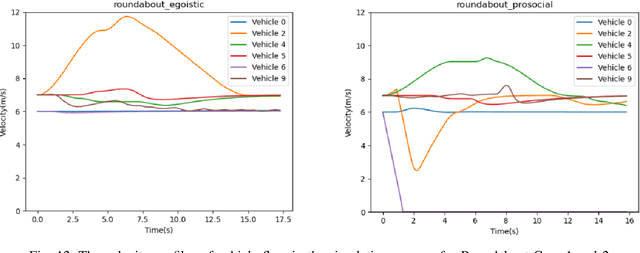
Digital twins for intelligent transportation systems are currently attracting great interests, in which generating realistic, diverse, and human-like traffic flow in simulations is a formidable challenge. Current approaches often hinge on predefined driver models, objective optimization, or reliance on pre-recorded driving datasets, imposing limitations on their scalability, versatility, and adaptability. In this paper, we introduce TrafficMCTS, an innovative framework that harnesses the synergy of groupbased Monte Carlo tree search (MCTS) and Social Value Orientation (SVO) to engender a multifaceted traffic flow replete with varying driving styles and cooperative tendencies. Anchored by a closed-loop architecture, our framework enables vehicles to dynamically adapt to their environment in real time, and ensure feasible collision-free trajectories. Through comprehensive comparisons with state-of-the-art methods, we illuminate the advantages of our approach in terms of computational efficiency, planning success rate, intent completion time, and diversity metrics. Besides, we simulate highway and roundabout scenarios to illustrate the effectiveness of the proposed framework and highlight its ability to induce diverse social behaviors within the traffic flow. Finally, we validate the scalability of TrafficMCTS by showcasing its prowess in simultaneously mass vehicles within a sprawling road network, cultivating a landscape of traffic flow that mirrors the intricacies of human behavior.