 Add to Chrome
 Add to Firefox
 Add to Edge
Equitable System-Prompt Selection via Constrained Mixed-Strategy GroupDRO
Aug 05, 2026
Large language models are increasingly used for information seeking, yet semantically equivalent questions phrased in different ways can receive answers of considerably different quality. System prompts are widely employed to steer response behavior, but they are typically optimized for average-case quality, so some question phrasings may still receive incomplete or low-quality answers. To address this, we formulate a constrained mixed-strategy GroupDRO framework for system-prompt selection. Instead of optimizing the system-prompt text, the framework assigns weights to system prompts in an existing pool to minimize the worst-case information-quality loss across evaluation metrics and groups, while constraining the mean loss to stay close to that of average-based selection. Because pool generation and selection are decoupled, the method applies to any system-prompt pool and can leverage an ensemble of complementary system prompts rather than a single one. Across five LLMs on two bilingual medical and consumer-finance benchmarks, the constrained method reduces the Overall Mean, Worst 25% Mean, and Worst by 13.1%, 13.2%, and 13.7% on average relative to no mitigation while keeping overall quality close to Average selection. Its multi-prompt weights reveal complementarity across metric-group pairs. Code and data are available at https://github.com/Rainxu09/equitable-system-prompt-selection.

LIME-M: Less Is More for Evaluation of MLLMs
Sep 10, 2024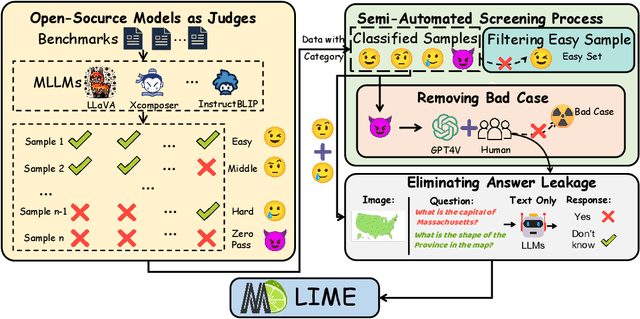
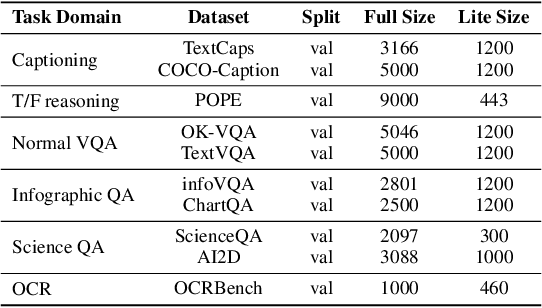
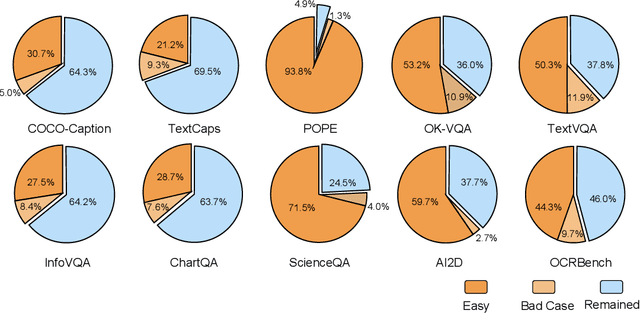
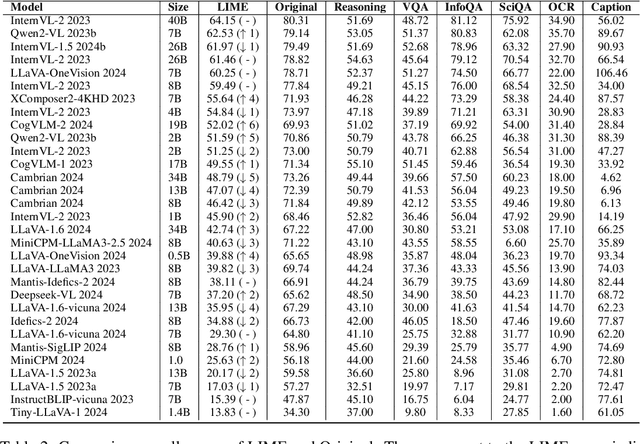
With the remarkable success achieved by Multimodal Large Language Models (MLLMs), numerous benchmarks have been designed to assess MLLMs' ability to guide their development in image perception tasks (e.g., image captioning and visual question answering). However, the existence of numerous benchmarks results in a substantial computational burden when evaluating model performance across all of them. Moreover, these benchmarks contain many overly simple problems or challenging samples, which do not effectively differentiate the capabilities among various MLLMs. To address these challenges, we propose a pipeline to process the existing benchmarks, which consists of two modules: (1) Semi-Automated Screening Process and (2) Eliminating Answer Leakage. The Semi-Automated Screening Process filters out samples that cannot distinguish the model's capabilities by synthesizing various MLLMs and manually evaluating them. The Eliminate Answer Leakage module filters samples whose answers can be inferred without images. Finally, we curate the LIME-M: Less Is More for Evaluation of Multimodal LLMs, a lightweight Multimodal benchmark that can more effectively evaluate the performance of different models. Our experiments demonstrate that: LIME-M can better distinguish the performance of different MLLMs with fewer samples (24% of the original) and reduced time (23% of the original); LIME-M eliminates answer leakage, focusing mainly on the information within images; The current automatic metric (i.e., CIDEr) is insufficient for evaluating MLLMs' capabilities in captioning. Moreover, removing the caption task score when calculating the overall score provides a more accurate reflection of model performance differences. All our codes and data are released at https://github.com/kangreen0210/LIME-M.