 Add to Chrome
 Add to Firefox
 Add to Edge
Retromorphic Testing with Hierarchical Verification for Hallucination Detection in RAG
Mar 29, 2026
Large language models (LLMs) continue to hallucinate in retrieval-augmented generation (RAG), producing claims that are unsupported by or conflict with the retrieved context. Detecting such errors remains challenging when faithfulness is evaluated solely with respect to the retrieved context. Existing approaches either provide coarse-grained, answer-level scores or focus on open-domain factuality, often lacking fine-grained, evidence-grounded diagnostics. We present RT4CHART, a retromorphic testing framework for context-faithfulness assessment. RT4CHART decomposes model outputs into independently verifiable claims and performs hierarchical, local-to-global verification against the retrieved context. Each claim is assigned one of three labels: entailed, contradicted, or baseless. Furthermore, RT4CHART maps claim-level decisions back to specific answer spans and retrieves explicit supporting or refuting evidence from the context, enabling fine-grained and interpretable auditing. We evaluate RT4CHART on RAGTruth++ (408 samples) and RAGTruth-Enhance (2,675 samples), a newly re-annotated benchmark. RT4CHART achieves the best answer-level hallucination detection F1 among all baselines. On RAGTruth++, it reaches an F1 score of 0.776, outperforming the strongest baseline by 83%. On RAGTruth-Enhance, it achieves a span-level F1 of 47.5%. Ablation studies show that the hierarchical verification design is the primary driver of performance gains. Finally, our re-annotation reveals 1.68x more hallucination cases than the original labels, suggesting that existing benchmarks substantially underestimate the prevalence of hallucinations.

Prototype Learning Guided Hybrid Network for Breast Tumor Segmentation in DCE-MRI
Aug 11, 2024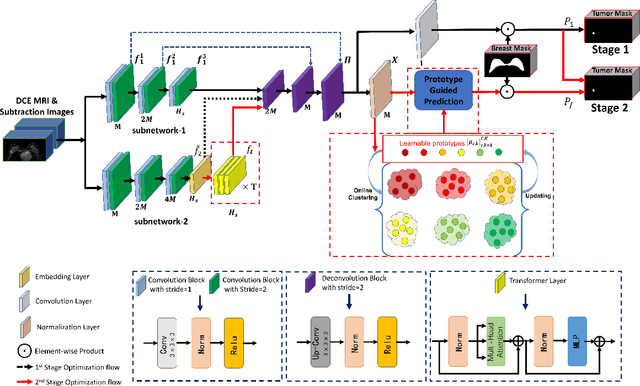
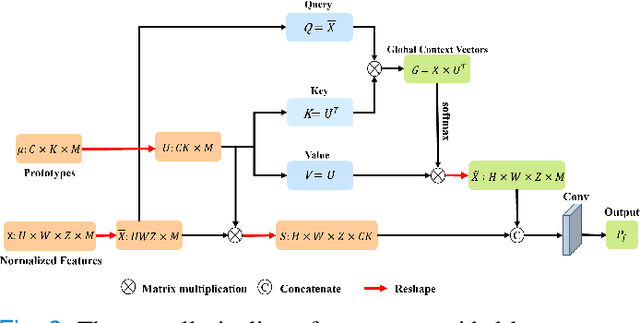
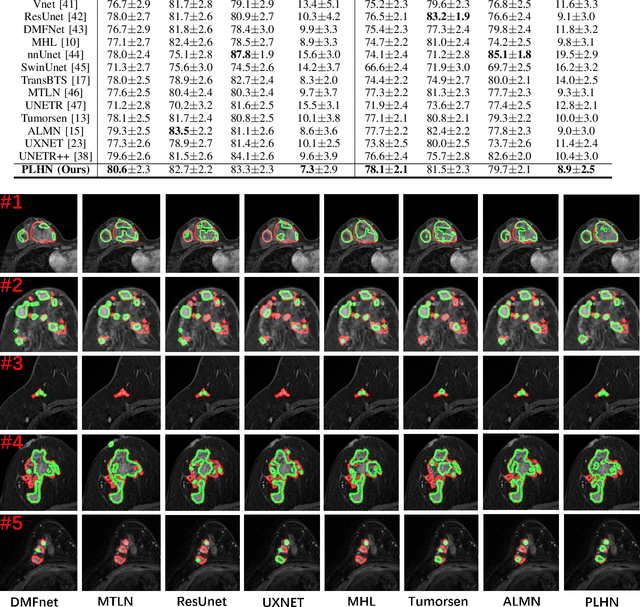
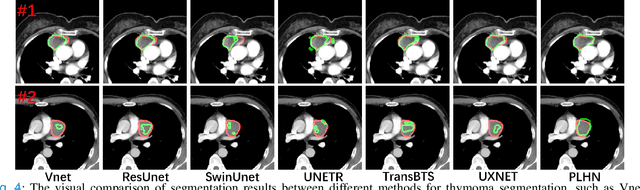
Automated breast tumor segmentation on the basis of dynamic contrast-enhancement magnetic resonance imaging (DCE-MRI) has shown great promise in clinical practice, particularly for identifying the presence of breast disease. However, accurate segmentation of breast tumor is a challenging task, often necessitating the development of complex networks. To strike an optimal trade-off between computational costs and segmentation performance, we propose a hybrid network via the combination of convolution neural network (CNN) and transformer layers. Specifically, the hybrid network consists of a encoder-decoder architecture by stacking convolution and decovolution layers. Effective 3D transformer layers are then implemented after the encoder subnetworks, to capture global dependencies between the bottleneck features. To improve the efficiency of hybrid network, two parallel encoder subnetworks are designed for the decoder and the transformer layers, respectively. To further enhance the discriminative capability of hybrid network, a prototype learning guided prediction module is proposed, where the category-specified prototypical features are calculated through on-line clustering. All learned prototypical features are finally combined with the features from decoder for tumor mask prediction. The experimental results on private and public DCE-MRI datasets demonstrate that the proposed hybrid network achieves superior performance than the state-of-the-art (SOTA) methods, while maintaining balance between segmentation accuracy and computation cost. Moreover, we demonstrate that automatically generated tumor masks can be effectively applied to identify HER2-positive subtype from HER2-negative subtype with the similar accuracy to the analysis based on manual tumor segmentation. The source code is available at https://github.com/ZhouL-lab/PLHN.