 Add to Chrome
 Add to Firefox
 Add to Edge
LinkedOut: Linking World Knowledge Representation Out of Video LLM for Next-Generation Video Recommendation
Dec 18, 2025
Video Large Language Models (VLLMs) unlock world-knowledge-aware video understanding through pretraining on internet-scale data and have already shown promise on tasks such as movie analysis and video question answering. However, deploying VLLMs for downstream tasks such as video recommendation remains challenging, since real systems require multi-video inputs, lightweight backbones, low-latency sequential inference, and rapid response. In practice, (1) decode-only generation yields high latency for sequential inference, (2) typical interfaces do not support multi-video inputs, and (3) constraining outputs to language discards fine-grained visual details that matter for downstream vision tasks. We argue that these limitations stem from the absence of a representation that preserves pixel-level detail while leveraging world knowledge. We present LinkedOut, a representation that extracts VLLM world knowledge directly from video to enable fast inference, supports multi-video histories, and removes the language bottleneck. LinkedOut extracts semantically grounded, knowledge-aware tokens from raw frames using VLLMs, guided by promptable queries and optional auxiliary modalities. We introduce a cross-layer knowledge fusion MoE that selects the appropriate level of abstraction from the rich VLLM features, enabling personalized, interpretable, and low-latency recommendation. To our knowledge, LinkedOut is the first VLLM-based video recommendation method that operates on raw frames without handcrafted labels, achieving state-of-the-art results on standard benchmarks. Interpretability studies and ablations confirm the benefits of layer diversity and layer-wise fusion, pointing to a practical path that fully leverages VLLM world-knowledge priors and visual reasoning for downstream vision tasks such as recommendation.

Selective Conformal Risk Control
Dec 14, 2025
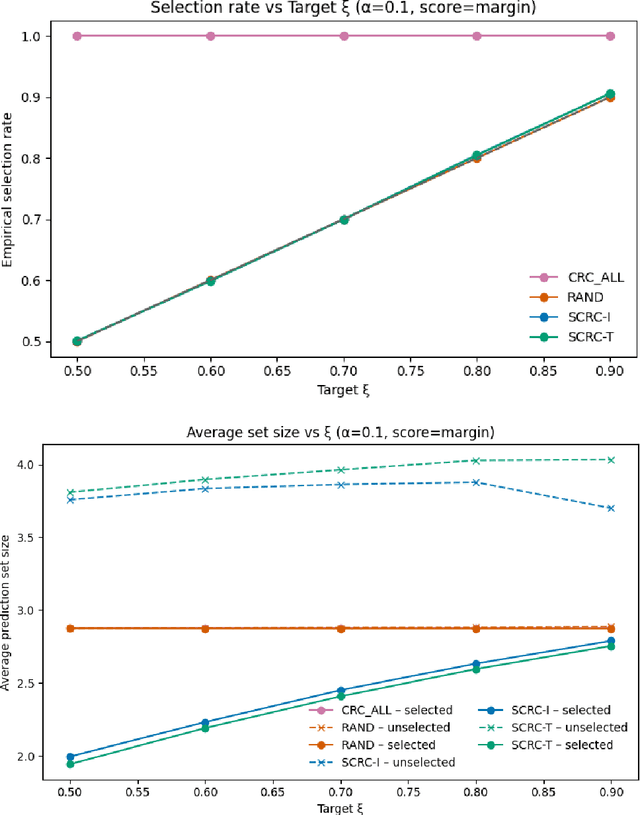

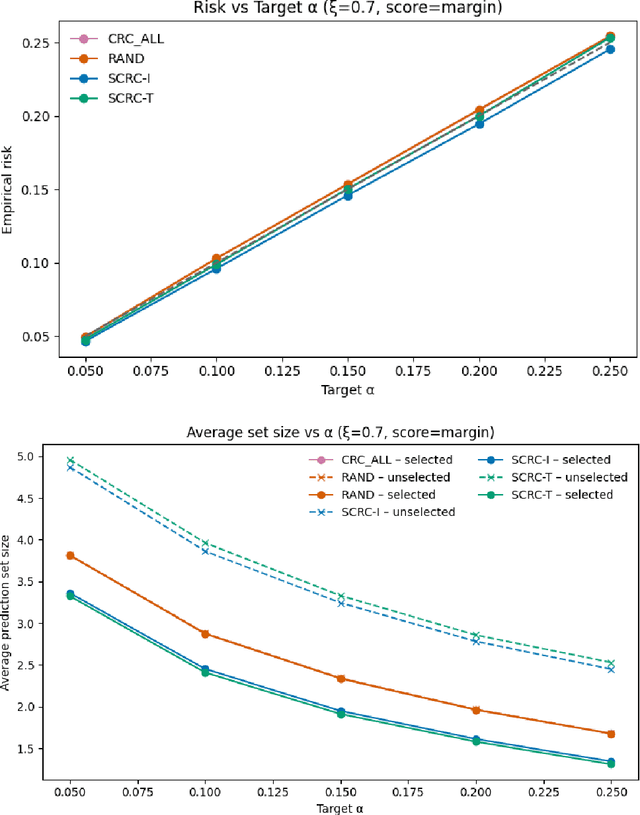
Reliable uncertainty quantification is essential for deploying machine learning systems in high-stakes domains. Conformal prediction provides distribution-free coverage guarantees but often produces overly large prediction sets, limiting its practical utility. To address this issue, we propose \textit{Selective Conformal Risk Control} (SCRC), a unified framework that integrates conformal prediction with selective classification. The framework formulates uncertainty control as a two-stage problem: the first stage selects confident samples for prediction, and the second stage applies conformal risk control on the selected subset to construct calibrated prediction sets. We develop two algorithms under this framework. The first, SCRC-T, preserves exchangeability by computing thresholds jointly over calibration and test samples, offering exact finite-sample guarantees. The second, SCRC-I, is a calibration-only variant that provides PAC-style probabilistic guarantees while being more computational efficient. Experiments on two public datasets show that both methods achieve the target coverage and risk levels, with nearly identical performance, while SCRC-I exhibits slightly more conservative risk control but superior computational practicality. Our results demonstrate that selective conformal risk control offers an effective and efficient path toward compact, reliable uncertainty quantification.
Information Gain-Guided Causal Intervention for Autonomous Debiasing Large Language Models
Apr 17, 2025Despite significant progress, recent studies indicate that current large language models (LLMs) may still capture dataset biases and utilize them during inference, leading to the poor generalizability of LLMs. However, due to the diversity of dataset biases and the insufficient nature of bias suppression based on in-context learning, the effectiveness of previous prior knowledge-based debiasing methods and in-context learning based automatic debiasing methods is limited. To address these challenges, we explore the combination of causal mechanisms with information theory and propose an information gain-guided causal intervention debiasing (IGCIDB) framework. This framework first utilizes an information gain-guided causal intervention method to automatically and autonomously balance the distribution of instruction-tuning dataset. Subsequently, it employs a standard supervised fine-tuning process to train LLMs on the debiased dataset. Experimental results show that IGCIDB can effectively debias LLM to improve its generalizability across different tasks.
Conformal Risk Control for Ordinal Classification
May 01, 2024As a natural extension to the standard conformal prediction method, several conformal risk control methods have been recently developed and applied to various learning problems. In this work, we seek to control the conformal risk in expectation for ordinal classification tasks, which have broad applications to many real problems. For this purpose, we firstly formulated the ordinal classification task in the conformal risk control framework, and provided theoretic risk bounds of the risk control method. Then we proposed two types of loss functions specially designed for ordinal classification tasks, and developed corresponding algorithms to determine the prediction set for each case to control their risks at a desired level. We demonstrated the effectiveness of our proposed methods, and analyzed the difference between the two types of risks on three different datasets, including a simulated dataset, the UTKFace dataset and the diabetic retinopathy detection dataset.
* 17 pages, 8 figures, 2 table; 1 supplementary page
Conformal Ranked Retrieval
Apr 27, 2024
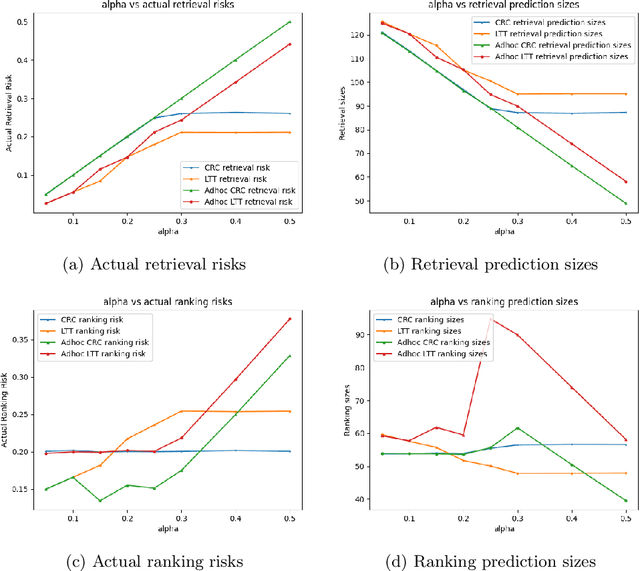


Given the wide adoption of ranked retrieval techniques in various information systems that significantly impact our daily lives, there is an increasing need to assess and address the uncertainty inherent in their predictions. This paper introduces a novel method using the conformal risk control framework to quantitatively measure and manage risks in the context of ranked retrieval problems. Our research focuses on a typical two-stage ranked retrieval problem, where the retrieval stage generates candidates for subsequent ranking. By carefully formulating the conformal risk for each stage, we have developed algorithms to effectively control these risks within their specified bounds. The efficacy of our proposed methods has been demonstrated through comprehensive experiments on three large-scale public datasets for ranked retrieval tasks, including the MSLR-WEB dataset, the Yahoo LTRC dataset and the MS MARCO dataset.
DAD vision: opto-electronic co-designed computer vision with division adjoint method
Nov 04, 2022
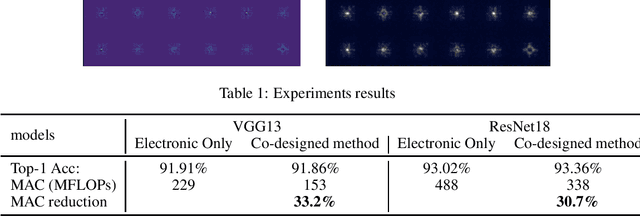
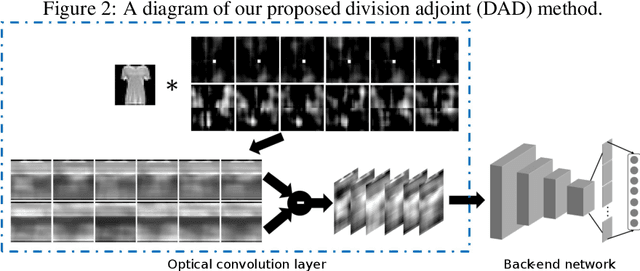
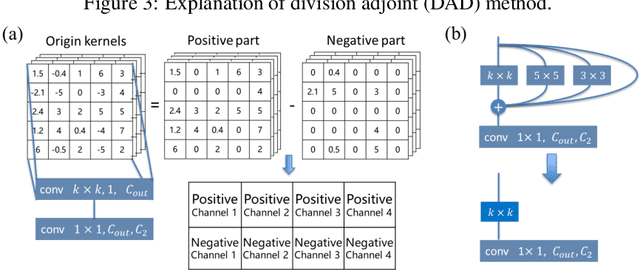
The miniaturization and mobility of computer vision systems are limited by the heavy computational burden and the size of optical lenses. Here, we propose to use a ultra-thin diffractive optical element to implement passive optical convolution. A division adjoint opto-electronic co-design method is also proposed. In our simulation experiments, the first few convolutional layers of the neural network can be replaced by optical convolution in a classification task on the CIFAR-10 dataset with no power consumption, while similar performance can be obtained.