 Add to Chrome
 Add to Firefox
 Add to Edge
Grounded Token Initialization for New Vocabulary in LMs for Generative Recommendation
Apr 02, 2026
Language models (LMs) are increasingly extended with new learnable vocabulary tokens for domain-specific tasks, such as Semantic-ID tokens in generative recommendation. The standard practice initializes these new tokens as the mean of existing vocabulary embeddings, then relies on supervised fine-tuning to learn their representations. We present a systematic analysis of this strategy: through spectral and geometric diagnostics, we show that mean initialization collapses all new tokens into a degenerate subspace, erasing inter-token distinctions that subsequent fine-tuning struggles to fully recover. These findings suggest that \emph{token initialization} is a key bottleneck when extending LMs with new vocabularies. Motivated by this diagnosis, we propose the \emph{Grounded Token Initialization Hypothesis}: linguistically grounding novel tokens in the pretrained embedding space before fine-tuning better enables the model to leverage its general-purpose knowledge for novel-token domains. We operationalize this hypothesis as GTI (Grounded Token Initialization), a lightweight grounding stage that, prior to fine-tuning, maps new tokens to distinct, semantically meaningful locations in the pretrained embedding space using only paired linguistic supervision. Despite its simplicity, GTI outperforms both mean initialization and existing auxiliary-task adaptation methods in the majority of evaluation settings across multiple generative recommendation benchmarks, including industry-scale and public datasets. Further analyses show that grounded embeddings produce richer inter-token structure that persists through fine-tuning, corroborating the hypothesis that initialization quality is a key bottleneck in vocabulary extension.

Is Conformal Factuality for RAG-based LLMs Robust? Novel Metrics and Systematic Insights
Mar 17, 2026Large language models (LLMs) frequently hallucinate, limiting their reliability in knowledge-intensive applications. Retrieval-augmented generation (RAG) and conformal factuality have emerged as potential ways to address this limitation. While RAG aims to ground responses in retrieved evidence, it provides no statistical guarantee that the final output is correct. Conformal factuality filtering offers distribution-free statistical reliability by scoring and filtering atomic claims using a threshold calibrated on held-out data, however, the informativeness of the final output is not guaranteed. We systematically analyze the reliability and usefulness of conformal factuality for RAG-based LLMs across generation, scoring, calibration, robustness, and efficiency. We propose novel informativeness-aware metrics that better reflect task utility under conformal filtering. Across three benchmarks and multiple model families, we find that (i) conformal filtering suffers from low usefulness at high factuality levels due to vacuous outputs, (ii) conformal factuality guarantee is not robust to distribution shifts and distractors, highlighting the limitation that requires calibration data to closely match deployment conditions, and (iii) lightweight entailment-based verifiers match or outperform LLM-based model confidence scorers while requiring over $100\times$ fewer FLOPs. Overall, our results expose factuality-informativeness trade-offs and fragility of conformal filtering framework under distribution shifts and distractors, highlighting the need for new approaches for reliability with robustness and usefulness as key metrics, and provide actionable guidance for building RAG pipelines that are both reliable and computationally efficient.
LinkedOut: Linking World Knowledge Representation Out of Video LLM for Next-Generation Video Recommendation
Dec 18, 2025Video Large Language Models (VLLMs) unlock world-knowledge-aware video understanding through pretraining on internet-scale data and have already shown promise on tasks such as movie analysis and video question answering. However, deploying VLLMs for downstream tasks such as video recommendation remains challenging, since real systems require multi-video inputs, lightweight backbones, low-latency sequential inference, and rapid response. In practice, (1) decode-only generation yields high latency for sequential inference, (2) typical interfaces do not support multi-video inputs, and (3) constraining outputs to language discards fine-grained visual details that matter for downstream vision tasks. We argue that these limitations stem from the absence of a representation that preserves pixel-level detail while leveraging world knowledge. We present LinkedOut, a representation that extracts VLLM world knowledge directly from video to enable fast inference, supports multi-video histories, and removes the language bottleneck. LinkedOut extracts semantically grounded, knowledge-aware tokens from raw frames using VLLMs, guided by promptable queries and optional auxiliary modalities. We introduce a cross-layer knowledge fusion MoE that selects the appropriate level of abstraction from the rich VLLM features, enabling personalized, interpretable, and low-latency recommendation. To our knowledge, LinkedOut is the first VLLM-based video recommendation method that operates on raw frames without handcrafted labels, achieving state-of-the-art results on standard benchmarks. Interpretability studies and ablations confirm the benefits of layer diversity and layer-wise fusion, pointing to a practical path that fully leverages VLLM world-knowledge priors and visual reasoning for downstream vision tasks such as recommendation.
PAL: Pluralistic Alignment Framework for Learning from Heterogeneous Preferences
Jun 12, 2024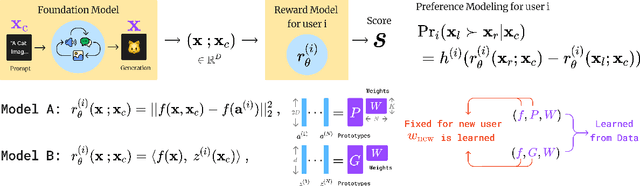
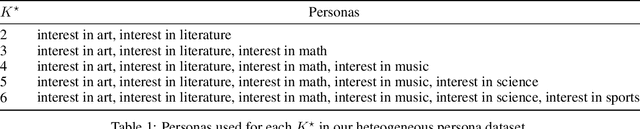


Large foundation models pretrained on raw web-scale data are not readily deployable without additional step of extensive alignment to human preferences. Such alignment is typically done by collecting large amounts of pairwise comparisons from humans ("Do you prefer output A or B?") and learning a reward model or a policy with the Bradley-Terry-Luce (BTL) model as a proxy for a human's underlying implicit preferences. These methods generally suffer from assuming a universal preference shared by all humans, which lacks the flexibility of adapting to plurality of opinions and preferences. In this work, we propose PAL, a framework to model human preference complementary to existing pretraining strategies, which incorporates plurality from the ground up. We propose using the ideal point model as a lens to view alignment using preference comparisons. Together with our novel reformulation and using mixture modeling, our framework captures the plurality of population preferences while simultaneously learning a common preference latent space across different preferences, which can few-shot generalize to new, unseen users. Our approach enables us to use the penultimate-layer representation of large foundation models and simple MLP layers to learn reward functions that are on-par with the existing large state-of-the-art reward models, thereby enhancing efficiency of reward modeling significantly. We show that PAL achieves competitive reward model accuracy compared to strong baselines on 1) Language models with Summary dataset ; 2) Image Generative models with Pick-a-Pic dataset ; 3) A new semisynthetic heterogeneous dataset generated using Anthropic Personas. Finally, our experiments also highlight the shortcoming of current preference datasets that are created using rigid rubrics which wash away heterogeneity, and call for more nuanced data collection approaches.
Learning Capacity: A Measure of the Effective Dimensionality of a Model
May 27, 2023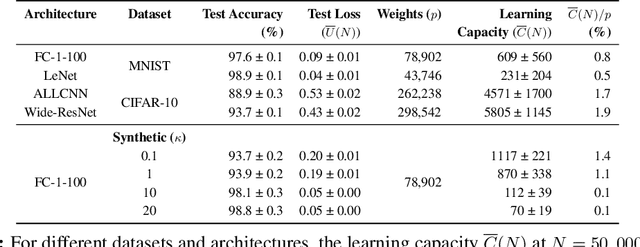
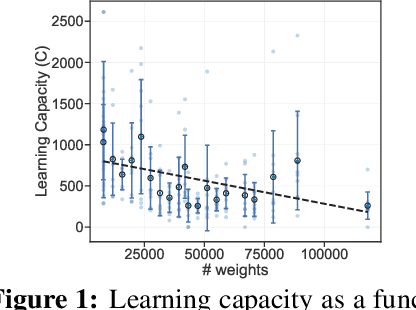
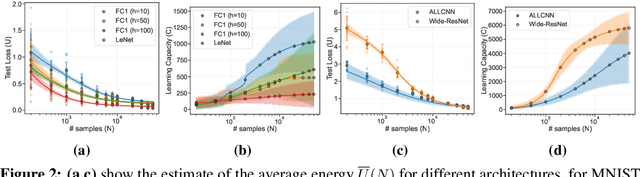
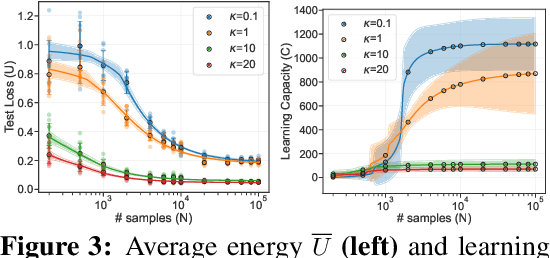
We exploit a formal correspondence between thermodynamics and inference, where the number of samples can be thought of as the inverse temperature, to define a "learning capacity'' which is a measure of the effective dimensionality of a model. We show that the learning capacity is a tiny fraction of the number of parameters for many deep networks trained on typical datasets, depends upon the number of samples used for training, and is numerically consistent with notions of capacity obtained from the PAC-Bayesian framework. The test error as a function of the learning capacity does not exhibit double descent. We show that the learning capacity of a model saturates at very small and very large sample sizes; this provides guidelines, as to whether one should procure more data or whether one should search for new architectures, to improve performance. We show how the learning capacity can be used to understand the effective dimensionality, even for non-parametric models such as random forests and $k$-nearest neighbor classifiers.