 Add to Chrome
 Add to Firefox
 Add to Edge
BrainCast: A Spatio-Temporal Forecasting Model for Whole-Brain fMRI Time Series Prediction
Mar 09, 2026
Functional magnetic resonance imaging (fMRI) enables noninvasive investigation of brain function, while short clinical scan durations, arising from human and non-human factors, usually lead to reduced data quality and limited statistical power for neuroimaging research. In this paper, we propose BrainCast, a novel spatio-temporal forecasting framework specifically tailored for whole-brain fMRI time series forecasting, to extend informative fMRI time series without additional data acquisition. It formulates fMRI time series forecasting as a multivariate time series prediction task and jointly models temporal dynamics within regions of interest (ROIs) and spatial interactions across ROIs. Specifically, BrainCast integrates a Spatial Interaction Awareness module to characterize inter-ROI dependencies via embedding every ROI time series as a token, a Temporal Feature Refinement module to capture intrinsic neural dynamics within each ROI by enhancing both low- and high-energy temporal components of fMRI time series at the ROI level, and a Spatio-temporal Pattern Alignment module to combine spatial and temporal representations for producing informative whole-brain features. Experimental results on resting-state and task fMRI datasets from the Human Connectome Project demonstrate the superiority of BrainCast over state-of-the-art time series forecasting baselines. Moreover, fMRI time series extended by BrainCast improve downstream cognitive ability prediction, highlighting the clinical and neuroscientific impact brought by whole-brain fMRI time series forecasting in scenarios with restricted scan durations.

Boosting Meta-Learning for Few-Shot Text Classification via Label-guided Distance Scaling
Feb 28, 2026Few-shot text classification aims to recognize unseen classes with limited labeled text samples. Existing approaches focus on boosting meta-learners by developing complex algorithms in the training stage. However, the labeled samples are randomly selected during the testing stage, so they may not provide effective supervision signals, leading to misclassification. To address this issue, we propose a \textbf{L}abel-guided \textbf{D}istance \textbf{S}caling (LDS) strategy. The core of our method is exploiting label semantics as supervision signals in both the training and testing stages. Specifically, in the training stage, we design a label-guided loss to inject label semantic information, pulling closer the sample representations and corresponding label representations. In the testing stage, we propose a Label-guided Scaler which scales sample representations with label semantics to provide additional supervision signals. Thus, even if labeled sample representations are far from class centers, our Label-guided Scaler pulls them closer to their class centers, thereby mitigating the misclassification. We combine two common meta-learners to verify the effectiveness of the method. Extensive experimental results demonstrate that our approach significantly outperforms state-of-the-art models. All datasets and codes are available at https://anonymous.4open.science/r/Label-guided-Text-Classification.
Learning Actionable World Models for Industrial Process Control
Mar 03, 2025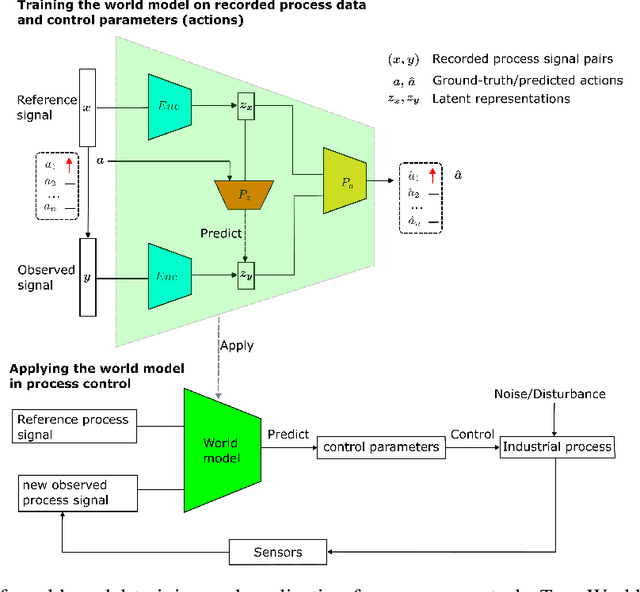
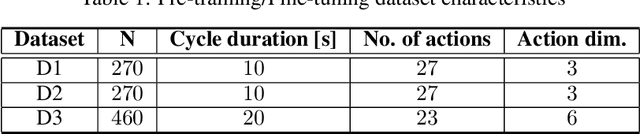

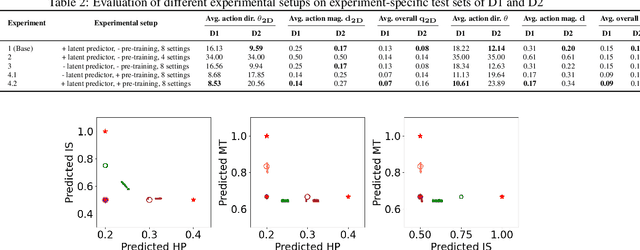
To go from (passive) process monitoring to active process control, an effective AI system must learn about the behavior of the complex system from very limited training data, forming an ad-hoc digital twin with respect to process in- and outputs that captures the consequences of actions on the process's world. We propose a novel methodology based on learning world models that disentangles process parameters in the learned latent representation, allowing for fine-grained control. Representation learning is driven by the latent factors that influence the processes through contrastive learning within a joint embedding predictive architecture. This makes changes in representations predictable from changes in inputs and vice versa, facilitating interpretability of key factors responsible for process variations, paving the way for effective control actions to keep the process within operational bounds. The effectiveness of our method is validated on the example of plastic injection molding, demonstrating practical relevance in proposing specific control actions for a notoriously unstable process.
Improve Meta-learning for Few-Shot Text Classification with All You Can Acquire from the Tasks
Oct 14, 2024
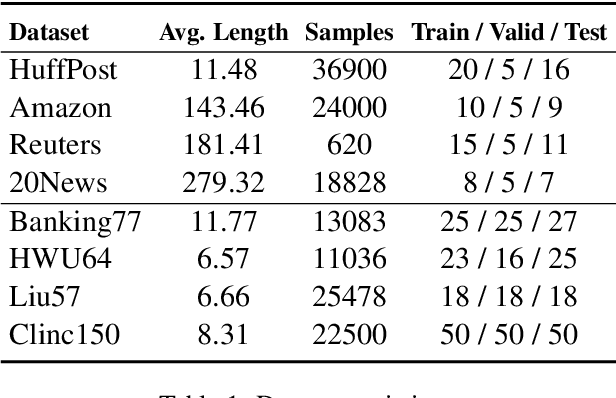
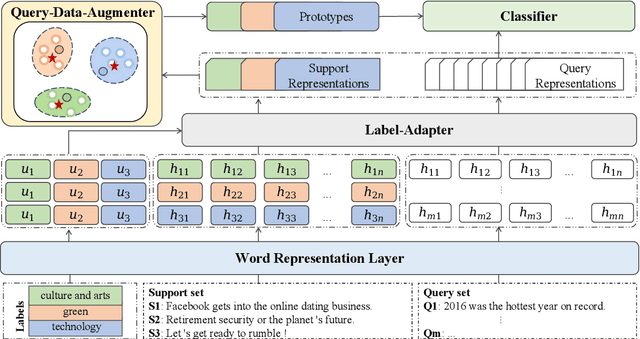
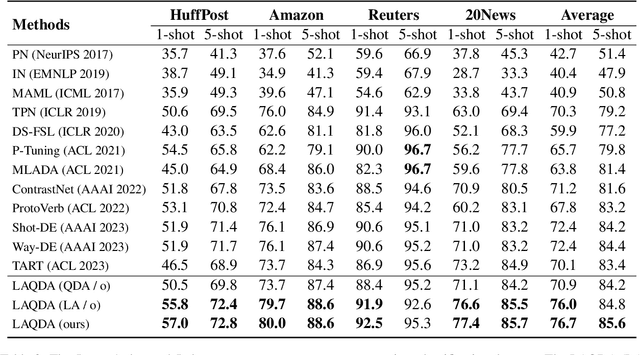
Meta-learning has emerged as a prominent technology for few-shot text classification and has achieved promising performance. However, existing methods often encounter difficulties in drawing accurate class prototypes from support set samples, primarily due to probable large intra-class differences and small inter-class differences within the task. Recent approaches attempt to incorporate external knowledge or pre-trained language models to augment data, but this requires additional resources and thus does not suit many few-shot scenarios. In this paper, we propose a novel solution to address this issue by adequately leveraging the information within the task itself. Specifically, we utilize label information to construct a task-adaptive metric space, thereby adaptively reducing the intra-class differences and magnifying the inter-class differences. We further employ the optimal transport technique to estimate class prototypes with query set samples together, mitigating the problem of inaccurate and ambiguous support set samples caused by large intra-class differences. We conduct extensive experiments on eight benchmark datasets, and our approach shows obvious advantages over state-of-the-art models across all the tasks on all the datasets. For reproducibility, all the datasets and codes are available at https://github.com/YvoGao/LAQDA.