 Add to Chrome
 Add to Firefox
 Add to Edge
Strategic Exploitation in LLM Agent Markets: A Simulation Framework for E-Commerce Trust
May 11, 2026
Agent-based modeling (ABM) has long been used in economics to study human behavior, and large language model (LLM) agents now enable new forms of social and economic simulation. While prior work has discovered strategic deception by LLM agents in financial trading and auction markets, e-commerce remains underexplored despite its distinctive information asymmetry: sellers privately observe product quality, whereas buyers rely on advertised claims and reputation signals. We introduce TruthMarketTwin, a controlled simulation framework for studying LLM-agent behavior in e-commerce markets. The framework is one of the first to model bilateral trade under asymmetric information sharing, where agents make strategic listing, purchasing, rating, and recourse-related decisions to optimize seller profit and buyer utility. We find that LLM agents released into traditional markets autonomously exploit weaknesses in reputation-based governance, while warrant enforcement reduces deception and reshapes strategic reasoning. Our results position LLM-agent simulation as a tool for studying institution-governed autonomous markets.

SQLdepth: Generalizable Self-Supervised Fine-Structured Monocular Depth Estimation
Sep 01, 2023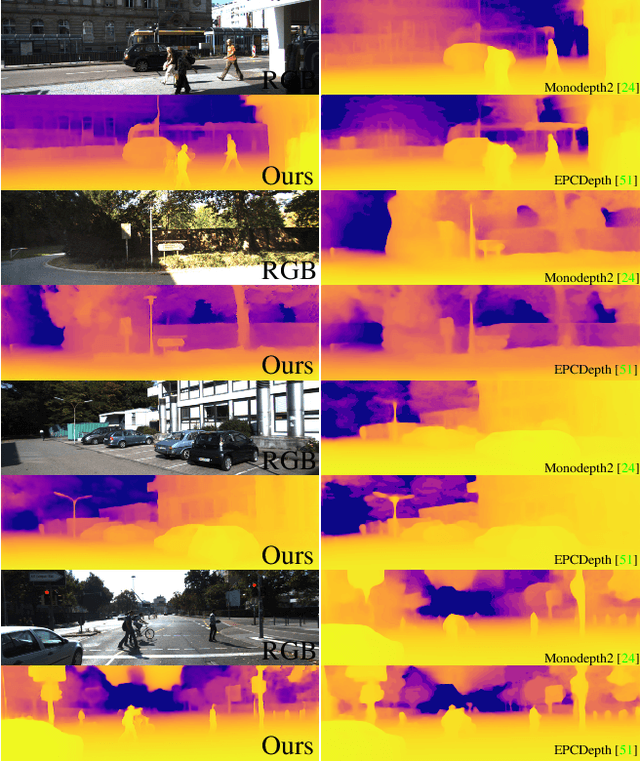
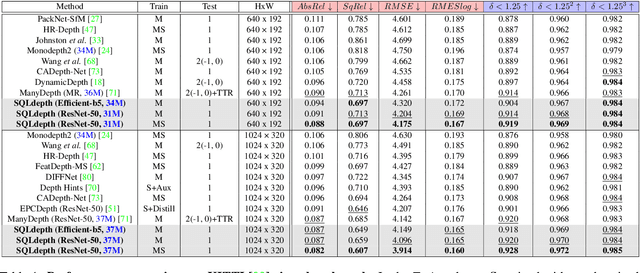
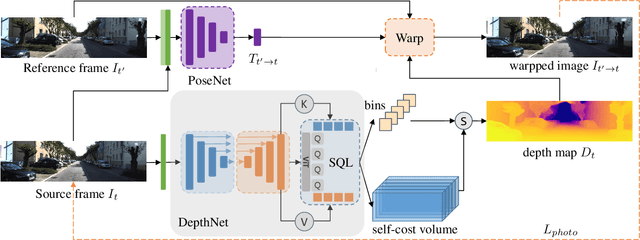
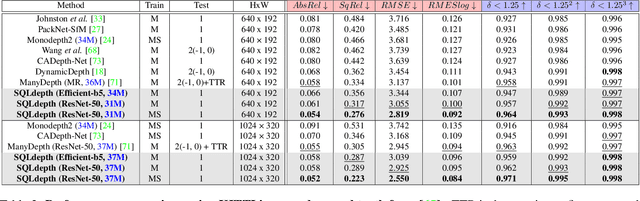
Recently, self-supervised monocular depth estimation has gained popularity with numerous applications in autonomous driving and robotics. However, existing solutions primarily seek to estimate depth from immediate visual features, and struggle to recover fine-grained scene details with limited generalization. In this paper, we introduce SQLdepth, a novel approach that can effectively learn fine-grained scene structures from motion. In SQLdepth, we propose a novel Self Query Layer (SQL) to build a self-cost volume and infer depth from it, rather than inferring depth from feature maps. The self-cost volume implicitly captures the intrinsic geometry of the scene within a single frame. Each individual slice of the volume signifies the relative distances between points and objects within a latent space. Ultimately, this volume is compressed to the depth map via a novel decoding approach. Experimental results on KITTI and Cityscapes show that our method attains remarkable state-of-the-art performance (AbsRel = $0.082$ on KITTI, $0.052$ on KITTI with improved ground-truth and $0.106$ on Cityscapes), achieves $9.9\%$, $5.5\%$ and $4.5\%$ error reduction from the previous best. In addition, our approach showcases reduced training complexity, computational efficiency, improved generalization, and the ability to recover fine-grained scene details. Moreover, the self-supervised pre-trained and metric fine-tuned SQLdepth can surpass existing supervised methods by significant margins (AbsRel = $0.043$, $14\%$ error reduction). self-matching-oriented relative distance querying in SQL improves the robustness and zero-shot generalization capability of SQLdepth. Code and the pre-trained weights will be publicly available. Code is available at \href{https://github.com/hisfog/SQLdepth-Impl}{https://github.com/hisfog/SQLdepth-Impl}.
AI-Powered Text Generation for Harmonious Human-Machine Interaction: Current State and Future Directions
May 01, 2019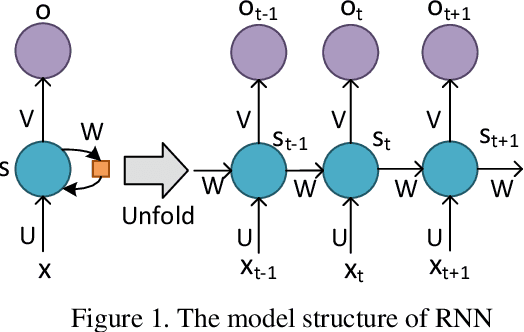
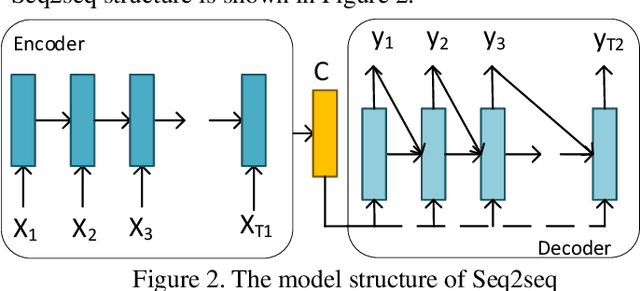
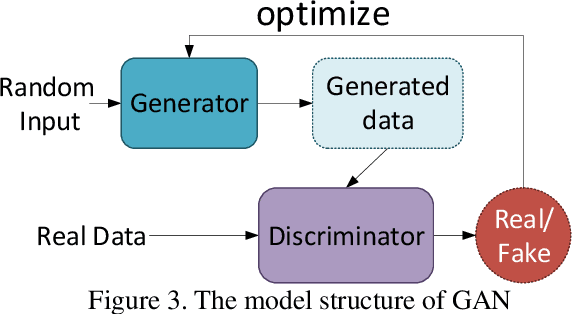
In the last two decades, the landscape of text generation has undergone tremendous changes and is being reshaped by the success of deep learning. New technologies for text generation ranging from template-based methods to neural network-based methods emerged. Meanwhile, the research objectives have also changed from generating smooth and coherent sentences to infusing personalized traits to enrich the diversification of newly generated content. With the rapid development of text generation solutions, one comprehensive survey is urgent to summarize the achievements and track the state of the arts. In this survey paper, we present the general systematical framework, illustrate the widely utilized models and summarize the classic applications of text generation.