 Add to Chrome
 Add to Firefox
 Add to Edge
Open-Ended Instruction Realization with LLM-Enabled Multi-Planner Scheduling in Autonomous Vehicles
Apr 09, 2026
Most Human-Machine Interaction (HMI) research overlooks the maneuvering needs of passengers in autonomous driving (AD). Natural language offers an intuitive interface, yet translating passenger open-ended instructions into control signals, without sacrificing interpretability and traceability, remains a challenge. This study proposes an instruction-realization framework that leverages a large language model (LLM) to interpret instructions, generates executable scripts that schedule multiple model predictive control (MPC)-based motion planners based on real-time feedback, and converts planned trajectories into control signals. This scheduling-centric design decouples semantic reasoning from vehicle control at different timescales, establishing a transparent, traceable decision-making chain from high-level instructions to low-level actions. Due to the absence of high-fidelity evaluation tools, this study introduces a benchmark for open-ended instruction realization in a closed-loop setting. Comprehensive experiments reveal that the framework significantly improves task-completion rates over instruction-realization baselines, reduces LLM query costs, achieves safety and compliance on par with specialized AD approaches, and exhibits considerable tolerance to LLM inference latency. For more qualitative illustrations and a clearer understanding.

From Failures to Fixes: LLM-Driven Scenario Repair for Self-Evolving Autonomous Driving
May 28, 2025Ensuring robust and generalizable autonomous driving requires not only broad scenario coverage but also efficient repair of failure cases, particularly those related to challenging and safety-critical scenarios. However, existing scenario generation and selection methods often lack adaptivity and semantic relevance, limiting their impact on performance improvement. In this paper, we propose \textbf{SERA}, an LLM-powered framework that enables autonomous driving systems to self-evolve by repairing failure cases through targeted scenario recommendation. By analyzing performance logs, SERA identifies failure patterns and dynamically retrieves semantically aligned scenarios from a structured bank. An LLM-based reflection mechanism further refines these recommendations to maximize relevance and diversity. The selected scenarios are used for few-shot fine-tuning, enabling targeted adaptation with minimal data. Experiments on the benchmark show that SERA consistently improves key metrics across multiple autonomous driving baselines, demonstrating its effectiveness and generalizability under safety-critical conditions.
Adversarial Driving Behavior Generation Incorporating Human Risk Cognition for Autonomous Vehicle Evaluation
Oct 14, 2023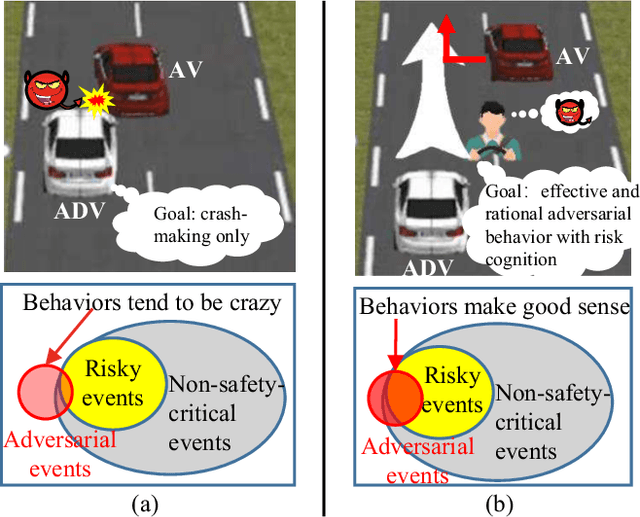
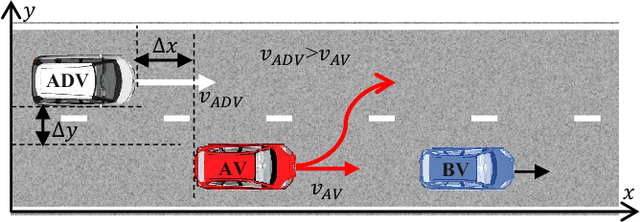


Autonomous vehicle (AV) evaluation has been the subject of increased interest in recent years both in industry and in academia. This paper focuses on the development of a novel framework for generating adversarial driving behavior of background vehicle interfering against the AV to expose effective and rational risky events. Specifically, the adversarial behavior is learned by a reinforcement learning (RL) approach incorporated with the cumulative prospect theory (CPT) which allows representation of human risk cognition. Then, the extended version of deep deterministic policy gradient (DDPG) technique is proposed for training the adversarial policy while ensuring training stability as the CPT action-value function is leveraged. A comparative case study regarding the cut-in scenario is conducted on a high fidelity Hardware-in-the-Loop (HiL) platform and the results demonstrate the adversarial effectiveness to infer the weakness of the tested AV.