 Add to Chrome
 Add to Firefox
 Add to Edge
Towards Long-Horizon Vessel Trajectory and Destination Forecasting with Reasoning Large Language Models
Jun 07, 2026
Long-horizon maritime trajectory prediction is important for shipping management, logistics planning, and maritime risk analysis, yet month-level forecasting remains insufficiently studied. Existing deep learning methods mainly focus on short- and mid-term coordinate extrapolation and often struggle to preserve route feasibility and destination correctness over extended horizons. This paper investigates joint long-horizon vessel trajectory and destination forecasting with reasoning-capable large language models, and develops a Maritime LLM post-training framework based on Reinforcement Learning with Verifiable Reward (RLVR). An AIS-based benchmark is constructed with 60-day historical trajectories and 30-day forecasting horizons, where trajectories are converted into semantic textual representations for RL prompt construction. RLVR aligns LLMs with maritime forecasting objectives by enforcing physical validity, providing early-weighted trajectory supervision, and evaluating destination correctness through hierarchical matching and curriculum learning. Experimental results show that RLVR-trained LLMs substantially improve over zero-shot LLMs and representative deep learning baselines, especially on destination-related metrics. Among the evaluated RLVR-trained variants, 4B LLMs achieve the best overall performance, suggesting that reward-compatible optimization and task-specific capacity matching are more important than simply using larger 8B or 14B LLMs. The results also show that LSTM remains a strong deep learning baseline under limited fine-tuning data, while Transformer-style spatio-temporal models typically require larger datasets and richer structured inputs. Overall, this work advances semantic, verifier-aligned maritime forecasting for operational decision support.

Open-Ended Instruction Realization with LLM-Enabled Multi-Planner Scheduling in Autonomous Vehicles
Apr 09, 2026Most Human-Machine Interaction (HMI) research overlooks the maneuvering needs of passengers in autonomous driving (AD). Natural language offers an intuitive interface, yet translating passenger open-ended instructions into control signals, without sacrificing interpretability and traceability, remains a challenge. This study proposes an instruction-realization framework that leverages a large language model (LLM) to interpret instructions, generates executable scripts that schedule multiple model predictive control (MPC)-based motion planners based on real-time feedback, and converts planned trajectories into control signals. This scheduling-centric design decouples semantic reasoning from vehicle control at different timescales, establishing a transparent, traceable decision-making chain from high-level instructions to low-level actions. Due to the absence of high-fidelity evaluation tools, this study introduces a benchmark for open-ended instruction realization in a closed-loop setting. Comprehensive experiments reveal that the framework significantly improves task-completion rates over instruction-realization baselines, reduces LLM query costs, achieves safety and compliance on par with specialized AD approaches, and exhibits considerable tolerance to LLM inference latency. For more qualitative illustrations and a clearer understanding.
Learn Like Humans: Use Meta-cognitive Reflection for Efficient Self-Improvement
Jan 17, 2026While Large Language Models (LLMs) enable complex autonomous behavior, current agents remain constrained by static, human-designed prompts that limit adaptability. Existing self-improving frameworks attempt to bridge this gap but typically rely on inefficient, multi-turn recursive loops that incur high computational costs. To address this, we propose Metacognitive Agent Reflective Self-improvement (MARS), a framework that achieves efficient self-evolution within a single recurrence cycle. Inspired by educational psychology, MARS mimics human learning by integrating principle-based reflection (abstracting normative rules to avoid errors) and procedural reflection (deriving step-by-step strategies for success). By synthesizing these insights into optimized instructions, MARS allows agents to systematically refine their reasoning logic without continuous online feedback. Extensive experiments on six benchmarks demonstrate that MARS outperforms state-of-the-art self-evolving systems while significantly reducing computational overhead.
Transductive Reward Inference on Graph
Feb 06, 2024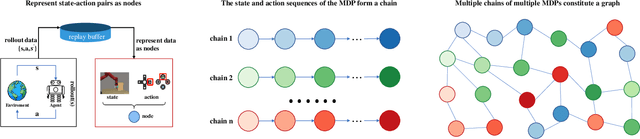
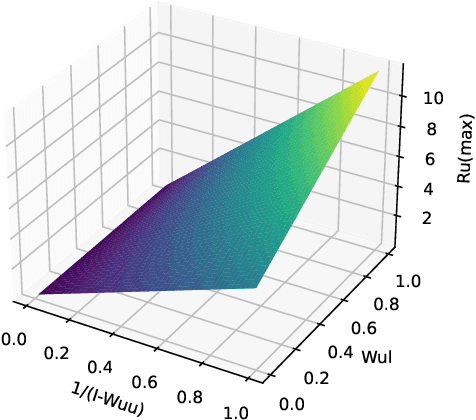
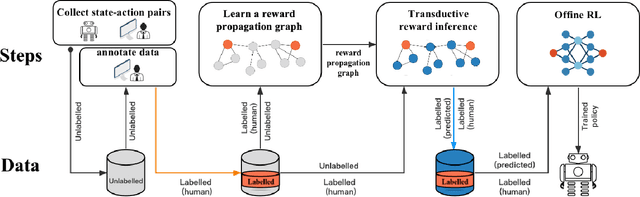
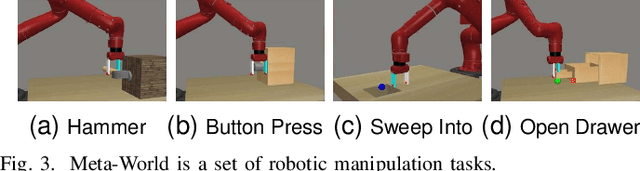
In this study, we present a transductive inference approach on that reward information propagation graph, which enables the effective estimation of rewards for unlabelled data in offline reinforcement learning. Reward inference is the key to learning effective policies in practical scenarios, while direct environmental interactions are either too costly or unethical and the reward functions are rarely accessible, such as in healthcare and robotics. Our research focuses on developing a reward inference method based on the contextual properties of information propagation on graphs that capitalizes on a constrained number of human reward annotations to infer rewards for unlabelled data. We leverage both the available data and limited reward annotations to construct a reward propagation graph, wherein the edge weights incorporate various influential factors pertaining to the rewards. Subsequently, we employ the constructed graph for transductive reward inference, thereby estimating rewards for unlabelled data. Furthermore, we establish the existence of a fixed point during several iterations of the transductive inference process and demonstrate its at least convergence to a local optimum. Empirical evaluations on locomotion and robotic manipulation tasks validate the effectiveness of our approach. The application of our inferred rewards improves the performance in offline reinforcement learning tasks.
Policy Dispersion in Non-Markovian Environment
Feb 28, 2023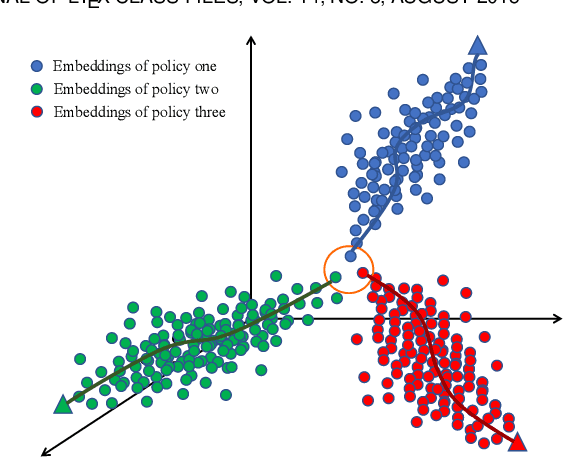

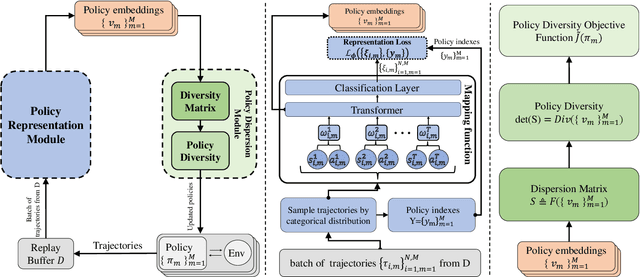

Markov Decision Process (MDP) presents a mathematical framework to formulate the learning processes of agents in reinforcement learning. MDP is limited by the Markovian assumption that a reward only depends on the immediate state and action. However, a reward sometimes depends on the history of states and actions, which may result in the decision process in a non-Markovian environment. In such environments, agents receive rewards via temporally-extended behaviors sparsely, and the learned policies may be similar. This leads the agents acquired with similar policies generally overfit to the given task and can not quickly adapt to perturbations of environments. To resolve this problem, this paper tries to learn the diverse policies from the history of state-action pairs under a non-Markovian environment, in which a policy dispersion scheme is designed for seeking diverse policy representation. Specifically, we first adopt a transformer-based method to learn policy embeddings. Then, we stack the policy embeddings to construct a dispersion matrix to induce a set of diverse policies. Finally, we prove that if the dispersion matrix is positive definite, the dispersed embeddings can effectively enlarge the disagreements across policies, yielding a diverse expression for the original policy embedding distribution. Experimental results show that this dispersion scheme can obtain more expressive diverse policies, which then derive more robust performance than recent learning baselines under various learning environments.