 Add to Chrome
 Add to Firefox
 Add to Edge
Omnidirectional Humanoid Locomotion on Stairs via Unsafe Stepping Penalty and Sparse LiDAR Elevation Mapping
Mar 09, 2026
Humanoid robots, characterized by numerous degrees of freedom and a high center of gravity, are inherently unstable. Safe omnidirectional locomotion on stairs requires both omnidirectional terrain perception and reliable foothold selection. Existing methods often rely on forward-facing depth cameras, which create blind zones that restrict omnidirectional mobility. Furthermore, sparse post-contact unsafe stepping penalties lead to low learning efficiency and suboptimal strategies. To realize safe stair-traversal gaits, this paper introduces a single-stage training framework incorporating a dense unsafe stepping penalty that provides continuous feedback as the foot approaches a hazardous placement. To obtain stable and reliable elevation maps, we build a rolling point-cloud mapping system with spatiotemporal confidence decay and a self-protection zone mechanism, producing temporally consistent local maps. These maps are further refined by an Edge-Guided Asymmetric U-Net (EGAU), which mitigates reconstruction distortion caused by sparse LiDAR returns on stair risers. Simulation and real-robot experiments show that the proposed method achieves a near-100\% safe stepping rate on stair terrains in simulation, while maintaining a remarkably high safe stepping rate in real-world deployments. Furthermore, it completes a continuous long-distance walking test on complex outdoor terrains, demonstrating reliable sim-to-real transfer and long-term stability.

UAV-Enabled Joint Sensing, Communication, Powering and Backhaul Transmission in Maritime Monitoring Networks
May 18, 2025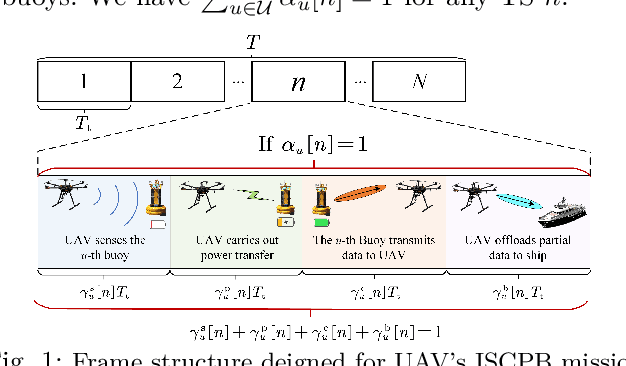
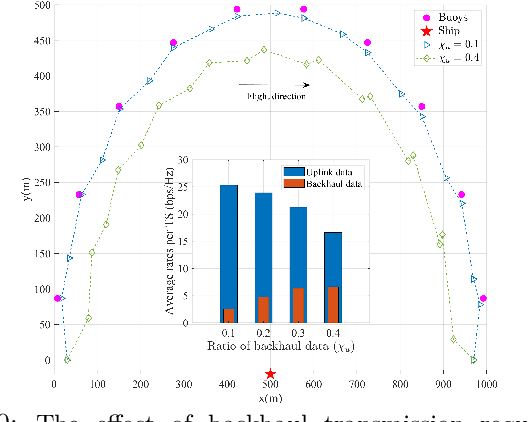
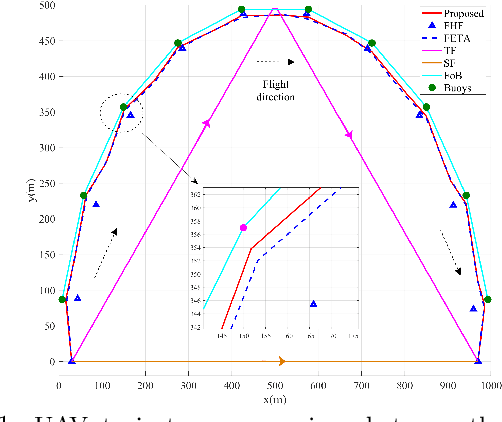
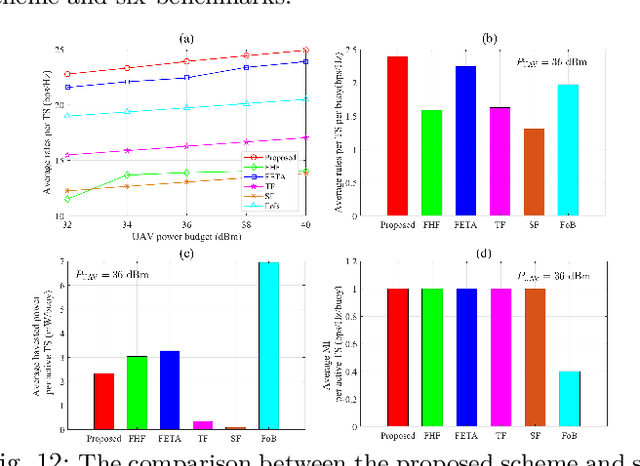
This paper addresses the challenge of energy-constrained maritime monitoring networks by proposing an unmanned aerial vehicle (UAV)-enabled integrated sensing, communication, powering and backhaul transmission scheme with a tailored time-division duplex frame structure. Within each time slot, the UAV sequentially implements sensing, wireless charging and uplink receiving with buoys, and lastly forwards part of collected data to the central ship via backhaul links. Considering the tight coupling among these functions, we jointly optimize time allocation, UAV trajectory, UAV-buoy association, and power scheduling to maximize the performance of data collection, with the practical consideration of sea clutter effects during UAV sensing. A novel optimization framework combining alternating optimization, quadratic transform and augmented first-order Taylor approximation is developed, which demonstrates good convergence behavior and robustness. Simulation results show that under sensing quality-of-service constraint, buoys are able to achieve an average data rate over 22bps/Hz using around 2mW harvested power per active time slot, validating the scheme's effectiveness for open-sea monitoring. Additionally, it is found that under the influence of sea clutters, the optimal UAV trajectory always keeps a certain distance with buoys to strike a balance between sensing and other multi-functional transmissions.