 Add to Chrome
 Add to Firefox
 Add to Edge
PosterIQ: A Design Perspective Benchmark for Poster Understanding and Generation
Mar 25, 2026
We present PosterIQ, a design-driven benchmark for poster understanding and generation, annotated across composition structure, typographic hierarchy, and semantic intent. It includes 7,765 image-annotation instances and 822 generation prompts spanning real, professional, and synthetic cases. To bridge visual design cognition and generative modeling, we define tasks for layout parsing, text-image correspondence, typography/readability and font perception, design quality assessment, and controllable, composition-aware generation with metaphor. We evaluate state-of-the-art MLLMs and diffusion-based generators, finding persistent gaps in visual hierarchy, typographic semantics, saliency control, and intention communication; commercial models lead on high-level reasoning but act as insensitive automatic raters, while generators render text well yet struggle with composition-aware synthesis. Extensive analyses show PosterIQ is both a quantitative benchmark and a diagnostic tool for design reasoning, offering reproducible, task-specific metrics. We aim to catalyze models' creativity and integrate human-centred design principles into generative vision-language systems.

Twin Co-Adaptive Dialogue for Progressive Image Generation
Apr 21, 2025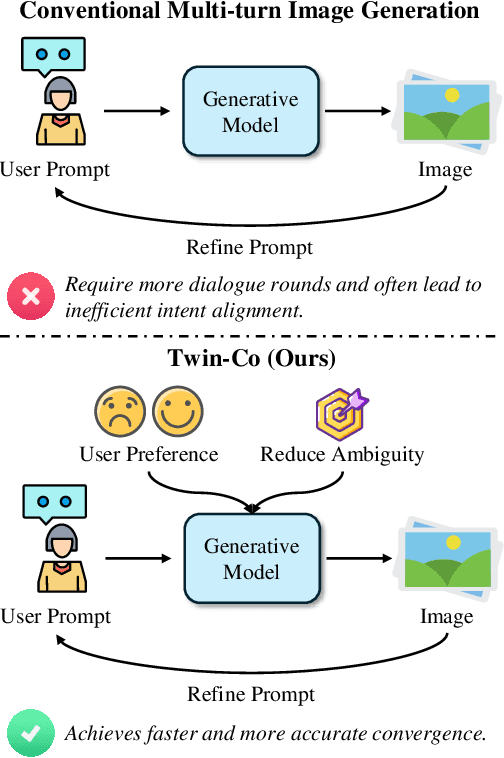
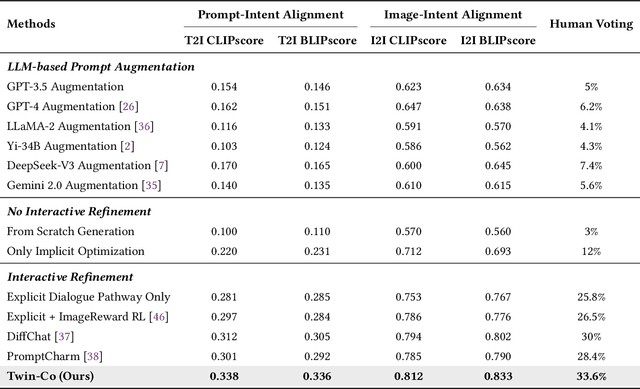
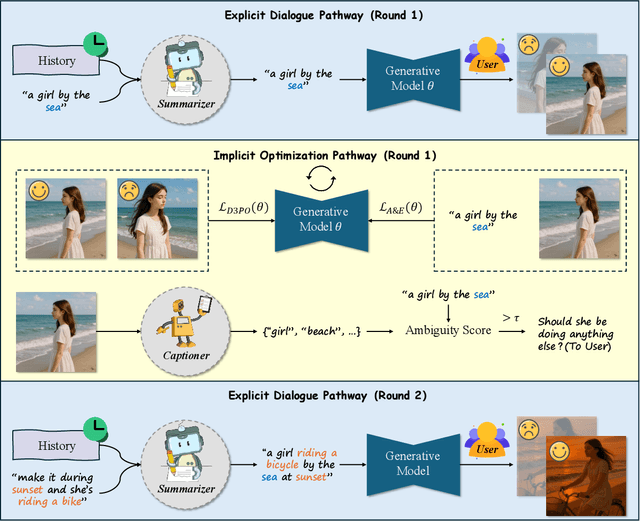

Modern text-to-image generation systems have enabled the creation of remarkably realistic and high-quality visuals, yet they often falter when handling the inherent ambiguities in user prompts. In this work, we present Twin-Co, a framework that leverages synchronized, co-adaptive dialogue to progressively refine image generation. Instead of a static generation process, Twin-Co employs a dynamic, iterative workflow where an intelligent dialogue agent continuously interacts with the user. Initially, a base image is generated from the user's prompt. Then, through a series of synchronized dialogue exchanges, the system adapts and optimizes the image according to evolving user feedback. The co-adaptive process allows the system to progressively narrow down ambiguities and better align with user intent. Experiments demonstrate that Twin-Co not only enhances user experience by reducing trial-and-error iterations but also improves the quality of the generated images, streamlining the creative process across various applications.