 Add to Chrome
 Add to Firefox
 Add to Edge
Multi-LLM Token Filtering and Routing for Sequential Recommendation
Apr 20, 2026
Large language models (LLMs) have recently shown promise in recommendation by providing rich semantic knowledge. While most existing approaches rely on external textual corpora to align LLMs with recommender systems, we revisit a more fundamental yet underexplored question: Can recommendation benefit from LLM token embeddings alone without textual input? Through a systematic empirical study, we show that directly injecting token embeddings from a single LLM into sequential recommenders leads to unstable or limited gains, due to semantic misalignment, insufficient task adaptation, and the restricted coverage of individual LLMs. To address these challenges, we propose MLTFR, a Multi-LLM Token Filtering and Routing framework for corpus-free sequential recommendation. MLTFR follows an interaction-guided LLM knowledge integration paradigm, where task-relevant token embeddings are selected via user-guided token filtering to suppress noisy and irrelevant vocabulary signals. To overcome the limitations of single-LLM representations, MLTFR integrates multiple LLM token spaces through a Mixture-of-Experts architecture, with a Fisher-weighted semantic consensus expert to balance heterogeneous experts and prevent domination during training. By jointly filtering informative tokens and aggregating complementary semantic knowledge across multiple LLMs, MLTFR enables stable and effective utilization of LLM token embeddings without textual inputs or backbone modification. Extensive experiments demonstrate that MLTFR consistently outperforms state-of-the-art sequential recommendation baselines and existing alignment methods. Our code is available at: https://github.com/ccwwhhh/MLTFR.

Breaking the Clusters: Uniformity-Optimization for Text-Based Sequential Recommendation
Feb 19, 2025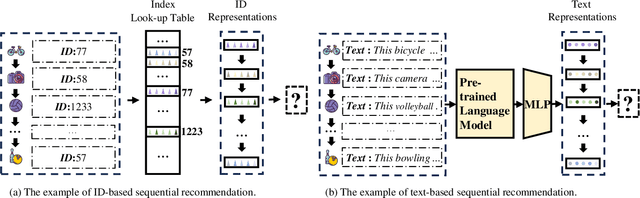
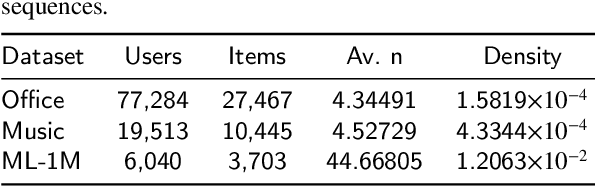
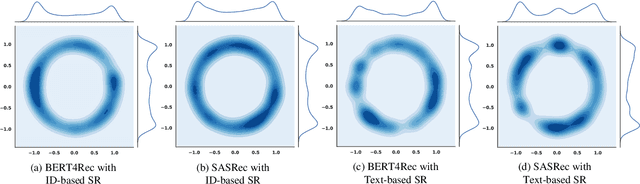
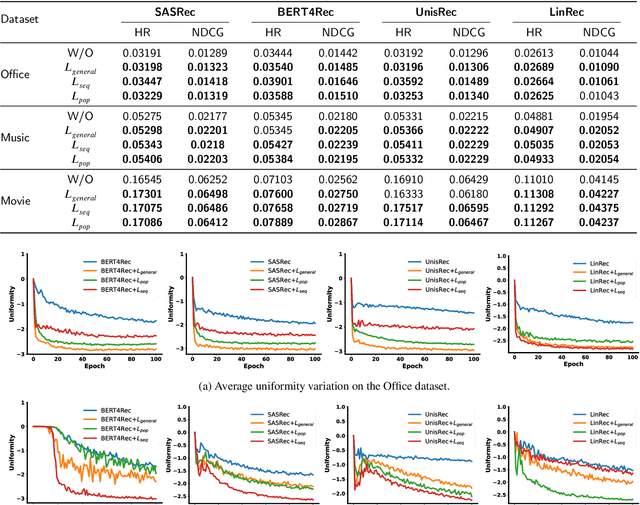
Traditional sequential recommendation (SR) methods heavily rely on explicit item IDs to capture user preferences over time. This reliance introduces critical limitations in cold-start scenarios and domain transfer tasks, where unseen items and new contexts often lack established ID mappings. To overcome these limitations, recent studies have shifted towards leveraging text-only information for recommendation, thereby improving model generalization and adaptability across domains. Although promising, text-based SR faces unique difficulties: items' text descriptions often share semantic similarities that lead to clustered item representations, compromising their uniformity, a property essential for promoting diversity and enhancing generalization in recommendation systems. In this paper, we explore a novel framework to improve the uniformity of item representations in text-based SR. Our analysis reveals that items within a sequence exhibit marked semantic similarity, meaning they are closer in representation than items overall, and that this effect is more pronounced for less popular items, which form tighter clusters compared to their more popular counterparts. Based on these findings, we propose UniT, a framework that employs three pairwise item sampling strategies: Unified General Sampling Strategy, Sequence-Driven Sampling Strategy, and Popularity-Driven Sampling Strategy. Each strategy applies varying degrees of repulsion to selectively adjust the distances between item pairs, thereby refining representation uniformity while considering both sequence context and item popularity. Extensive experiments on multiple real-world datasets demonstrate that our proposed approach outperforms state-of-the-art models, validating the effectiveness of UniT in enhancing both representation uniformity and recommendation accuracy.The source code is available at https://github.com/ccwwhhh/Model-Rec.
Sensing-Assisted Beam Tracking with Real-Time Beamwidth Adaptation for THz Communications
Nov 13, 2024Terahertz (THz) communications, with their substantial bandwidth, are essential for meeting the ultra-high data rate demands of emerging high-mobility scenarios such as vehicular-to-everything (V2X) networks. In these contexts, beamwidth adaptation has been explored to address the problem that high-mobility targets frequently move out of the narrow THz beam range. However, existing approaches cannot effectively track targets due to a lack of real-time motion awareness. Consequently, we propose a sensing-assisted beam tracking scheme with real-time beamwidth adaptation. Specifically, the base station (BS) periodically collects prior sensing information to predict the target's motion path by applying a particular motion model. Then, we build a pre-calculated codebook by optimising precoders to align the beamwidth with various predicted target paths, thereby maximising the average achievable data rates within each sensing period. Finally, the BS selects the optimal precoder from the codebook to maintain stable and continuous connectivity. Simulation results show that the proposed scheme significantly improves the rate performance and reduces outage probability compared to existing approaches under various target mobility.