 Add to Chrome
 Add to Firefox
 Add to Edge
SSH-Net: A Deep Neural Network for Predicting Failure Time Distribution Functions under Competing Risks with Application to GPU Data
Jun 18, 2026
Competing risks are commonly observed in engineering fields and can bring challenges to time-to-event data modeling when the application scenarios are complicated. Recently, deep neural networks have received great attention for prediction with competing risks, due to their flexibility and high learning capability. However, the complexity of neural network structure brings extra difficulty in hyperparameter tuning based on different data inputs. Additionally, when an engineered system has complex physical structures with multiple hierarchical levels, treating all structural levels as a single group of inputs may fail to capture critical information. To address the issues, we propose a Structured Segmented Hazard Deep Neural Network (SSH-Net) for failure time prediction under cause-specific competing risks framework. Our approach associates neural network structure with data structures, and allows different covariate groups to impact the failure prediction through separate sub-networks. The neural network is constructed based on a cause-specific competing risks model. The SSH-Net outputs cause-specific hazard functions, and utilizes the penalized log-likelihood as the loss function. The prediction accuracy of SSH-Net is validated through simulation studies by evaluating the Brier score, the area under receiver operating characteristic curves (AUC), and the root mean square error (RMSE) of the predicted cause-specific cumulative incident function. We further demonstrate the model's ability to predict failure time distribution functions using the Titan GPU failure time data.

Statistical Perspectives on Reliability of Artificial Intelligence Systems
Nov 09, 2021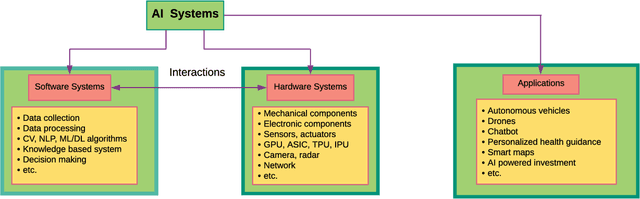
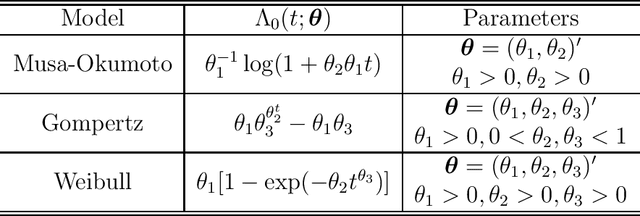
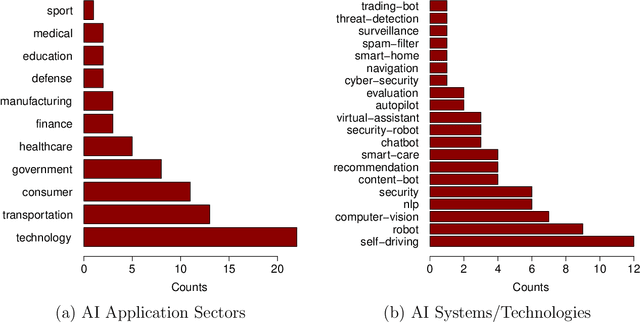
Artificial intelligence (AI) systems have become increasingly popular in many areas. Nevertheless, AI technologies are still in their developing stages, and many issues need to be addressed. Among those, the reliability of AI systems needs to be demonstrated so that the AI systems can be used with confidence by the general public. In this paper, we provide statistical perspectives on the reliability of AI systems. Different from other considerations, the reliability of AI systems focuses on the time dimension. That is, the system can perform its designed functionality for the intended period. We introduce a so-called SMART statistical framework for AI reliability research, which includes five components: Structure of the system, Metrics of reliability, Analysis of failure causes, Reliability assessment, and Test planning. We review traditional methods in reliability data analysis and software reliability, and discuss how those existing methods can be transformed for reliability modeling and assessment of AI systems. We also describe recent developments in modeling and analysis of AI reliability and outline statistical research challenges in this area, including out-of-distribution detection, the effect of the training set, adversarial attacks, model accuracy, and uncertainty quantification, and discuss how those topics can be related to AI reliability, with illustrative examples. Finally, we discuss data collection and test planning for AI reliability assessment and how to improve system designs for higher AI reliability. The paper closes with some concluding remarks.
Extracting human emotions at different places based on facial expressions and spatial clustering analysis
May 06, 2019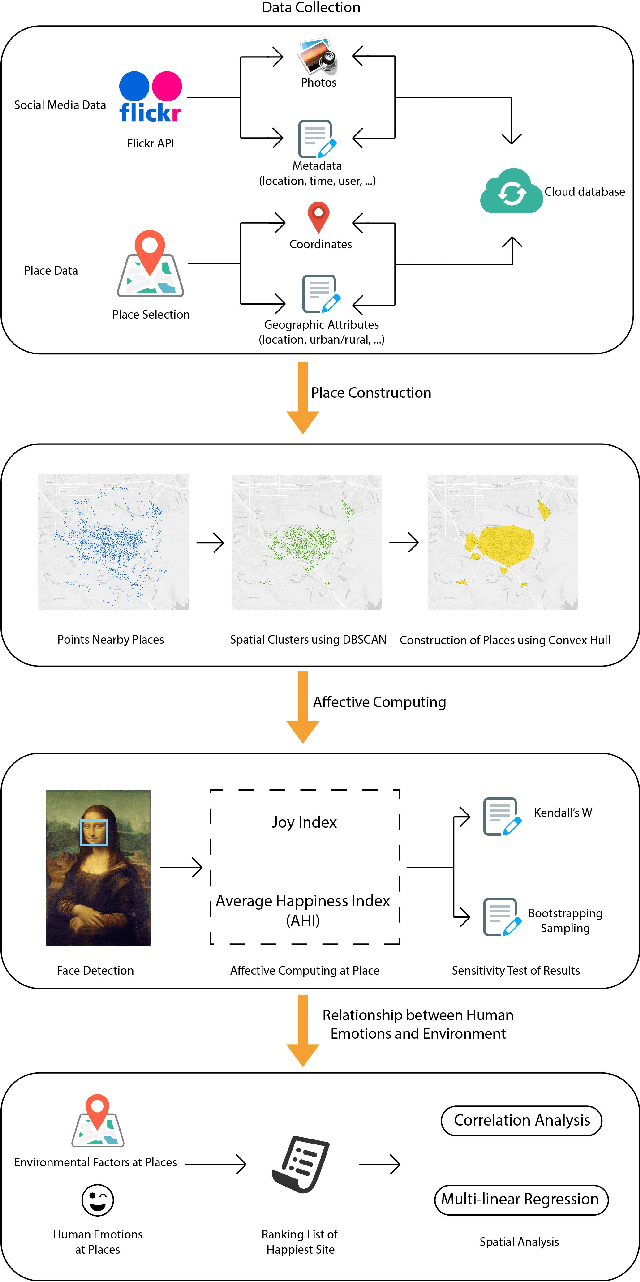
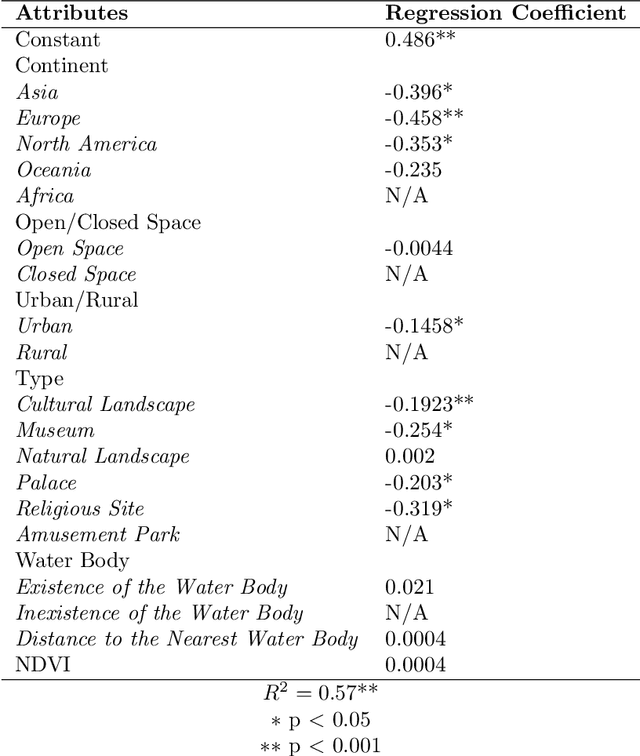
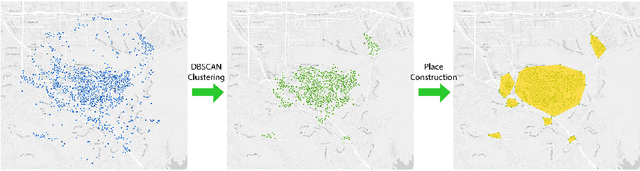
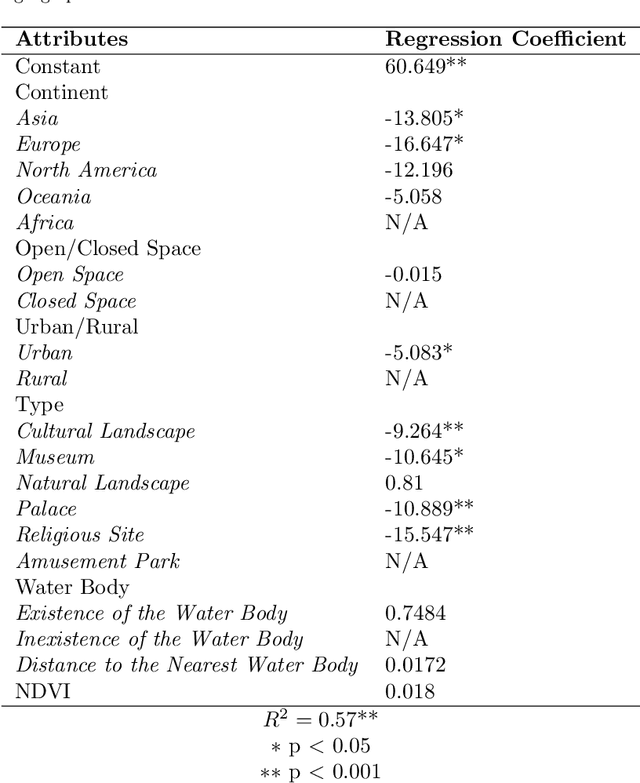
The emergence of big data enables us to evaluate the various human emotions at places from a statistic perspective by applying affective computing. In this study, a novel framework for extracting human emotions from large-scale georeferenced photos at different places is proposed. After the construction of places based on spatial clustering of user generated footprints collected in social media websites, online cognitive services are utilized to extract human emotions from facial expressions using the state-of-the-art computer vision techniques. And two happiness metrics are defined for measuring the human emotions at different places. To validate the feasibility of the framework, we take 80 tourist attractions around the world as an example and a happiness ranking list of places is generated based on human emotions calculated over 2 million faces detected out from over 6 million photos. Different kinds of geographical contexts are taken into consideration to find out the relationship between human emotions and environmental factors. Results show that much of the emotional variation at different places can be explained by a few factors such as openness. The research may offer insights on integrating human emotions to enrich the understanding of sense of place in geography and in place-based GIS.
* 40 pages; 9 figures