 Add to Chrome
 Add to Firefox
 Add to Edge
SSH-Net: A Deep Neural Network for Predicting Failure Time Distribution Functions under Competing Risks with Application to GPU Data
Jun 18, 2026
Competing risks are commonly observed in engineering fields and can bring challenges to time-to-event data modeling when the application scenarios are complicated. Recently, deep neural networks have received great attention for prediction with competing risks, due to their flexibility and high learning capability. However, the complexity of neural network structure brings extra difficulty in hyperparameter tuning based on different data inputs. Additionally, when an engineered system has complex physical structures with multiple hierarchical levels, treating all structural levels as a single group of inputs may fail to capture critical information. To address the issues, we propose a Structured Segmented Hazard Deep Neural Network (SSH-Net) for failure time prediction under cause-specific competing risks framework. Our approach associates neural network structure with data structures, and allows different covariate groups to impact the failure prediction through separate sub-networks. The neural network is constructed based on a cause-specific competing risks model. The SSH-Net outputs cause-specific hazard functions, and utilizes the penalized log-likelihood as the loss function. The prediction accuracy of SSH-Net is validated through simulation studies by evaluating the Brier score, the area under receiver operating characteristic curves (AUC), and the root mean square error (RMSE) of the predicted cause-specific cumulative incident function. We further demonstrate the model's ability to predict failure time distribution functions using the Titan GPU failure time data.

Simulation-Driven Deep Learning Framework for Raman Spectral Denoising Under Fluorescence-Dominant Conditions
Dec 19, 2025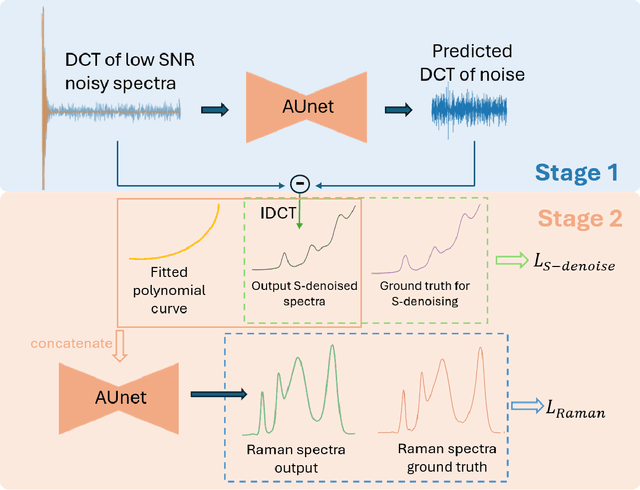
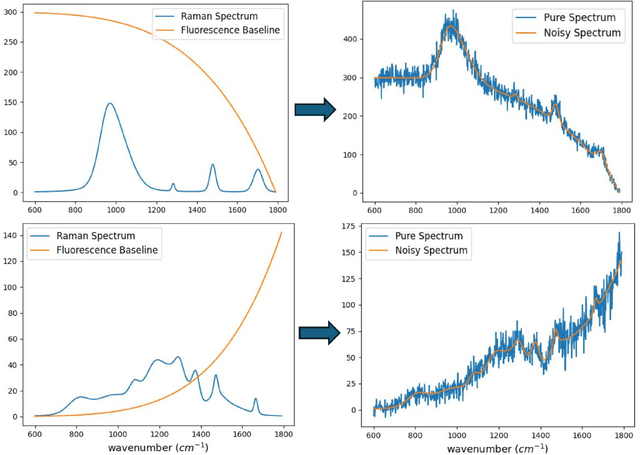
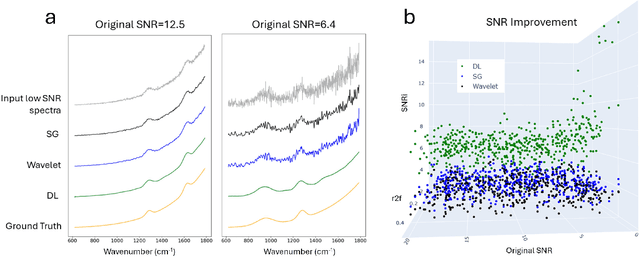
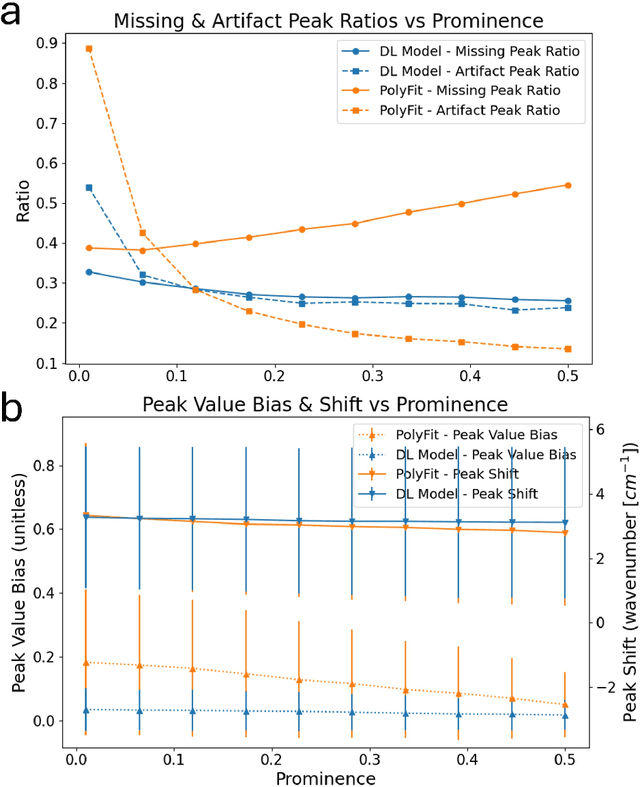
Raman spectroscopy enables non-destructive, label-free molecular analysis with high specificity, making it a powerful tool for biomedical diagnostics. However, its application to biological tissues is challenged by inherently weak Raman scattering and strong fluorescence background, which significantly degrade signal quality. In this study, we present a simulation-driven denoising framework that combines a statistically grounded noise model with deep learning to enhance Raman spectra acquired under fluorescence-dominated conditions. We comprehensively modeled major noise sources. Based on this model, we generated biologically realistic Raman spectra and used them to train a cascaded deep neural network designed to jointly suppress stochastic detector noise and fluorescence baseline interference. To evaluate the performance of our approach, we simulated human skin spectra derived from real experimental data as a validation case study. Our results demonstrate the potential of physics-informed learning to improve spectral quality and enable faster, more accurate Raman-based tissue analysis.
Single color virtual H&E staining with In-and-Out Net
May 22, 2024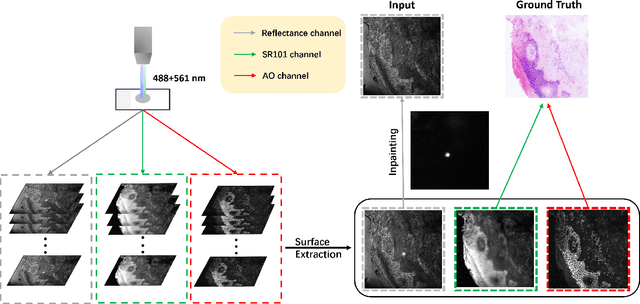
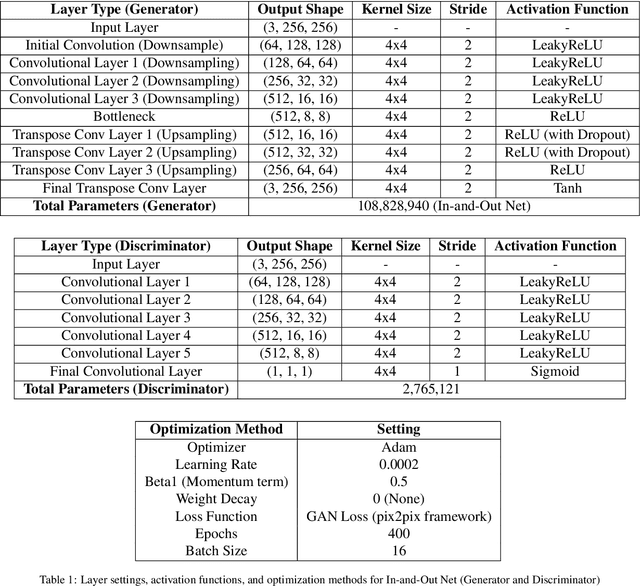
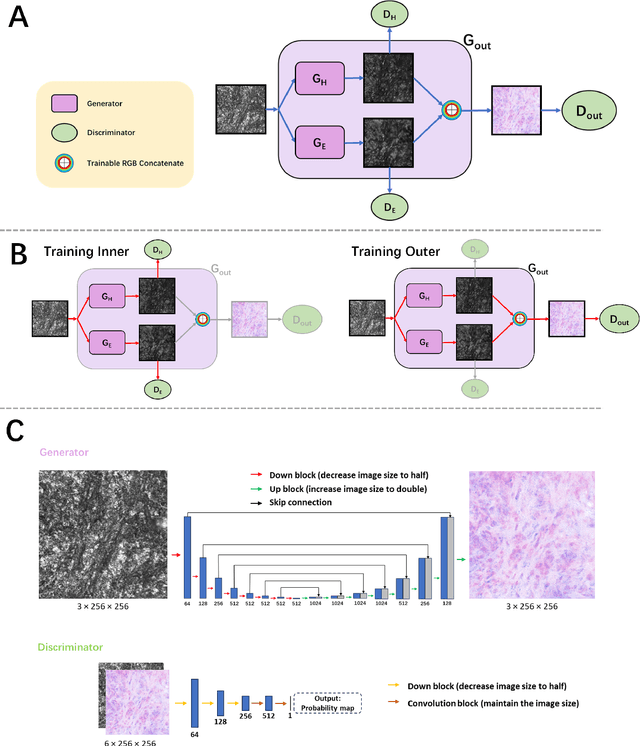
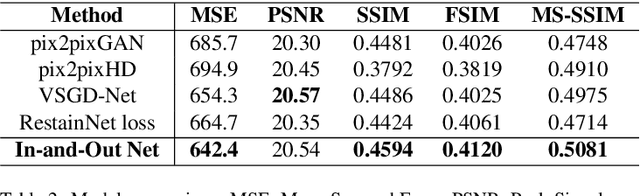
Virtual staining streamlines traditional staining procedures by digitally generating stained images from unstained or differently stained images. While conventional staining methods involve time-consuming chemical processes, virtual staining offers an efficient and low infrastructure alternative. Leveraging microscopy-based techniques, such as confocal microscopy, researchers can expedite tissue analysis without the need for physical sectioning. However, interpreting grayscale or pseudo-color microscopic images remains a challenge for pathologists and surgeons accustomed to traditional histologically stained images. To fill this gap, various studies explore digitally simulating staining to mimic targeted histological stains. This paper introduces a novel network, In-and-Out Net, specifically designed for virtual staining tasks. Based on Generative Adversarial Networks (GAN), our model efficiently transforms Reflectance Confocal Microscopy (RCM) images into Hematoxylin and Eosin (H&E) stained images. We enhance nuclei contrast in RCM images using aluminum chloride preprocessing for skin tissues. Training the model with virtual H\&E labels featuring two fluorescence channels eliminates the need for image registration and provides pixel-level ground truth. Our contributions include proposing an optimal training strategy, conducting a comparative analysis demonstrating state-of-the-art performance, validating the model through an ablation study, and collecting perfectly matched input and ground truth images without registration. In-and-Out Net showcases promising results, offering a valuable tool for virtual staining tasks and advancing the field of histological image analysis.