 Add to Chrome
 Add to Firefox
 Add to Edge
Early Quantization Shrinks Codebook: A Simple Fix for Diversity-Preserving Tokenization
Mar 17, 2026
Vector quantization is a technique in machine learning that discretizes continuous representations into a set of discrete vectors. It is widely employed in tokenizing data representations for large language models, diffusion models, and other generative models. Despite its prevalence, the characteristics and behaviors of vector quantization in generative models remain largely underexplored. In this study, we systematically investigate the issue of collapses in vector quantization, where collapsed representations are observed across discrete codebook tokens and continuous latent embeddings. By leveraging both synthetic and real datasets, we identify the severity of each type of collapses and triggering conditions. Our analysis reveals that random initialization and limited encoder capacity result in tokens collapse and embeddings collapse. Building on these findings, we propose potential solutions aimed at mitigating each collapse. To the best of our knowledge, this is the first comprehensive study examining representation collapsing problems in vector quantization.

LLM4DSR: Leveraing Large Language Model for Denoising Sequential Recommendation
Aug 15, 2024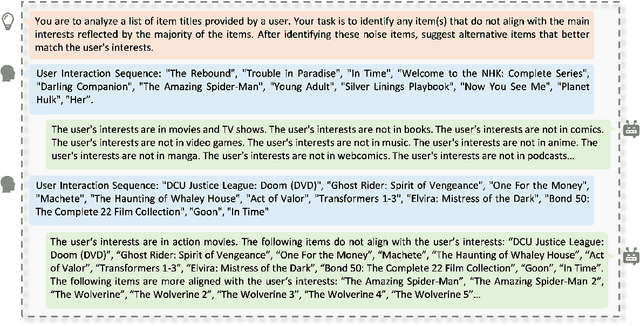
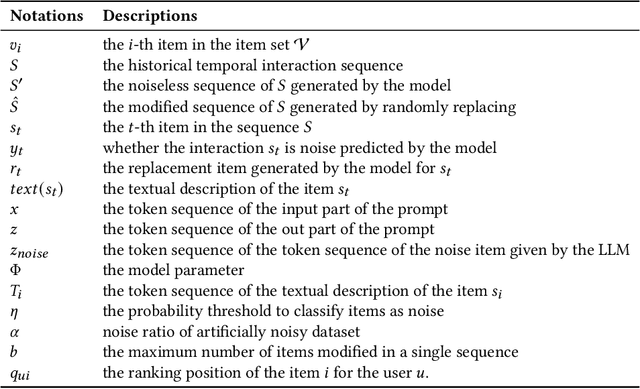
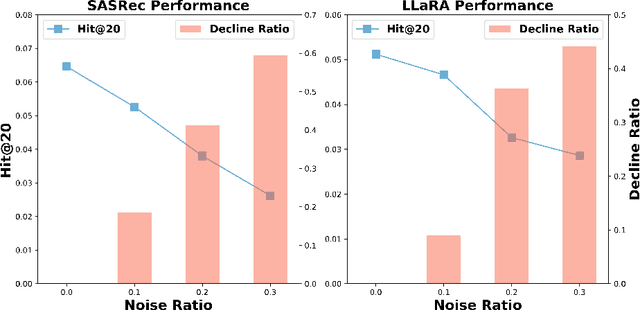

Sequential recommendation systems fundamentally rely on users' historical interaction sequences, which are often contaminated by noisy interactions. Identifying these noisy interactions accurately without additional information is particularly difficult due to the lack of explicit supervisory signals to denote noise. Large Language Models (LLMs), equipped with extensive open knowledge and semantic reasoning abilities, present a promising avenue to bridge this information gap. However, employing LLMs for denoising in sequential recommendation introduces notable challenges: 1) Direct application of pretrained LLMs may not be competent for the denoising task, frequently generating nonsensical responses; 2) Even after fine-tuning, the reliability of LLM outputs remains questionable, especially given the complexity of the task and th inherent hallucinatory issue of LLMs. To tackle these challenges, we propose LLM4DSR, a tailored approach for denoising sequential recommendation using LLMs. We constructed a self-supervised fine-tuning task to activate LLMs' capabilities to identify noisy items and suggest replacements. Furthermore, we developed an uncertainty estimation module that ensures only high-confidence responses are utilized for sequence corrections. Remarkably, LLM4DSR is model-agnostic, allowing the corrected sequences to be flexibly applied across various recommendation models. Extensive experiments validate the superiority of LLM4DSR over existing methods across three datasets and three recommendation backbones.