 Add to Chrome
 Add to Firefox
 Add to Edge
Breaking Diversity Collapse in Spiking Pseudo-Ensembles for Efficient OOD Detection in Remote Sensing
Aug 02, 2026
Spiking Neural Networks (SNNs) are attractive for resource-constrained remote-sensing systems, but reliable out-of-distribution (OOD) detection remains challenging. Deep ensembles provide strong predictive uncertainty, yet require multiple complete models and backbone evaluations. We propose an efficient spiking pseudo-ensemble that attaches multiple lightweight classification heads to a frozen SNN backbone. Naively training these heads with cross-entropy can lead to diversity collapse, where independently parameterized heads may produce correlated predictions. To address this, we introduce an agree--disagree objective that preserves correct predictions on clean in-distribution samples while encouraging diversity on structured, uncertainty-inducing transformations of the same inputs. This provides a diversity-promoting training signal without requiring external OOD data. Experiments with Spikformer and ResNet19-SNN on EuroSAT demonstrate consistent improvements over conventionally trained pseudo-ensembles. Using three backbones with five heads each matches or improves upon a five-model deep ensemble on UCM and AID, while requiring approximately 38% fewer parameters and 40% fewer backbone evaluations. These results show that explicit diversity promotion can recover useful ensemble-style uncertainty at substantially lower deployment cost.

Compositionality Emerges in a Narrow Depth-Connectivity Regime: Architecture Constraints and Solution Manifolds
Jun 18, 2026Compositionality is believed to be the foundation for generalization, enabling models to reuse meaningful primitives in novel combinations. Yet, models trained with standard gradient-based optimization rarely, and often only weakly, exhibit compositional internal structure, and it remains unclear how or why such compositionality forms. In this work, we show that compositionality emerges in a narrow connectivity-depth sweet spot. Along the connectivity axis, compositionality only appears in some specifically sparse networks, heavily depends on which connections remain rather than on weights' sparsity alone. Along the depth axis, compositionality emerges within a narrow, target-dependent regime, peaking at specific depths, while both shallower and deeper networks fail. When either the depth or connectivity condition is violated, gradient descent silently converges to fractured solutions rather than compositional ones. To discover and exploit this emergence, we introduce (i) similarity-based pruning (SP) to recover compositional connectivity and (ii) a heuristic depth predictor to estimate where compositionality is most likely to appear. Finally, we support these empirical findings with a theoretical framework based on compositional sparsity, volume-ratio arguments, and feature-interference bounds, explaining why compositional solutions are reachable only in a narrow depth-connectivity regime.
JEDI: Joint Embedding Diffusion World Model for Online Model-Based Reinforcement Learning
May 13, 2026Diffusion world models have recently become competitive for online model-based reinforcement learning, but current approaches expose a tension: pixel diffusion is effective but computationally expensive while the latest latent diffusion approach improves efficiency yet performs subpar. The latter also relies on separately trained latents rather than the end-to-end world-model objectives that have driven much of modern MBRL progress. In particular, JEPA-style predictive representation learning has emerged as an especially promising direction for world modeling and MBRL. Concurrently, diffusion-style objectives have gained traction across multiple domains, with iterative refinement as a promising approach for multimodal and stochastic targets. Taken together, these trends motivate Joint Embedding DIffusion (JEDI), the first online end-to-end latent diffusion world model. JEDI learns its latent space directly from the diffusion denoising loss with a JEPA framework, using denoising to learn and predict future latents rather than relying on reconstruction and pretrained models. We provide a theoretical motivation showing that conventional JEPA objectives induce a predictive information bottleneck, and that conditional diffusion denoising admits a closely related predictive-compression decomposition. Empirically, JEDI is competitive on Atari100k and outperforms the baseline with seperately trained latents where directly comparable. Relative to the pixel diffusion baseline, JEDI uses 43% less VRAM, over 3$\times$ faster world-model sampling, and 2.5$\times$ faster training. JEDI also exhibits a markedly different task-level performance profile from the pixel baseline, suggesting that end-to-end predictive latents change more than compute alone.
Early Quantization Shrinks Codebook: A Simple Fix for Diversity-Preserving Tokenization
Mar 17, 2026Vector quantization is a technique in machine learning that discretizes continuous representations into a set of discrete vectors. It is widely employed in tokenizing data representations for large language models, diffusion models, and other generative models. Despite its prevalence, the characteristics and behaviors of vector quantization in generative models remain largely underexplored. In this study, we systematically investigate the issue of collapses in vector quantization, where collapsed representations are observed across discrete codebook tokens and continuous latent embeddings. By leveraging both synthetic and real datasets, we identify the severity of each type of collapses and triggering conditions. Our analysis reveals that random initialization and limited encoder capacity result in tokens collapse and embeddings collapse. Building on these findings, we propose potential solutions aimed at mitigating each collapse. To the best of our knowledge, this is the first comprehensive study examining representation collapsing problems in vector quantization.
CXR-LanIC: Language-Grounded Interpretable Classifier for Chest X-Ray Diagnosis
Oct 24, 2025Deep learning models have achieved remarkable accuracy in chest X-ray diagnosis, yet their widespread clinical adoption remains limited by the black-box nature of their predictions. Clinicians require transparent, verifiable explanations to trust automated diagnoses and identify potential failure modes. We introduce CXR-LanIC (Language-Grounded Interpretable Classifier for Chest X-rays), a novel framework that addresses this interpretability challenge through task-aligned pattern discovery. Our approach trains transcoder-based sparse autoencoders on a BiomedCLIP diagnostic classifier to decompose medical image representations into interpretable visual patterns. By training an ensemble of 100 transcoders on multimodal embeddings from the MIMIC-CXR dataset, we discover approximately 5,000 monosemantic patterns spanning cardiac, pulmonary, pleural, structural, device, and artifact categories. Each pattern exhibits consistent activation behavior across images sharing specific radiological features, enabling transparent attribution where predictions decompose into 20-50 interpretable patterns with verifiable activation galleries. CXR-LanIC achieves competitive diagnostic accuracy on five key findings while providing the foundation for natural language explanations through planned large multimodal model annotation. Our key innovation lies in extracting interpretable features from a classifier trained on specific diagnostic objectives rather than general-purpose embeddings, ensuring discovered patterns are directly relevant to clinical decision-making, demonstrating that medical AI systems can be both accurate and interpretable, supporting safer clinical deployment through transparent, clinically grounded explanations.
Representation Collapsing Problems in Vector Quantization
Nov 25, 2024Vector quantization is a technique in machine learning that discretizes continuous representations into a set of discrete vectors. It is widely employed in tokenizing data representations for large language models, diffusion models, and other generative models. Despite its prevalence, the characteristics and behaviors of vector quantization in generative models remain largely underexplored. In this study, we investigate representation collapse in vector quantization - a critical degradation where codebook tokens or latent embeddings lose their discriminative power by converging to a limited subset of values. This collapse fundamentally compromises the model's ability to capture diverse data patterns. By leveraging both synthetic and real datasets, we identify the severity of each type of collapses and triggering conditions. Our analysis reveals that restricted initialization and limited encoder capacity result in tokens collapse and embeddings collapse. Building on these findings, we propose potential solutions aimed at mitigating each collapse. To the best of our knowledge, this is the first comprehensive study examining representation collapsing problems in vector quantization.
Improving Discrete Optimisation Via Decoupled Straight-Through Gumbel-Softmax
Oct 17, 2024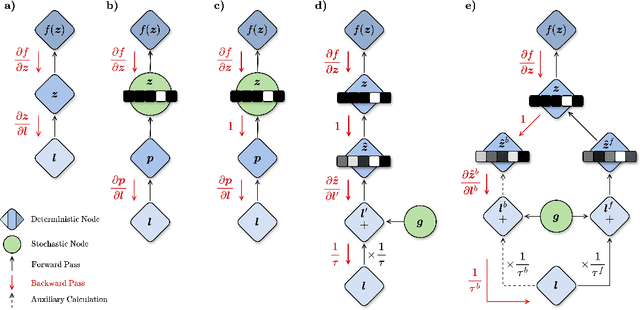
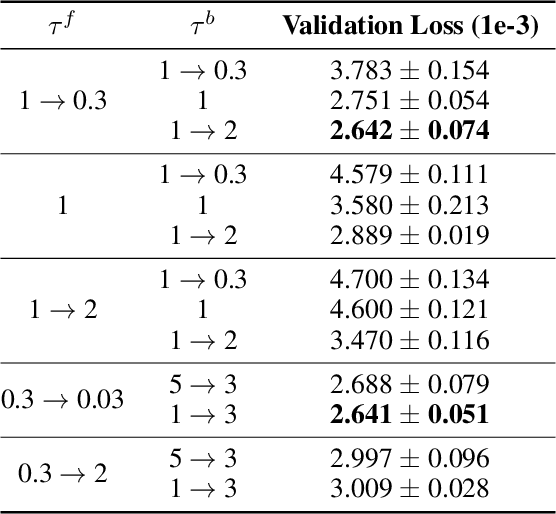
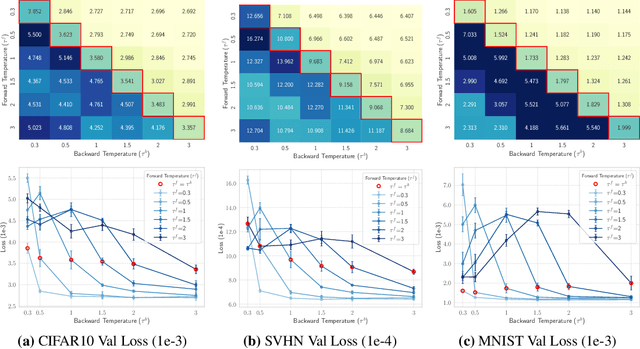
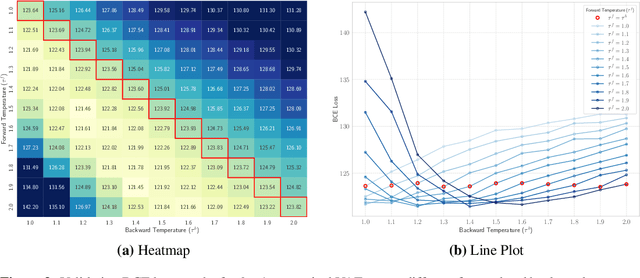
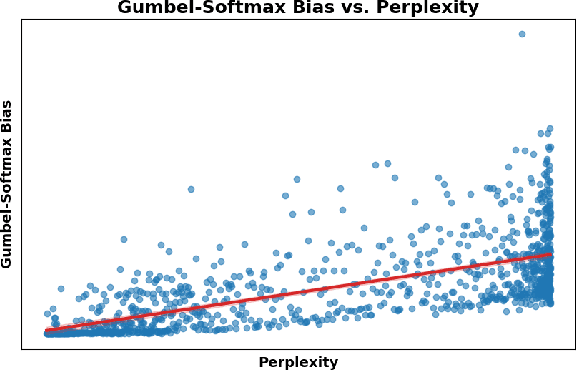
Discrete representations play a crucial role in many deep learning architectures, yet their non-differentiable nature poses significant challenges for gradient-based optimization. To address this issue, various gradient estimators have been developed, including the Straight-Through Gumbel-Softmax (ST-GS) estimator, which combines the Straight-Through Estimator (STE) and the Gumbel-based reparameterization trick. However, the performance of ST-GS is highly sensitive to temperature, with its selection often compromising gradient fidelity. In this work, we propose a simple yet effective extension to ST-GS by employing decoupled temperatures for forward and backward passes, which we refer to as "Decoupled ST-GS". We show that our approach significantly enhances the original ST-GS through extensive experiments across multiple tasks and datasets. We further investigate the impact of our method on gradient fidelity from multiple perspectives, including the gradient gap and the bias-variance trade-off of estimated gradients. Our findings contribute to the ongoing effort to improve discrete optimization in deep learning, offering a practical solution that balances simplicity and effectiveness.
Gaussian Mixture Vector Quantization with Aggregated Categorical Posterior
Oct 14, 2024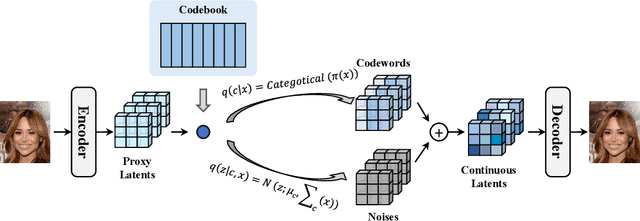

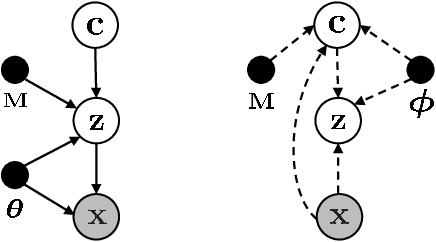
The vector quantization is a widely used method to map continuous representation to discrete space and has important application in tokenization for generative mode, bottlenecking information and many other tasks in machine learning. Vector Quantized Variational Autoencoder (VQ-VAE) is a type of variational autoencoder using discrete embedding as latent. We generalize the technique further, enriching the probabilistic framework with a Gaussian mixture as the underlying generative model. This framework leverages a codebook of latent means and adaptive variances to capture complex data distributions. This principled framework avoids various heuristics and strong assumptions that are needed with the VQ-VAE to address training instability and to improve codebook utilization. This approach integrates the benefits of both discrete and continuous representations within a variational Bayesian framework. Furthermore, by introducing the \textit{Aggregated Categorical Posterior Evidence Lower Bound} (ALBO), we offer a principled alternative optimization objective that aligns variational distributions with the generative model. Our experiments demonstrate that GM-VQ improves codebook utilization and reduces information loss without relying on handcrafted heuristics.