 Add to Chrome
 Add to Firefox
 Add to Edge
When Tools Fail: Benchmarking Dynamic Replanning and Anomaly Recovery in LLM Agents
Jun 04, 2026
Existing benchmarks evaluate Tool-Integrated Reasoning (TIR) in LLMs on idealized ''happy paths'', largely overlooking real-world tool failures. We introduce ToolMaze, a benchmark for dynamic path discovery and error recovery in TIR agents. To separate systematic replanning from blind trial-and-error, ToolMaze adopts a two-dimensional design: DAG-based topological complexity and a $2 \times 2$ taxonomy of tool perturbations (explicit/implicit, transient/permanent). Evaluations show that perturbations degrade performance across nearly all models, with the sharpest drops under implicit semantic failures. Driven by systemic over-trust in corrupted outputs, Perturbation Recovery Rate (PRR) plummets by around 37\% in these scenarios, while complex topologies trap agents in futile trial-and-error loops. Crucially, agentic fault-tolerance improves with model scale $3.66\times$ slower than basic task execution, highlighting dynamic replanning as a distinct bottleneck unaddressed by model scaling or prompting. Data and code are available at https://github.com/Zhudongsheng75/ToolMaze.

VISOR: Agentic Visual Retrieval-Augmented Generation via Iterative Search and Over-horizon Reasoning
Apr 10, 2026Visual Retrieval-Augmented Generation (VRAG) empowers Vision-Language Models to retrieve and reason over visually rich documents. To tackle complex queries requiring multi-step reasoning, agentic VRAG systems interleave reasoning with iterative retrieval.. However, existing agentic VRAG faces two critical bottlenecks. (1) Visual Evidence Sparsity: key evidence is scattered across pages yet processed in isolation, hindering cross-page reasoning; moreover, fine-grained intra-image evidence often requires precise visual actions, whose misuse degrades retrieval quality; (2) Search Drift in Long Horizons: the accumulation of visual tokens across retrieved pages dilutes context and causes cognitive overload, leading agents to deviate from their search objective. To address these challenges, we propose VISOR (Visual Retrieval-Augmented Generation via Iterative Search and Over-horizon Reasoning), a unified single-agent framework. VISOR features a structured Evidence Space for progressive cross-page reasoning, coupled with a Visual Action Evaluation and Correction mechanism to manage visual actions. Additionally, we introduce a Dynamic Trajectory with Sliding Window and Intent Injection to mitigate search drift. They anchor the evidence space while discarding earlier raw interactions, preventing context from being overwhelmed by visual tokens. We train VISOR using a Group Relative Policy Optimization-based Reinforcement Learning (GRPO-based RL) pipeline with state masking and credit assignment tailored for dynamic context reconstruction. Extensive experiments on ViDoSeek, SlideVQA, and MMLongBench demonstrate that VISOR achieves state-of-the-art performance with superior efficiency for long-horizon visual reasoning tasks.
Facial-R1: Aligning Reasoning and Recognition for Facial Emotion Analysis
Nov 13, 2025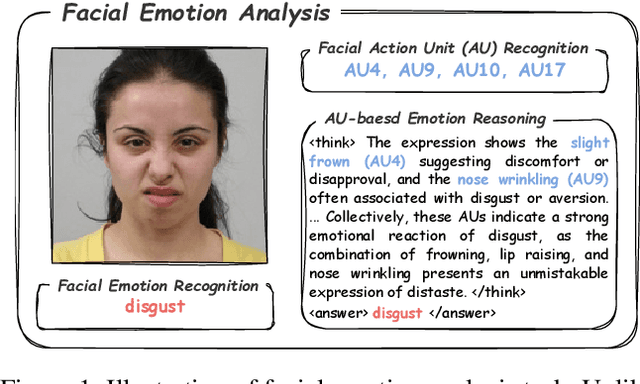
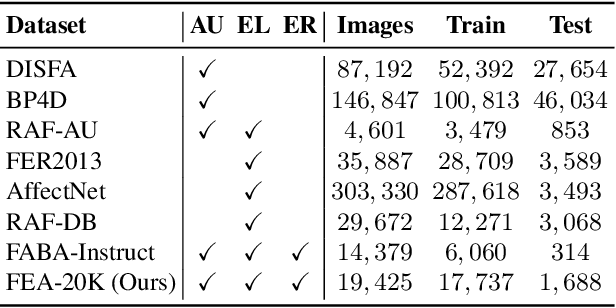
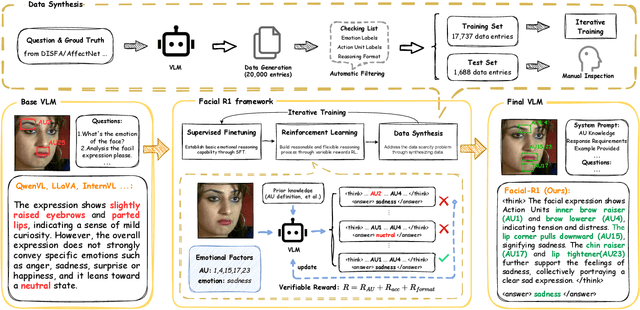
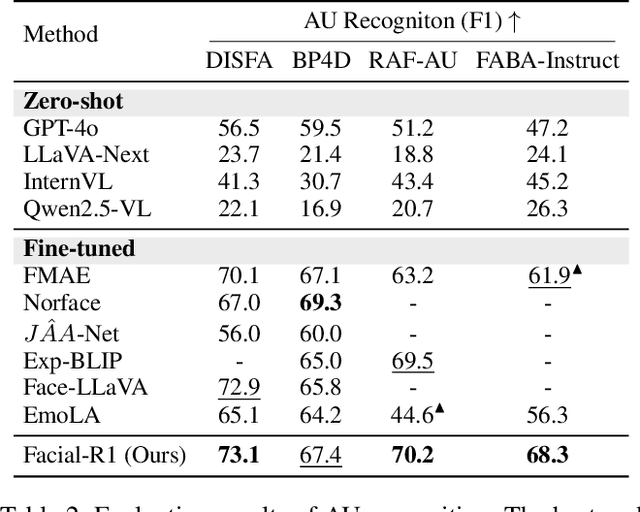
Facial Emotion Analysis (FEA) extends traditional facial emotion recognition by incorporating explainable, fine-grained reasoning. The task integrates three subtasks: emotion recognition, facial Action Unit (AU) recognition, and AU-based emotion reasoning to model affective states jointly. While recent approaches leverage Vision-Language Models (VLMs) and achieve promising results, they face two critical limitations: (1) hallucinated reasoning, where VLMs generate plausible but inaccurate explanations due to insufficient emotion-specific knowledge; and (2) misalignment between emotion reasoning and recognition, caused by fragmented connections between observed facial features and final labels. We propose Facial-R1, a three-stage alignment framework that effectively addresses both challenges with minimal supervision. First, we employ instruction fine-tuning to establish basic emotional reasoning capability. Second, we introduce reinforcement training guided by emotion and AU labels as reward signals, which explicitly aligns the generated reasoning process with the predicted emotion. Third, we design a data synthesis pipeline that iteratively leverages the prior stages to expand the training dataset, enabling scalable self-improvement of the model. Built upon this framework, we introduce FEA-20K, a benchmark dataset comprising 17,737 training and 1,688 test samples with fine-grained emotion analysis annotations. Extensive experiments across eight standard benchmarks demonstrate that Facial-R1 achieves state-of-the-art performance in FEA, with strong generalization and robust interpretability.
PIP: Perturbation-based Iterative Pruning for Large Language Models
Jan 25, 2025The rapid increase in the parameter counts of Large Language Models (LLMs), reaching billions or even trillions, presents significant challenges for their practical deployment, particularly in resource-constrained environments. To ease this issue, we propose PIP (Perturbation-based Iterative Pruning), a novel double-view structured pruning method to optimize LLMs, which combines information from two different views: the unperturbed view and the perturbed view. With the calculation of gradient differences, PIP iteratively prunes those that struggle to distinguish between these two views. Our experiments show that PIP reduces the parameter count by approximately 20% while retaining over 85% of the original model's accuracy across varied benchmarks. In some cases, the performance of the pruned model is within 5% of the unpruned version, demonstrating PIP's ability to preserve key aspects of model effectiveness. Moreover, PIP consistently outperforms existing state-of-the-art (SOTA) structured pruning methods, establishing it as a leading technique for optimizing LLMs in environments with constrained resources. Our code is available at: https://github.com/caoyiiiiii/PIP.