 Add to Chrome
 Add to Firefox
 Add to Edge
MEDR: Query-Independent Frame Selection via Multi-Signal Event Modeling and Dynamic Rescoring
Aug 15, 2026
Frame selection is a fundamental component of multimodal large language models, enabling long videos to be processed under limited visual-token and computational budgets. Uniform sampling preserves temporal coverage but may miss informative content that appears only briefly. To alleviate this limitation, query-dependent methods can retrieve question-relevant frames. However, because the selected frames depend on the current question, the same visual input cannot be directly shared across different questions, and frame selection must be repeated in multi-turn video dialogue. This motivates us to seek a query-independent frame selection method that preserves the reusability of a fixed visual input while improving the coverage of informative events beyond uniform sampling. We propose Multi-Signal Event Modeling and Dynamic Rescoring (MEDR), a training-free and query-independent frame selection method. Multi-Signal Event Modeling organizes complementary visual, motion, and text signals into signal-specific temporal events. Dynamic Rescoring then iteratively reevaluates each candidate relative to the current selected set, updating its score according to frame-level signal strength, additional event coverage, and temporal proximity. The resulting fixed frame set is constructed without observing the query and can be reused across different questions. On the standard benchmark evaluations, MEDR improves model accuracy by 0.63%-0.89% on Video-MME. On the long-video subset of LongVideoBench, it improves accuracy by up to 1.23% with Qwen3-VL-8B. MEDR further improves overall accuracy by 0.53%, while reusing exactly the same frame set for every question about a video.

LoopGuard: Breaking Self-Reinforcing Attention Loops via Dynamic KV Cache Intervention
Apr 11, 2026Through systematic experiments on long-context generation, we observe a damaging failure mode in which decoding can collapse into persistent repetition loops. We find that this degeneration is driven by collapsed attention patterns, where a subset of heads locks onto a narrow suffix of the history, and is further stabilized by inference-time KV cache reuse. Crucially, since many existing KV cache policies rely on attention-based importance, this collapse can produce spuriously high scores for repetitive tokens, causing cache management to inadvertently amplify repetition. To study this phenomenon in a controlled and reproducible manner, we introduce LoopBench, a benchmark with explicit loop-inducing conditions and loop-oriented metrics that quantify repetition severity and generation instability beyond downstream task scores. Building on these insights, we propose LoopGuard, a lightweight, plug-in KV cache guard that detects loop onset online and disrupts the feedback cycle by pruning repetitive tail spans under a fixed cache budget. Experiments on LoopBench show that LoopGuard reduces loop incidence by over 90 percentage points, while restoring output diversity and reducing token waste.
ELASTIC: Efficient Linear Attention for Sequential Interest Compression
Aug 20, 2024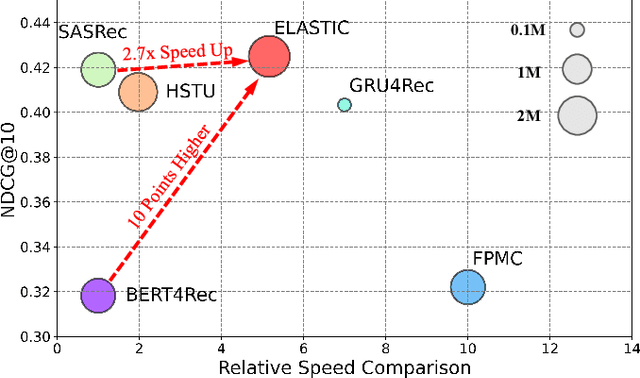

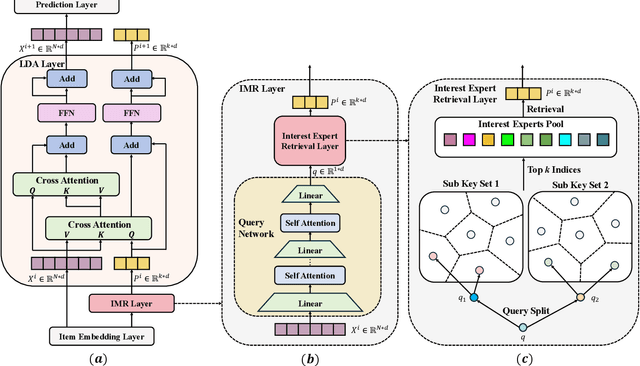

State-of-the-art sequential recommendation models heavily rely on transformer's attention mechanism. However, the quadratic computational and memory complexities of self attention have limited its scalability for modeling users' long range behaviour sequences. To address this problem, we propose ELASTIC, an Efficient Linear Attention for SequenTial Interest Compression, requiring only linear time complexity and decoupling model capacity from computational cost. Specifically, ELASTIC introduces a fixed length interest experts with linear dispatcher attention mechanism which compresses the long-term behaviour sequences to a significantly more compact representation which reduces up to 90% GPU memory usage with x2.7 inference speed up. The proposed linear dispatcher attention mechanism significantly reduces the quadratic complexity and makes the model feasible for adequately modeling extremely long sequences. Moreover, in order to retain the capacity for modeling various user interests, ELASTIC initializes a vast learnable interest memory bank and sparsely retrieves compressed user's interests from the memory with a negligible computational overhead. The proposed interest memory retrieval technique significantly expands the cardinality of available interest space while keeping the same computational cost, thereby striking a trade-off between recommendation accuracy and efficiency. To validate the effectiveness of our proposed ELASTIC, we conduct extensive experiments on various public datasets and compare it with several strong sequential recommenders. Experimental results demonstrate that ELASTIC consistently outperforms baselines by a significant margin and also highlight the computational efficiency of ELASTIC when modeling long sequences. We will make our implementation code publicly available.