 Add to Chrome
 Add to Firefox
 Add to Edge
Dynamic Inertial Poser (DynaIP): Part-Based Motion Dynamics Learning for Enhanced Human Pose Estimation with Sparse Inertial Sensors
Dec 02, 2023
This paper introduces a novel human pose estimation approach using sparse inertial sensors, addressing the shortcomings of previous methods reliant on synthetic data. It leverages a diverse array of real inertial motion capture data from different skeleton formats to improve motion diversity and model generalization. This method features two innovative components: a pseudo-velocity regression model for dynamic motion capture with inertial sensors, and a part-based model dividing the body and sensor data into three regions, each focusing on their unique characteristics. The approach demonstrates superior performance over state-of-the-art models across five public datasets, notably reducing pose error by 19\% on the DIP-IMU dataset, thus representing a significant improvement in inertial sensor-based human pose estimation. We will make the implementation of our model available for public use.

IG Captioner: Information Gain Captioners are Strong Zero-shot Classifiers
Nov 27, 2023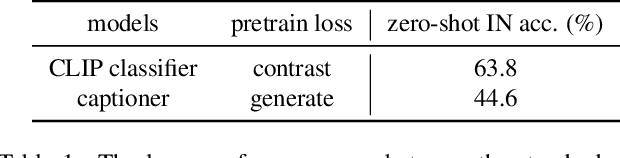
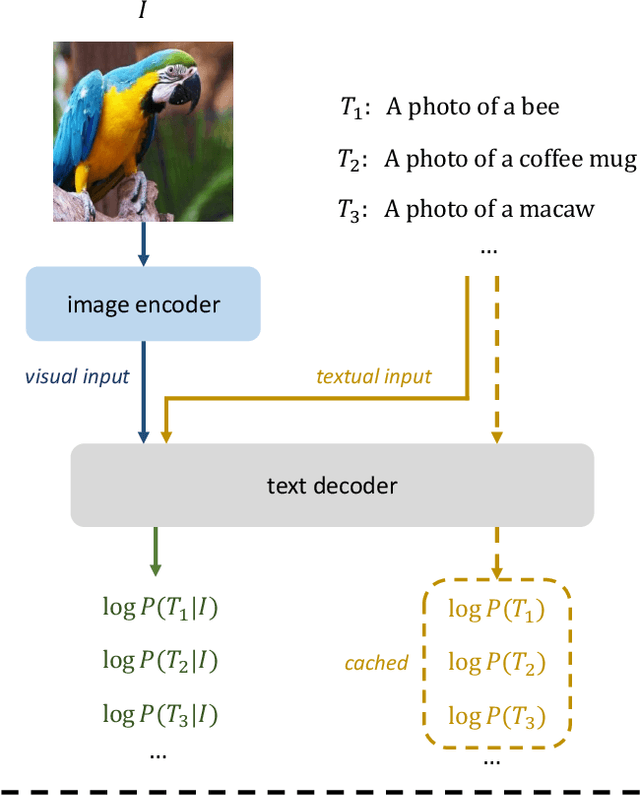

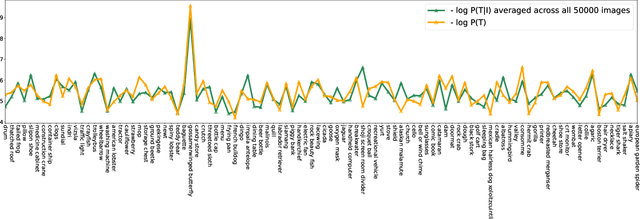
Generative training has been demonstrated to be powerful for building visual-language models. However, on zero-shot discriminative benchmarks, there is still a performance gap between models trained with generative and discriminative objectives. In this paper, we aim to narrow this gap by improving the efficacy of generative training on classification tasks, without any finetuning processes or additional modules. Specifically, we focus on narrowing the gap between the generative captioner and the CLIP classifier. We begin by analysing the predictions made by the captioner and classifier and observe that the caption generation inherits the distribution bias from the language model trained with pure text modality, making it less grounded on the visual signal. To tackle this problem, we redesign the scoring objective for the captioner to alleviate the distributional bias and focus on measuring the gain of information brought by the visual inputs. We further design a generative training objective to match the evaluation objective. We name our model trained and evaluated from the novel procedures as Information Gain (IG) captioner. We pretrain the models on the public Laion-5B dataset and perform a series of discriminative evaluations. For the zero-shot classification on ImageNet, IG captioner achieves $> 18\%$ improvements over the standard captioner, achieving comparable performances with the CLIP classifier. IG captioner also demonstrated strong performance on zero-shot image-text retrieval tasks on MSCOCO and Flickr30K. We hope this paper inspires further research towards unifying generative and discriminative training procedures for visual-language models.
HiPose: Hierarchical Binary Surface Encoding and Correspondence Pruning for RGB-D 6DoF Object Pose Estimation
Nov 21, 2023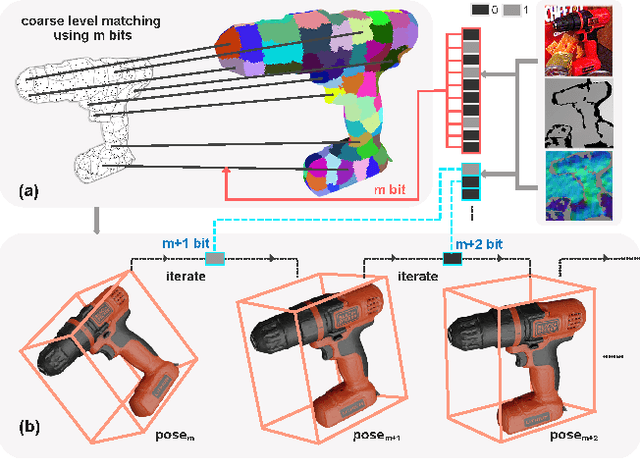

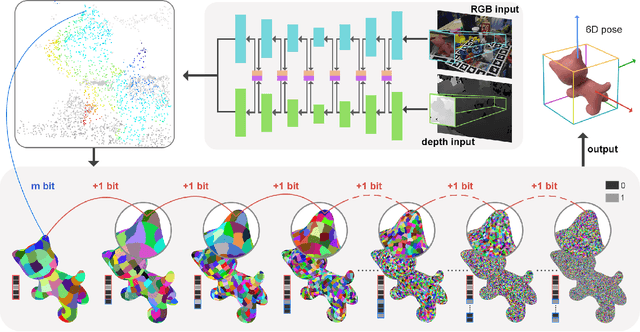
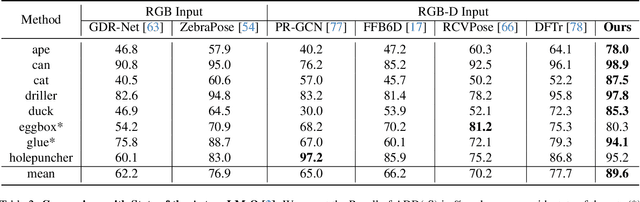
In this work, we present a novel dense-correspondence method for 6DoF object pose estimation from a single RGB-D image. While many existing data-driven methods achieve impressive performance, they tend to be time-consuming due to their reliance on rendering-based refinement approaches. To circumvent this limitation, we present HiPose, which establishes 3D-3D correspondences in a coarse-to-fine manner with a hierarchical binary surface encoding. Unlike previous dense-correspondence methods, we estimate the correspondence surface by employing point-to-surface matching and iteratively constricting the surface until it becomes a correspondence point while gradually removing outliers. Extensive experiments on public benchmarks LM-O, YCB-V, and T-Less demonstrate that our method surpasses all refinement-free methods and is even on par with expensive refinement-based approaches. Crucially, our approach is computationally efficient and enables real-time critical applications with high accuracy requirements. Code and models will be released.
Privacy-Preserving Load Forecasting via Personalized Model Obfuscation
Nov 21, 2023The widespread adoption of smart meters provides access to detailed and localized load consumption data, suitable for training building-level load forecasting models. To mitigate privacy concerns stemming from model-induced data leakage, federated learning (FL) has been proposed. This paper addresses the performance challenges of short-term load forecasting models trained with FL on heterogeneous data, emphasizing privacy preservation through model obfuscation. Our proposed algorithm, Privacy Preserving Federated Learning (PPFL), incorporates personalization layers for localized training at each smart meter. Additionally, we employ a differentially private mechanism to safeguard against data leakage from shared layers. Simulations on the NREL ComStock dataset corroborate the effectiveness of our approach.
Signal Processing Meets SGD: From Momentum to Filter
Nov 17, 2023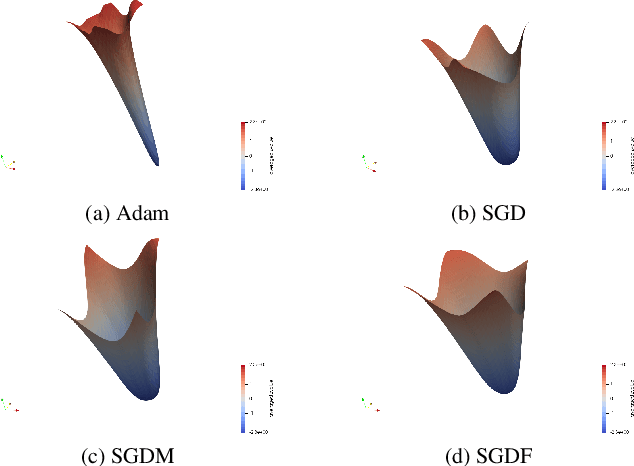



In the field of deep learning, Stochastic Gradient Descent (SGD) and its momentum-based variants are the predominant choices for optimization algorithms. Despite all that, these momentum strategies, which accumulate historical gradients by using a fixed $\beta$ hyperparameter to smooth the optimization processing, often neglect the potential impact of the variance of historical gradients on the current gradient estimation. In the gradient variance during training, fluctuation indicates the objective function does not meet the Lipschitz continuity condition at all time, which raises the troublesome optimization problem. This paper aims to explore the potential benefits of reducing the variance of historical gradients to make optimizer converge to flat solutions. Moreover, we proposed a new optimization method based on reducing the variance. We employed the Wiener filter theory to enhance the first moment estimation of SGD, notably introducing an adaptive weight to optimizer. Specifically, the adaptive weight dynamically changes along with temporal fluctuation of gradient variance during deep learning model training. Experimental results demonstrated our proposed adaptive weight optimizer, SGDF (Stochastic Gradient Descent With Filter), can achieve satisfactory performance compared with state-of-the-art optimizers.
Spatio-Temporal Similarity Measure based Multi-Task Learning for Predicting Alzheimer's Disease Progression using MRI Data
Nov 06, 2023
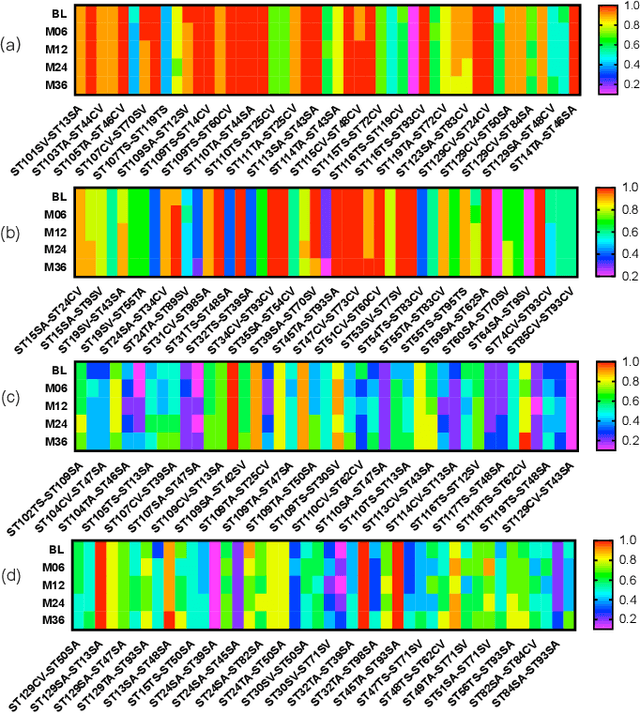
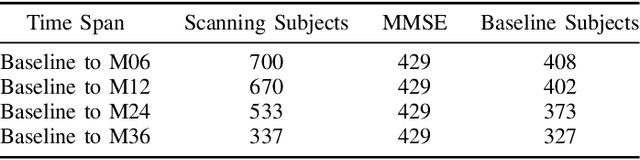
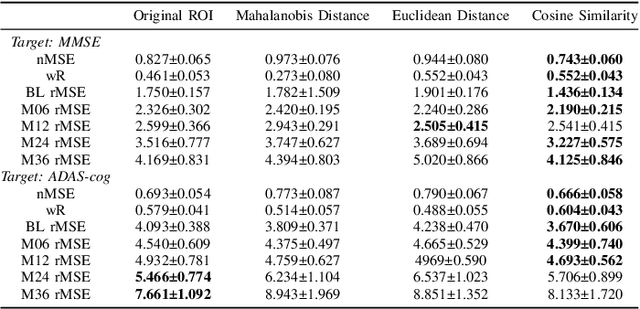
Identifying and utilising various biomarkers for tracking Alzheimer's disease (AD) progression have received many recent attentions and enable helping clinicians make the prompt decisions. Traditional progression models focus on extracting morphological biomarkers in regions of interest (ROIs) from MRI/PET images, such as regional average cortical thickness and regional volume. They are effective but ignore the relationships between brain ROIs over time, which would lead to synergistic deterioration. For exploring the synergistic deteriorating relationship between these biomarkers, in this paper, we propose a novel spatio-temporal similarity measure based multi-task learning approach for effectively predicting AD progression and sensitively capturing the critical relationships between biomarkers. Specifically, we firstly define a temporal measure for estimating the magnitude and velocity of biomarker change over time, which indicate a changing trend(temporal). Converting this trend into the vector, we then compare this variability between biomarkers in a unified vector space(spatial). The experimental results show that compared with directly ROI based learning, our proposed method is more effective in predicting disease progression. Our method also enables performing longitudinal stability selection to identify the changing relationships between biomarkers, which play a key role in disease progression. We prove that the synergistic deteriorating biomarkers between cortical volumes or surface areas have a significant effect on the cognitive prediction.
E3 TTS: Easy End-to-End Diffusion-based Text to Speech
Nov 02, 2023We propose Easy End-to-End Diffusion-based Text to Speech, a simple and efficient end-to-end text-to-speech model based on diffusion. E3 TTS directly takes plain text as input and generates an audio waveform through an iterative refinement process. Unlike many prior work, E3 TTS does not rely on any intermediate representations like spectrogram features or alignment information. Instead, E3 TTS models the temporal structure of the waveform through the diffusion process. Without relying on additional conditioning information, E3 TTS could support flexible latent structure within the given audio. This enables E3 TTS to be easily adapted for zero-shot tasks such as editing without any additional training. Experiments show that E3 TTS can generate high-fidelity audio, approaching the performance of a state-of-the-art neural TTS system. Audio samples are available at https://e3tts.github.io.
"Why Should I Review This Paper?" Unifying Semantic, Topic, and Citation Factors for Paper-Reviewer Matching
Oct 23, 2023
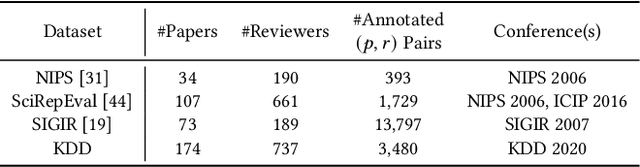


As many academic conferences are overwhelmed by a rapidly increasing number of paper submissions, automatically finding appropriate reviewers for each submission becomes a more urgent need than ever. Various factors have been considered by previous attempts on this task to measure the expertise relevance between a paper and a reviewer, including whether the paper is semantically close to, shares topics with, and cites previous papers of the reviewer. However, the majority of previous studies take only one of these factors into account, leading to an incomprehensive evaluation of paper-reviewer relevance. To bridge this gap, in this paper, we propose a unified model for paper-reviewer matching that jointly captures semantic, topic, and citation factors. In the unified model, a contextualized language model backbone is shared by all factors to learn common knowledge, while instruction tuning is introduced to characterize the uniqueness of each factor by producing factor-aware paper embeddings. Experiments on four datasets (one of which is newly contributed by us) across different fields, including machine learning, computer vision, information retrieval, and data mining, consistently validate the effectiveness of our proposed UniPR model in comparison with state-of-the-art paper-reviewer matching methods and scientific pre-trained language models.
How Biomimetic Morphing Dorsal Fin Affects the Swimming Performance of a Free-swimming Tuna Robot
Oct 19, 2023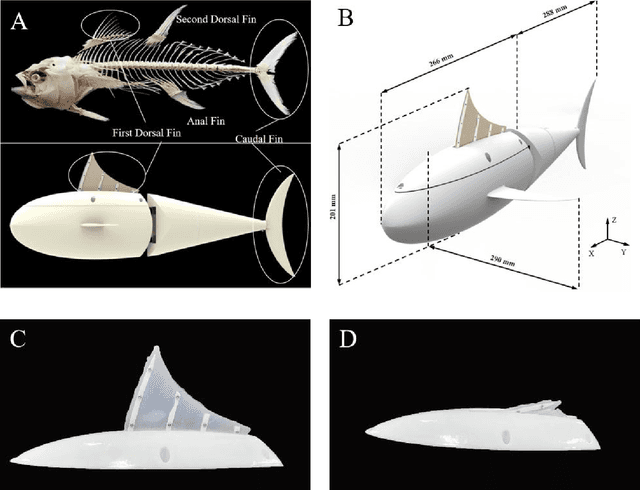


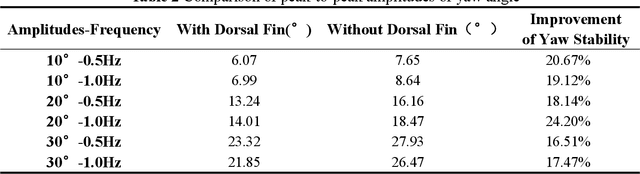
It is well known that tuna fish in the ocean can dynamically morph their median fins to achieve optimal hydrodynamic performance, e.g. linear acceleration and maneuverability. In this study, based on the previous studies about the median fin's hydrodynamic effects focusing on tethered conditions, we continue to explore the hydrodynamic function of tuna morphing dorsal fin in free swimming conditions for better approaching real-life situations.Here, we developed a tuna-inspired robotic fish platform that can swim independently in three dimensions, equipped with a biomimetic morphing dorsal fin magnetically attached to the robotic fish. Based on the free-swimming robotic fish platform, we investigated how the erected dorsal fin affects the speed, cost of transport (COT), and robotic fish's yaw angle at different frequencies and amplitudes. The erected dorsal fin plays a positive role in improving the yaw stability of robotic fish. However, it shows little influence on the speed and COT in our test. This remains to be further investigated in the future.
Machine Learning Methods for Background Potential Estimation in 2DEGs
Oct 11, 2023In the realm of quantum-effect devices and materials, two-dimensional electron gases (2DEGs) stand as fundamental structures that promise transformative technologies. However, the presence of impurities and defects in 2DEGs poses substantial challenges, impacting carrier mobility, conductivity, and quantum coherence time. To address this, we harness the power of scanning gate microscopy (SGM) and employ three distinct machine learning techniques to estimate the background potential of 2DEGs from SGM data: image-to-image translation using generative adversarial neural networks, cellular neural network, and evolutionary search. Our findings, despite data constraints, highlight the effectiveness of an evolutionary search algorithm in this context, offering a novel approach for defect analysis. This work not only advances our understanding of 2DEGs but also underscores the potential of machine learning in probing quantum materials, with implications for quantum computing and nanoelectronics.