 Add to Chrome
 Add to Firefox
 Add to Edge
ConceptTree: Bringing Semantic Transparency to Black-Box Decision Making for Robotic Manipulation
Jul 20, 2026
Establishing interpretable decision-making processes in long-horizon robotic manipulation is critical for enabling reliable human oversight and intervention. However, existing approaches to robotic manipulation largely treat skill selection as opaque mappings from observations to actions, offering limited transparency into how decisions are formed. In this work, we propose ConceptTree, a framework that reframes high-level manipulation skill selection as reasoning over human-interpretable concepts, representing high-level policies as a sequence of concept-level predicates over visual observations. Rather than relying on implicit latent representations, our method learns a normalized concept space grounded in visual inputs, over which a decision tree is trained to predict high-level skills. This formulation yields a transparent decision process that is both traceable and intervenable, enabling direct inspection and modification of policy behavior. We evaluate our approach on a set of real-world robotic manipulation tasks with increasing complexity. Experimental results show that ConceptTree consistently outperforms existing concept-based baselines, particularly in complex, long-horizon scenarios. Furthermore, we provide qualitative case studies showing that our model supports fine-grained intervention by modifying individual concepts, enabling targeted correction of decision errors without retraining.

Curriculum reinforcement learning with measurable task representation learning
May 22, 2026In curriculum reinforcement learning (CRL), an agent incrementally accumulates knowledge over a sequence of tasks (i.e., a curriculum), and the learning process is aimed at using the accumulated knowledge to finally solve a challenging target task. While early CRL works focus on sequencing candidate tasks, recent research explores automatic curriculum generation. Among the rich CRL literature, the interpolation-based CRL paradigm is a main body, which automatically generates intermediate tasks by interpolating between the initial task distribution and the target task distribution in task space with meaningful distance metrics (i.e., can measure the task similarity). However, in challenging navigation tasks, the non-Euclidean context (task) space invalidates this assumption. To achieve automatic curriculum generation in complex task, we propose a novel automatic curriculum generation approach based on measurable task representation learning. To better measure the similarity, we propose to transform the task space to a latent space. Through a variational autoencoder structure that encodes the reward and the state transitions, we achieve a latent task representation with a task similarity measurement property, and two close task embeddings correspond to two similar tasks in terms of rewards and state transitions. Based on the learned task representation, we further develop an automatic curriculum generation scheme, which can effectively generate new tasks more and more similar to the target task. We evaluate our method in a variety of challenging navigation tasks, and the experiment results indicate that the proposed approach surpasses state-of-the-art CRL approaches based on interpolation and generative adversarial networks.
SkillTree: Explainable Skill-Based Deep Reinforcement Learning for Long-Horizon Control Tasks
Nov 19, 2024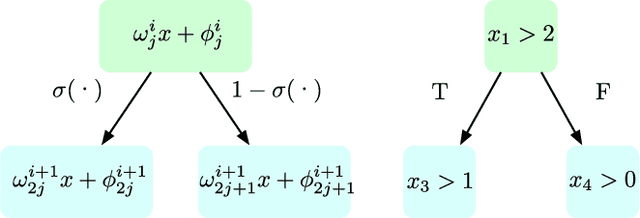

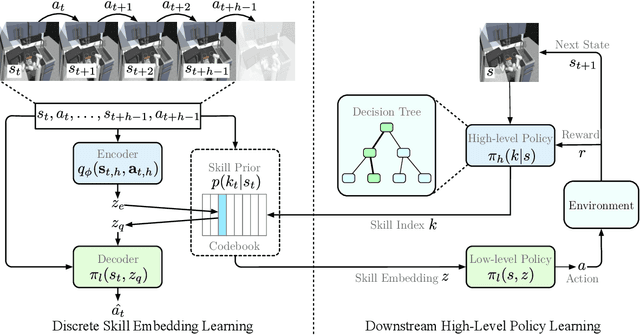
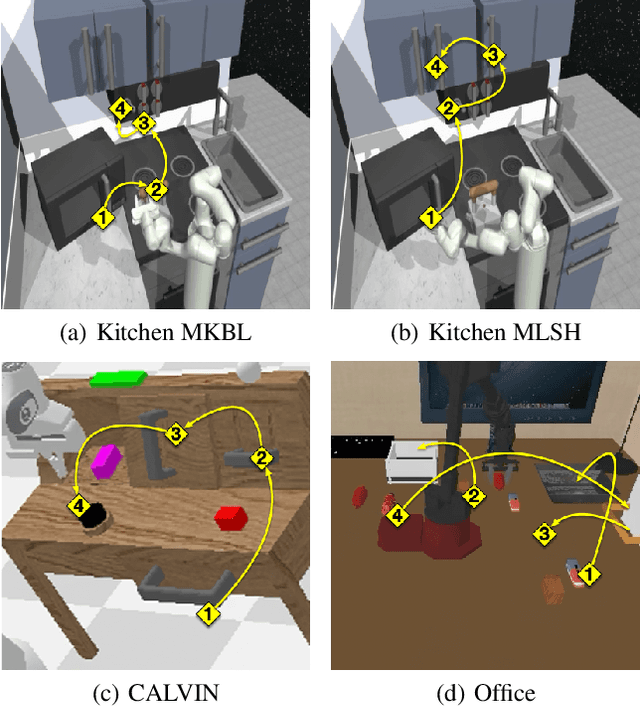
Deep reinforcement learning (DRL) has achieved remarkable success in various research domains. However, its reliance on neural networks results in a lack of transparency, which limits its practical applications. To achieve explainability, decision trees have emerged as a popular and promising alternative to neural networks. Nonetheless, due to their limited expressiveness, traditional decision trees struggle with high-dimensional long-horizon continuous control tasks. In this paper, we proposes SkillTree, a novel framework that reduces complex continuous action spaces into discrete skill spaces. Our hierarchical approach integrates a differentiable decision tree within the high-level policy to generate skill embeddings, which subsequently guide the low-level policy in executing skills. By making skill decisions explainable, we achieve skill-level explainability, enhancing the understanding of the decision-making process in complex tasks. Experimental results demonstrate that our method achieves performance comparable to skill-based neural networks in complex robotic arm control domains. Furthermore, SkillTree offers explanations at the skill level, thereby increasing the transparency of the decision-making process.