 Add to Chrome
 Add to Firefox
 Add to Edge
ConceptTree: Bringing Semantic Transparency to Black-Box Decision Making for Robotic Manipulation
Jul 20, 2026
Establishing interpretable decision-making processes in long-horizon robotic manipulation is critical for enabling reliable human oversight and intervention. However, existing approaches to robotic manipulation largely treat skill selection as opaque mappings from observations to actions, offering limited transparency into how decisions are formed. In this work, we propose ConceptTree, a framework that reframes high-level manipulation skill selection as reasoning over human-interpretable concepts, representing high-level policies as a sequence of concept-level predicates over visual observations. Rather than relying on implicit latent representations, our method learns a normalized concept space grounded in visual inputs, over which a decision tree is trained to predict high-level skills. This formulation yields a transparent decision process that is both traceable and intervenable, enabling direct inspection and modification of policy behavior. We evaluate our approach on a set of real-world robotic manipulation tasks with increasing complexity. Experimental results show that ConceptTree consistently outperforms existing concept-based baselines, particularly in complex, long-horizon scenarios. Furthermore, we provide qualitative case studies showing that our model supports fine-grained intervention by modifying individual concepts, enabling targeted correction of decision errors without retraining.

Yunshan Cup 2020: Overview of the Part-of-Speech Tagging Task for Low-resourced Languages
Apr 06, 2022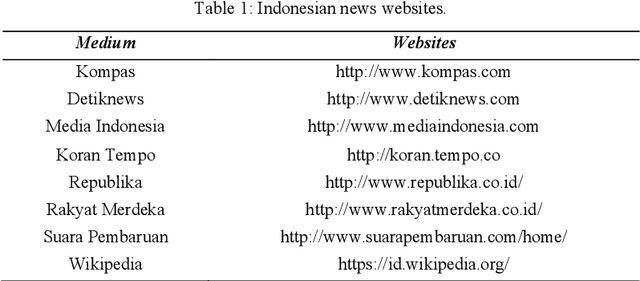
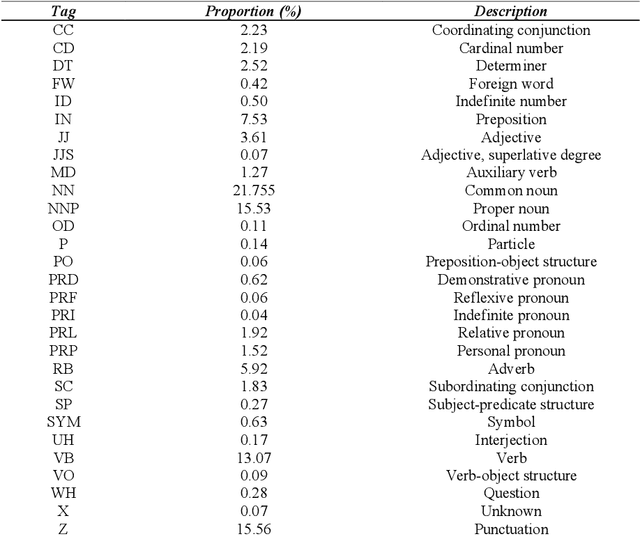
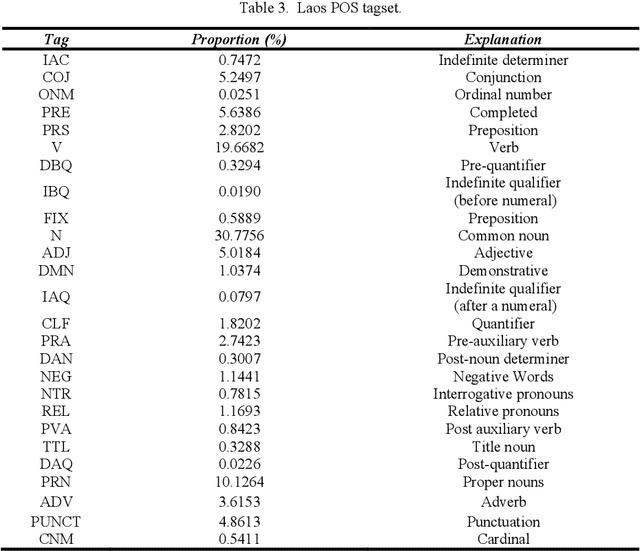
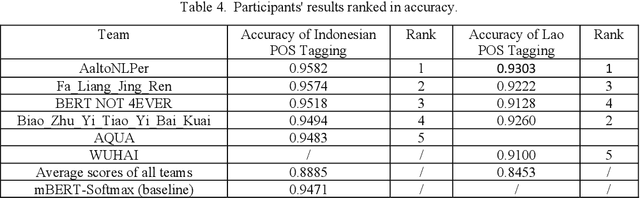
The Yunshan Cup 2020 track focused on creating a framework for evaluating different methods of part-of-speech (POS). There were two tasks for this track: (1) POS tagging for the Indonesian language, and (2) POS tagging for the Lao tagging. The Indonesian dataset is comprised of 10000 sentences from Indonesian news within 29 tags. And the Lao dataset consists of 8000 sentences within 27 tags. 25 teams registered for the task. The methods of participants ranged from feature-based to neural networks using either classical machine learning techniques or ensemble methods. The best performing results achieve an accuracy of 95.82% for Indonesian and 93.03%, showing that neural sequence labeling models significantly outperform classic feature-based methods and rule-based methods.