 Add to Chrome
 Add to Firefox
 Add to Edge
RLFTSim: Realistic and Controllable Multi-Agent Traffic Simulation via Reinforcement Learning Fine-Tuning
May 18, 2026
Supervised open-loop training has been widely adopted for training traffic simulation models; however, it fails to capture the inherently dynamic, multi-agent interactions common in complex driving scenarios. We introduce RLFTSim, a reinforcement-learning-based fine-tuning framework that enhances scenario realism by aligning simulator rollouts with real-world data distributions and provides a method for distilling goal-conditioned controllability in scenario generation. We instantiate RLFTSim on top of a pre-trained simulation model, design a reward that balances fidelity and controllability, and perform comprehensive experiments on the Waymo Open Motion Dataset. Our results show improvements in realism, achieving state-of-the-art performance. Compared with other heuristic search-based fine-tuning methods, RLFTSim requires significantly fewer samples due to a proposed low-variance and dense reward signal, and it directly addresses the realism alignment issue by design. We also demonstrate the effectiveness of our approach for distilling traffic simulation controllability through goal conditioning. The project page is available at https://ehsan-ami.github.io/rlftsim.

Cactus: Accelerating Auto-Regressive Decoding with Constrained Acceptance Speculative Sampling
Apr 05, 2026Speculative sampling (SpS) has been successful in accelerating the decoding throughput of auto-regressive large language models by leveraging smaller draft models. SpS strictly enforces the generated distribution to match that of the verifier LLM. This is unnecessarily restrictive as slight variations of the verifier's distribution, such as sampling with top-$k$ or temperature, would also be acceptable. Typical acceptance sampling (TAS) alleviates this issue by accepting more tokens using entropy-based heuristics. However, this approach distorts the verifier distribution, potentially degrading output quality when the verifier encodes critical information. In this work, we formalize the speculative sampling algorithm through the lens of constrained optimization. Based on this formulation, we propose Cactus (constrained acceptance speculative sampling), a method that guarantees controlled divergence from the verifier distribution and increasing acceptance rates. Empirical results across a wide range of benchmarks confirm the effectiveness of our approach.
Do Neural Networks Lose Plasticity in a Gradually Changing World?
Feb 09, 2026Continual learning has become a trending topic in machine learning. Recent studies have discovered an interesting phenomenon called loss of plasticity, referring to neural networks gradually losing the ability to learn new tasks. However, existing plasticity research largely relies on contrived settings with abrupt task transitions, which often do not reflect real-world environments. In this paper, we propose to investigate a gradually changing environment, and we simulate this by input/output interpolation and task sampling. We perform theoretical and empirical analysis, showing that the loss of plasticity is an artifact of abrupt tasks changes in the environment and can be largely mitigated if the world changes gradually.
Multi-Persona Thinking for Bias Mitigation in Large Language Models
Jan 21, 2026Large Language Models (LLMs) exhibit significant social biases that can perpetuate harmful stereotypes and unfair outcomes. In this paper, we propose Multi-Persona Thinking (MPT), a novel inference-time framework that leverages dialectical reasoning from multiple perspectives to reduce bias. MPT guides models to adopt contrasting social identities (e.g., male and female) along with a neutral viewpoint, and then engages these personas iteratively to expose and correct biases. Through a dialectical reasoning process, the framework transforms the potential weakness of persona assignment into a strength for bias mitigation. We evaluate MPT on two widely used bias benchmarks across both open-source and closed-source models of varying scales. Our results demonstrate substantial improvements over existing prompting-based strategies: MPT achieves the lowest bias while maintaining core reasoning ability.
LoRAQuant: Mixed-Precision Quantization of LoRA to Ultra-Low Bits
Oct 30, 2025Low-Rank Adaptation (LoRA) has become a popular technique for parameter-efficient fine-tuning of large language models (LLMs). In many real-world scenarios, multiple adapters are loaded simultaneously to enable LLM customization for personalized user experiences or to support a diverse range of tasks. Although each adapter is lightweight in isolation, their aggregate cost becomes substantial at scale. To address this, we propose LoRAQuant, a mixed-precision post-training quantization method tailored to LoRA. Specifically, LoRAQuant reparameterizes each adapter by singular value decomposition (SVD) to concentrate the most important information into specific rows and columns. This makes it possible to quantize the important components to higher precision, while quantizing the rest to ultra-low bitwidth. We conduct comprehensive experiments with LLaMA 2-7B, LLaMA 2-13B, and Mistral 7B models on mathematical reasoning, coding, and summarization tasks. Results show that our LoRAQuant uses significantly lower bits than other quantization methods, but achieves comparable or even higher performance.
RL-PLUS: Countering Capability Boundary Collapse of LLMs in Reinforcement Learning with Hybrid-policy Optimization
Jul 31, 2025Reinforcement Learning with Verifiable Reward (RLVR) has significantly advanced the complex reasoning abilities of Large Language Models (LLMs). However, it struggles to break through the inherent capability boundaries of the base LLM, due to its inherently on-policy strategy with LLM's immense action space and sparse reward. Further, RLVR can lead to the capability boundary collapse, narrowing the LLM's problem-solving scope. To address this problem, we propose RL-PLUS, a novel approach that synergizes internal exploitation (i.e., Thinking) with external data (i.e., Learning) to achieve stronger reasoning capabilities and surpass the boundaries of base models. RL-PLUS integrates two core components: Multiple Importance Sampling to address for distributional mismatch from external data, and an Exploration-Based Advantage Function to guide the model towards high-value, unexplored reasoning paths. We provide both theoretical analysis and extensive experiments to demonstrate the superiority and generalizability of our approach. The results show that RL-PLUS achieves state-of-the-art performance compared with existing RLVR methods on six math reasoning benchmarks and exhibits superior performance on six out-of-distribution reasoning tasks. It also achieves consistent and significant gains across diverse model families, with average relative improvements ranging from 21.1\% to 69.2\%. Moreover, Pass@k curves across multiple benchmarks indicate that RL-PLUS effectively resolves the capability boundary collapse problem.
KETCHUP: K-Step Return Estimation for Sequential Knowledge Distillation
Apr 26, 2025We propose a novel k-step return estimation method (called KETCHUP) for Reinforcement Learning(RL)-based knowledge distillation (KD) in text generation tasks. Our idea is to induce a K-step return by using the Bellman Optimality Equation for multiple steps. Theoretical analysis shows that this K-step formulation reduces the variance of the gradient estimates, thus leading to improved RL optimization especially when the student model size is large. Empirical evaluation on three text generation tasks demonstrates that our approach yields superior performance in both standard task metrics and large language model (LLM)-based evaluation. These results suggest that our K-step return induction offers a promising direction for enhancing RL-based KD in LLM research.
A Decoding Algorithm for Length-Control Summarization Based on Directed Acyclic Transformers
Feb 06, 2025Length-control summarization aims to condense long texts into a short one within a certain length limit. Previous approaches often use autoregressive (AR) models and treat the length requirement as a soft constraint, which may not always be satisfied. In this study, we propose a novel length-control decoding algorithm based on the Directed Acyclic Transformer (DAT). Our approach allows for multiple plausible sequence fragments and predicts a \emph{path} to connect them. In addition, we propose a Sequence Maximum a Posteriori (SeqMAP) decoding algorithm that marginalizes different possible paths and finds the most probable summary satisfying the length budget. Our algorithm is based on beam search, which further facilitates a reranker for performance improvement. Experimental results on the Gigaword and DUC2004 datasets demonstrate our state-of-the-art performance for length-control summarization.
ULPT: Prompt Tuning with Ultra-Low-Dimensional Optimization
Feb 06, 2025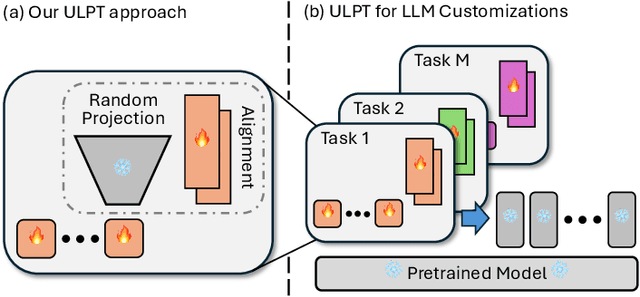


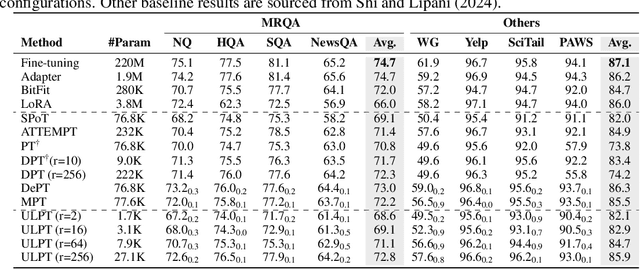
Large language models achieve state-of-the-art performance but are costly to fine-tune due to their size. Parameter-efficient fine-tuning methods, such as prompt tuning, address this by reducing trainable parameters while maintaining strong performance. However, prior methods tie prompt embeddings to the model's dimensionality, which may not scale well with larger LLMs and more customized LLMs. In this paper, we propose Ultra-Low-dimensional Prompt Tuning (ULPT), which optimizes prompts in a low-dimensional space (e.g., 2D) and use a random but frozen matrix for the up-projection. To enhance alignment, we introduce learnable shift and scale embeddings. ULPT drastically reduces the trainable parameters, e.g., 2D only using 2% parameters compared with vanilla prompt tuning while retaining most of the performance across 21 NLP tasks. Our theoretical analysis shows that random projections can capture high-rank structures effectively, and experimental results demonstrate ULPT's competitive performance over existing parameter-efficient methods.
Revisiting Intermediate-Layer Matching in Knowledge Distillation: Layer-Selection Strategy Doesn't Matter (Much)
Feb 06, 2025
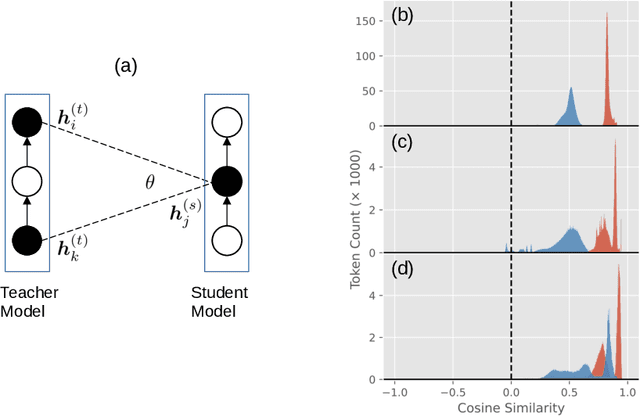

Knowledge distillation (KD) is a popular method of transferring knowledge from a large "teacher" model to a small "student" model. KD can be divided into two categories: prediction matching and intermediate-layer matching. We explore an intriguing phenomenon: layer-selection strategy does not matter (much) in intermediate-layer matching. In this paper, we show that seemingly nonsensical matching strategies such as matching the teacher's layers in reverse still result in surprisingly good student performance. We provide an interpretation for this phenomenon by examining the angles between teacher layers viewed from the student's perspective.