 Add to Chrome
 Add to Firefox
 Add to Edge
Modeling and Control of a Pneumatic Soft Robotic Catheter Using Neural Koopman Operators
Mar 04, 2026
Catheter-based interventions are widely used for the diagnosis and treatment of cardiac diseases. Recently, robotic catheters have attracted attention for their ability to improve precision and stability over conventional manual approaches. However, accurate modeling and control of soft robotic catheters remain challenging due to their complex, nonlinear behavior. The Koopman operator enables lifting the original system data into a linear "lifted space", offering a data-driven framework for predictive control; however, manually chosen basis functions in the lifted space often oversimplify system behaviors and degrade control performance. To address this, we propose a neural network-enhanced Koopman operator framework that jointly learns the lifted space representation and Koopman operator in an end-to-end manner. Moreover, motivated by the need to minimize radiation exposure during X-ray fluoroscopy in cardiac ablation, we investigate open-loop control strategies using neural Koopman operators to reliably reach target poses without continuous imaging feedback. The proposed method is validated in two experimental scenarios: interactive position control and a simulated cardiac ablation task using an atrium-like cavity. Our approach achieves average errors of 2.1 +- 0.4 mm in position and 4.9 +- 0.6 degrees in orientation, outperforming not only model-based baselines but also other Koopman variants in targeting accuracy and efficiency. These results highlight the potential of the proposed framework for advancing soft robotic catheter systems and improving catheter-based interventions.

An Extended Generalized Prandtl-Ishlinskii Hysteresis Model for I2RIS Robot
Apr 16, 2025Retinal surgery requires extreme precision due to constrained anatomical spaces in the human retina. To assist surgeons achieve this level of accuracy, the Improved Integrated Robotic Intraocular Snake (I2RIS) with dexterous capability has been developed. However, such flexible tendon-driven robots often suffer from hysteresis problems, which significantly challenges precise control and positioning. In particular, we observed multi-stage hysteresis phenomena in the small-scale I2RIS. In this paper, we propose an Extended Generalized Prandtl-Ishlinskii (EGPI) model to increase the fitting accuracy of the hysteresis. The model incorporates a novel switching mechanism that enables it to describe multi-stage hysteresis in the regions of monotonic input. Experimental validation on I2RIS data demonstrate that the EGPI model outperforms the conventional Generalized Prandtl-Ishlinskii (GPI) model in terms of RMSE, NRMSE, and MAE across multiple motor input directions. The EGPI model in our study highlights the potential in modeling multi-stage hysteresis in minimally invasive flexible robots.
Efficient RRT*-based Safety-Constrained Motion Planning for Continuum Robots in Dynamic Environments
Sep 25, 2023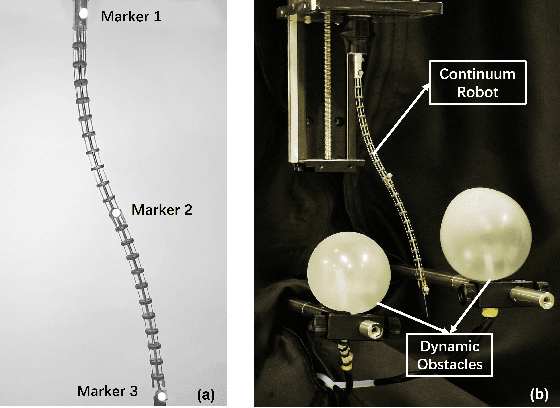
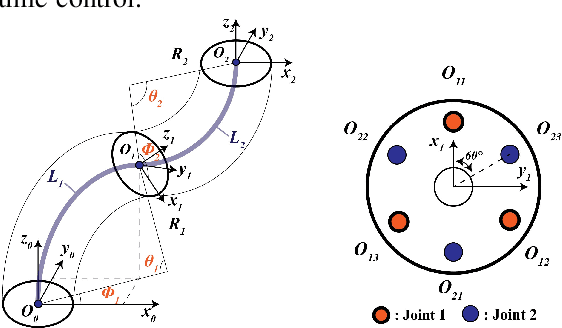
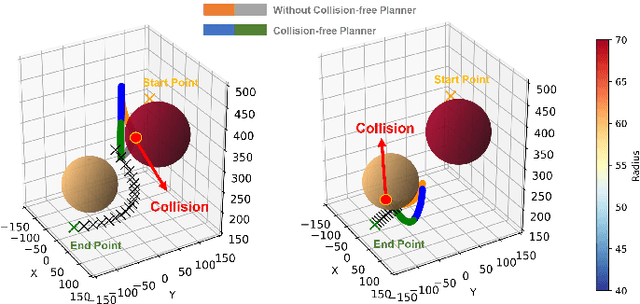
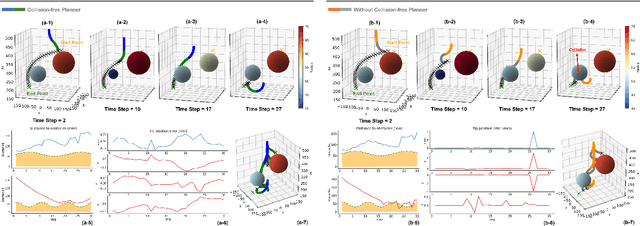
Continuum robots, characterized by their high flexibility and infinite degrees of freedom (DoFs), have gained prominence in applications such as minimally invasive surgery and hazardous environment exploration. However, the intrinsic complexity of continuum robots requires a significant amount of time for their motion planning, posing a hurdle to their practical implementation. To tackle these challenges, efficient motion planning methods such as Rapidly Exploring Random Trees (RRT) and its variant, RRT*, have been employed. This paper introduces a unique RRT*-based motion control method tailored for continuum robots. Our approach embeds safety constraints derived from the robots' posture states, facilitating autonomous navigation and obstacle avoidance in rapidly changing environments. Simulation results show efficient trajectory planning amidst multiple dynamic obstacles and provide a robust performance evaluation based on the generated postures. Finally, preliminary tests were conducted on a two-segment cable-driven continuum robot prototype, confirming the effectiveness of the proposed planning approach. This method is versatile and can be adapted and deployed for various types of continuum robots through parameter adjustments.