 Add to Chrome
 Add to Firefox
 Add to Edge
Q-Doc: Benchmarking Document Image Quality Assessment Capabilities in Multi-modal Large Language Models
Nov 14, 2025
The rapid advancement of Multi-modal Large Language Models (MLLMs) has expanded their capabilities beyond high-level vision tasks. Nevertheless, their potential for Document Image Quality Assessment (DIQA) remains underexplored. To bridge this gap, we propose Q-Doc, a three-tiered evaluation framework for systematically probing DIQA capabilities of MLLMs at coarse, middle, and fine granularity levels. a) At the coarse level, we instruct MLLMs to assign quality scores to document images and analyze their correlation with Quality Annotations. b) At the middle level, we design distortion-type identification tasks, including single-choice and multi-choice tests for multi-distortion scenarios. c) At the fine level, we introduce distortion-severity assessment where MLLMs classify distortion intensity against human-annotated references. Our evaluation demonstrates that while MLLMs possess nascent DIQA abilities, they exhibit critical limitations: inconsistent scoring, distortion misidentification, and severity misjudgment. Significantly, we show that Chain-of-Thought (CoT) prompting substantially enhances performance across all levels. Our work provides a benchmark for DIQA capabilities in MLLMs, revealing pronounced deficiencies in their quality perception and promising pathways for enhancement. The benchmark and code are publicly available at: https://github.com/cydxf/Q-Doc.

CoCoL: A Communication Efficient Decentralized Collaborative Method for Multi-Robot Systems
Aug 28, 2025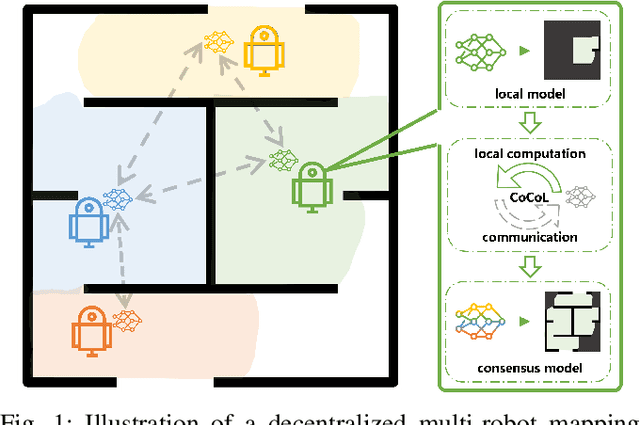
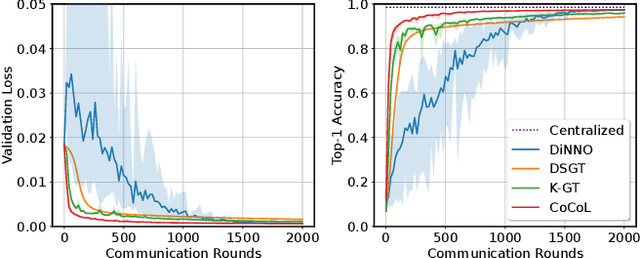
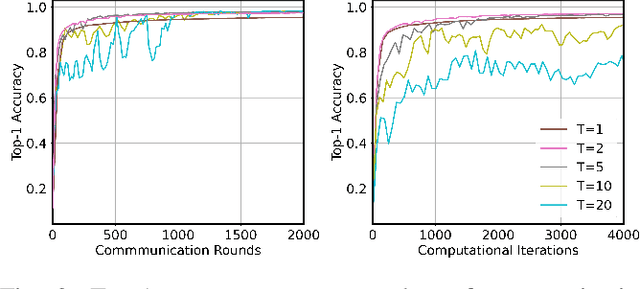
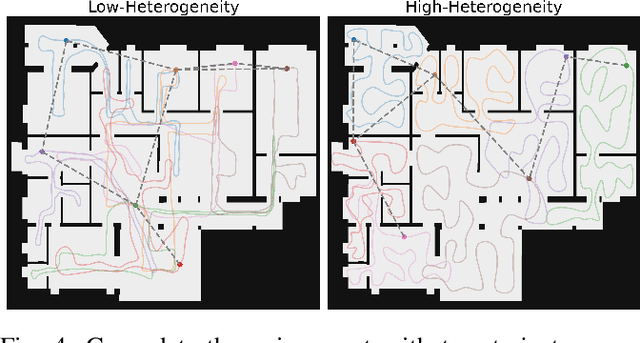
Collaborative learning enhances the performance and adaptability of multi-robot systems in complex tasks but faces significant challenges due to high communication overhead and data heterogeneity inherent in multi-robot tasks. To this end, we propose CoCoL, a Communication efficient decentralized Collaborative Learning method tailored for multi-robot systems with heterogeneous local datasets. Leveraging a mirror descent framework, CoCoL achieves remarkable communication efficiency with approximate Newton-type updates by capturing the similarity between objective functions of robots, and reduces computational costs through inexact sub-problem solutions. Furthermore, the integration of a gradient tracking scheme ensures its robustness against data heterogeneity. Experimental results on three representative multi robot collaborative learning tasks show the superiority of the proposed CoCoL in significantly reducing both the number of communication rounds and total bandwidth consumption while maintaining state-of-the-art accuracy. These benefits are particularly evident in challenging scenarios involving non-IID (non-independent and identically distributed) data distribution, streaming data, and time-varying network topologies.