 Add to Chrome
 Add to Firefox
 Add to Edge
Deciphering Neural Reparameterized Full-Waveform Inversion with Neural Sensitivity Kernel and Wave Tangent Kernel
May 14, 2026
Full-waveform inversion (FWI) estimates unknown parameters in the wave equation from limited boundary measurements. Recent advances in neural reparameterized FWI (NeurFWI) demonstrate that representing the parameters using a neural network can reduce the reliance on the high-quality initial model and wavefield data, at the cost of slow high-resolution convergence. However, its underlying theoretical mechanism remains unclear. In this study, we establish the neural sensitivity kernel (NSK) and the wave tangent kernel (WTK) to analyze their convergence behavior from both model and data domains. These theoretical frameworks show that the neural tangent kernel (NTK) induced by neural representation adaptively modulates the original sensitivity and wave tangent kernels. This modulation leads to several key outcomes, i.e., the spectral filtering effect, the gradient wavenumber modulation, and the wave frequency bias, connecting the convergence behavior of NeurFWI with the eigen-structures of NSK and WTK. Building on these insights, we propose several enhanced NeurFWI methods with tailored eigen-structures in NSK and WTK to improve inversion performances and efficiency. We numerically validate these theoretical claims and the proposed methods in seismic exploration, and firstly extend their application to medical imaging.

Unveiling the Mechanism of Continuous Representation Full-Waveform Inversion: A Wave Based Neural Tangent Kernel Framework
Mar 23, 2026Full-waveform inversion (FWI) estimates physical parameters in the wave equation from limited measurements and has been widely applied in geophysical exploration, medical imaging, and non-destructive testing. Conventional FWI methods are limited by their notorious sensitivity to the accuracy of the initial models. Recent progress in continuous representation FWI (CR-FWI) demonstrates that representing parameter models with a coordinate-based neural network, such as implicit neural representation (INR), can mitigate the dependence on initial models. However, its underlying mechanism remains unclear, and INR-based FWI shows slower high-frequency convergence. In this work, we investigate the general CR-FWI framework and develop a unified theoretical understanding by extending the neural tangent kernel (NTK) for FWI to establish a wave-based NTK framework. Unlike standard NTK, our analysis reveals that wave-based NTK is not constant, both at initialization and during training, due to the inherent nonlinearity of FWI. We further show that the eigenvalue decay behavior of the wave-based NTK can explain why CR-FWI alleviates the dependency on initial models and shows slower high-frequency convergence. Building on these insights, we propose several CR-FWI methods with tailored eigenvalue decay properties for FWI, including a novel hybrid representation combining INR and multi-resolution grid (termed IG-FWI) that achieves a more balanced trade-off between robustness and high-frequency convergence rate. Applications in geophysical exploration on Marmousi, 2D SEG/EAGE Salt and Overthrust, 2004 BP model, and the more realistic 2014 Chevron models show the superior performance of our proposed methods compared to conventional FWI and existing INR-based FWI methods.
* Published as a conference paper at ICLR 2026 (poster)
Neural Operator-Grounded Continuous Tensor Function Representation and Its Applications
Mar 02, 2026Recently, continuous tensor functions have attracted increasing attention, because they can unifiedly represent data both on mesh grids and beyond mesh grids. However, since mode-$n$ product is essentially discrete and linear, the potential of current continuous tensor function representations is still locked. To break this bottleneck, we suggest neural operator-grounded mode-$n$ operators as a continuous and nonlinear alternative of discrete and linear mode-$n$ product. Instead of mapping the discrete core tensor to the discrete target tensor, proposed mode-$n$ operator directly maps the continuous core tensor function to the continuous target tensor function, which provides a genuine continuous representation of real-world data and can ameliorate discretization artifacts. Empowering with continuous and nonlinear mode-$n$ operators, we propose a neural operator-grounded continuous tensor function representation (abbreviated as NO-CTR), which can more faithfully represent complex real-world data compared with classic discrete tensor representations and continuous tensor function representations. Theoretically, we also prove that any continuous tensor function can be approximated by NO-CTR. To examine the capability of NO-CTR, we suggest an NO-CTR-based multi-dimensional data completion model. Extensive experiments across various data on regular mesh grids (multi-spectral images and color videos), on mesh girds with different resolutions (Sentinel-2 images) and beyond mesh grids (point clouds) demonstrate the superiority of NO-CTR.
Compressive Imaging Reconstruction via Tensor Decomposed Multi-Resolution Grid Encoding
Jul 10, 2025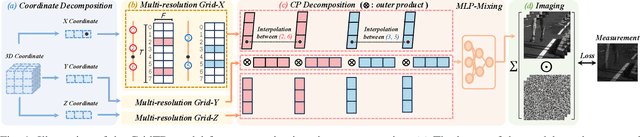
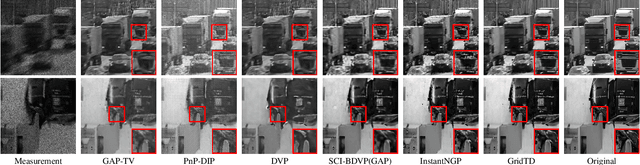
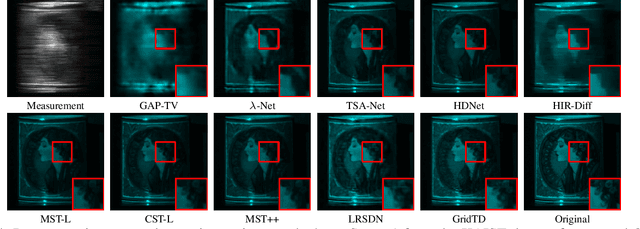
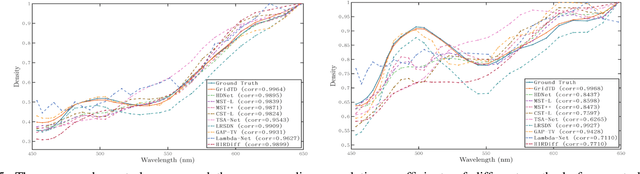
Compressive imaging (CI) reconstruction, such as snapshot compressive imaging (SCI) and compressive sensing magnetic resonance imaging (MRI), aims to recover high-dimensional images from low-dimensional compressed measurements. This process critically relies on learning an accurate representation of the underlying high-dimensional image. However, existing unsupervised representations may struggle to achieve a desired balance between representation ability and efficiency. To overcome this limitation, we propose Tensor Decomposed multi-resolution Grid encoding (GridTD), an unsupervised continuous representation framework for CI reconstruction. GridTD optimizes a lightweight neural network and the input tensor decomposition model whose parameters are learned via multi-resolution hash grid encoding. It inherently enjoys the hierarchical modeling ability of multi-resolution grid encoding and the compactness of tensor decomposition, enabling effective and efficient reconstruction of high-dimensional images. Theoretical analyses for the algorithm's Lipschitz property, generalization error bound, and fixed-point convergence reveal the intrinsic superiority of GridTD as compared with existing continuous representation models. Extensive experiments across diverse CI tasks, including video SCI, spectral SCI, and compressive dynamic MRI reconstruction, consistently demonstrate the superiority of GridTD over existing methods, positioning GridTD as a versatile and state-of-the-art CI reconstruction method.
Continuous Representation Methods, Theories, and Applications: An Overview and Perspectives
May 21, 2025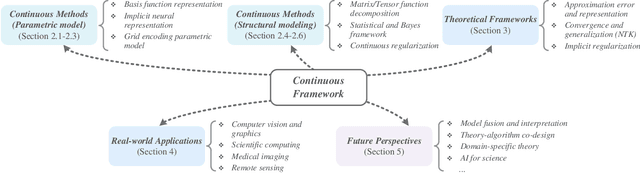
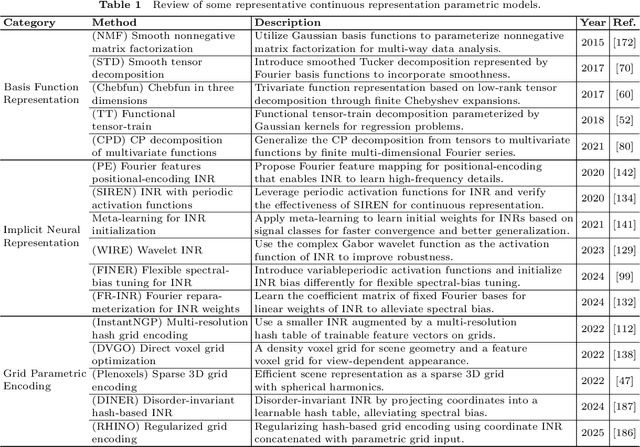
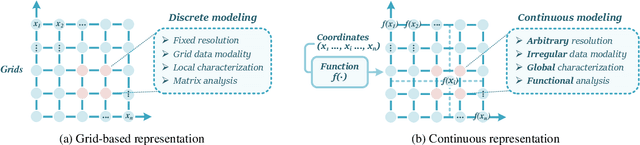
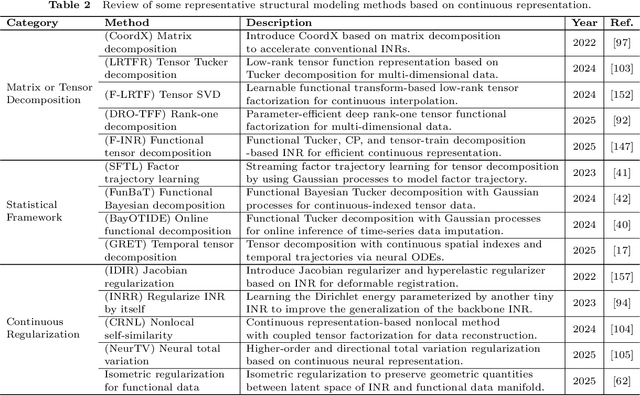
Recently, continuous representation methods emerge as novel paradigms that characterize the intrinsic structures of real-world data through function representations that map positional coordinates to their corresponding values in the continuous space. As compared with the traditional discrete framework, the continuous framework demonstrates inherent superiority for data representation and reconstruction (e.g., image restoration, novel view synthesis, and waveform inversion) by offering inherent advantages including resolution flexibility, cross-modal adaptability, inherent smoothness, and parameter efficiency. In this review, we systematically examine recent advancements in continuous representation frameworks, focusing on three aspects: (i) Continuous representation method designs such as basis function representation, statistical modeling, tensor function decomposition, and implicit neural representation; (ii) Theoretical foundations of continuous representations such as approximation error analysis, convergence property, and implicit regularization; (iii) Real-world applications of continuous representations derived from computer vision, graphics, bioinformatics, and remote sensing. Furthermore, we outline future directions and perspectives to inspire exploration and deepen insights to facilitate continuous representation methods, theories, and applications. All referenced works are summarized in our open-source repository: https://github.com/YisiLuo/Continuous-Representation-Zoo.
Motion-Enhanced Nonlocal Similarity Implicit Neural Representation for Infrared Dim and Small Target Detection
Apr 22, 2025Infrared dim and small target detection presents a significant challenge due to dynamic multi-frame scenarios and weak target signatures in the infrared modality. Traditional low-rank plus sparse models often fail to capture dynamic backgrounds and global spatial-temporal correlations, which results in background leakage or target loss. In this paper, we propose a novel motion-enhanced nonlocal similarity implicit neural representation (INR) framework to address these challenges. We first integrate motion estimation via optical flow to capture subtle target movements, and propose multi-frame fusion to enhance motion saliency. Second, we leverage nonlocal similarity to construct patch tensors with strong low-rank properties, and propose an innovative tensor decomposition-based INR model to represent the nonlocal patch tensor, effectively encoding both the nonlocal low-rankness and spatial-temporal correlations of background through continuous neural representations. An alternating direction method of multipliers is developed for the nonlocal INR model, which enjoys theoretical fixed-point convergence. Experimental results show that our approach robustly separates dim targets from complex infrared backgrounds, outperforming state-of-the-art methods in detection accuracy and robustness.
Cross-Frequency Implicit Neural Representation with Self-Evolving Parameters
Apr 15, 2025Implicit neural representation (INR) has emerged as a powerful paradigm for visual data representation. However, classical INR methods represent data in the original space mixed with different frequency components, and several feature encoding parameters (e.g., the frequency parameter $\omega$ or the rank $R$) need manual configurations. In this work, we propose a self-evolving cross-frequency INR using the Haar wavelet transform (termed CF-INR), which decouples data into four frequency components and employs INRs in the wavelet space. CF-INR allows the characterization of different frequency components separately, thus enabling higher accuracy for data representation. To more precisely characterize cross-frequency components, we propose a cross-frequency tensor decomposition paradigm for CF-INR with self-evolving parameters, which automatically updates the rank parameter $R$ and the frequency parameter $\omega$ for each frequency component through self-evolving optimization. This self-evolution paradigm eliminates the laborious manual tuning of these parameters, and learns a customized cross-frequency feature encoding configuration for each dataset. We evaluate CF-INR on a variety of visual data representation and recovery tasks, including image regression, inpainting, denoising, and cloud removal. Extensive experiments demonstrate that CF-INR outperforms state-of-the-art methods in each case.
NeurTV: Total Variation on the Neural Domain
May 27, 2024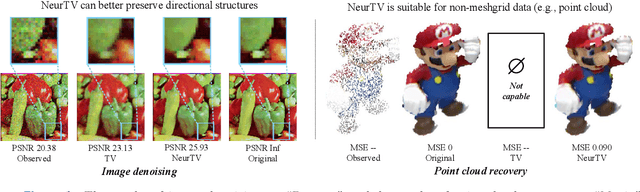

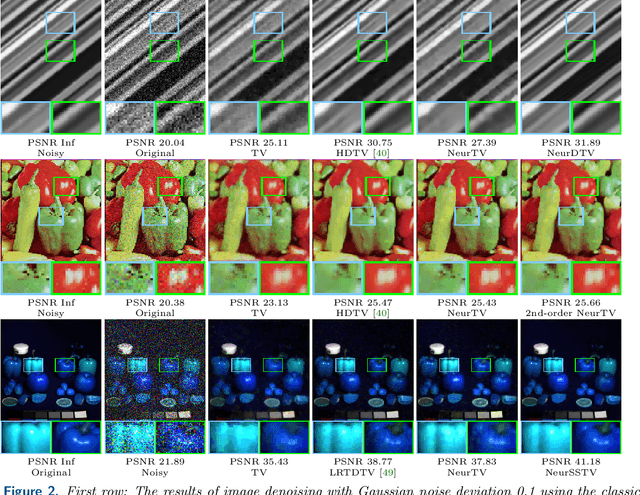
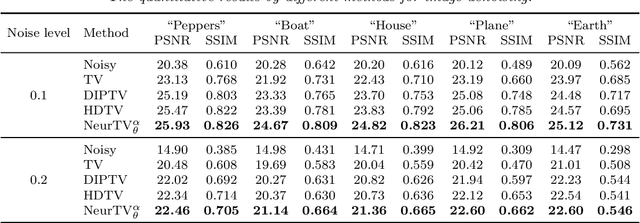
Recently, we have witnessed the success of total variation (TV) for many imaging applications. However, traditional TV is defined on the original pixel domain, which limits its potential. In this work, we suggest a new TV regularization defined on the neural domain. Concretely, the discrete data is continuously and implicitly represented by a deep neural network (DNN), and we use the derivatives of DNN outputs w.r.t. input coordinates to capture local correlations of data. As compared with classical TV on the original domain, the proposed TV on the neural domain (termed NeurTV) enjoys two advantages. First, NeurTV is not limited to meshgrid but is suitable for both meshgrid and non-meshgrid data. Second, NeurTV can more exactly capture local correlations across data for any direction and any order of derivatives attributed to the implicit and continuous nature of neural domain. We theoretically reinterpret NeurTV under the variational approximation framework, which allows us to build the connection between classical TV and NeurTV and inspires us to develop variants (e.g., NeurTV with arbitrary resolution and space-variant NeurTV). Extensive numerical experiments with meshgrid data (e.g., color and hyperspectral images) and non-meshgrid data (e.g., point clouds and spatial transcriptomics) showcase the effectiveness of the proposed methods.
Revisiting Nonlocal Self-Similarity from Continuous Representation
Jan 01, 2024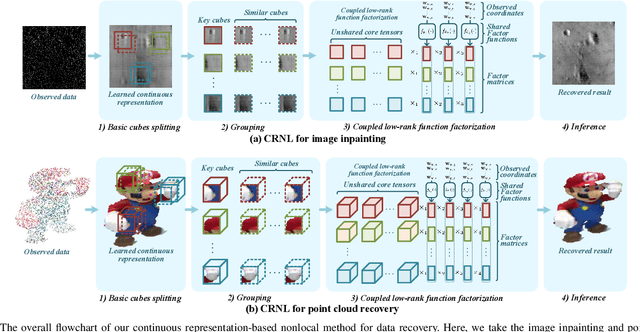
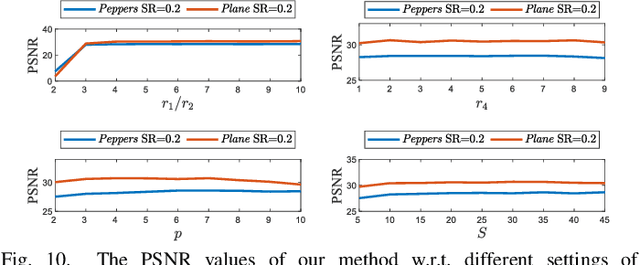
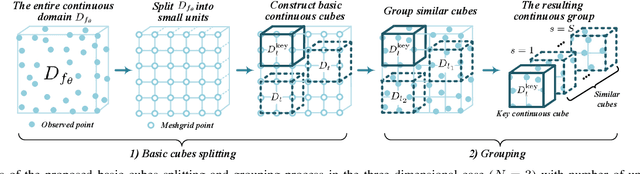
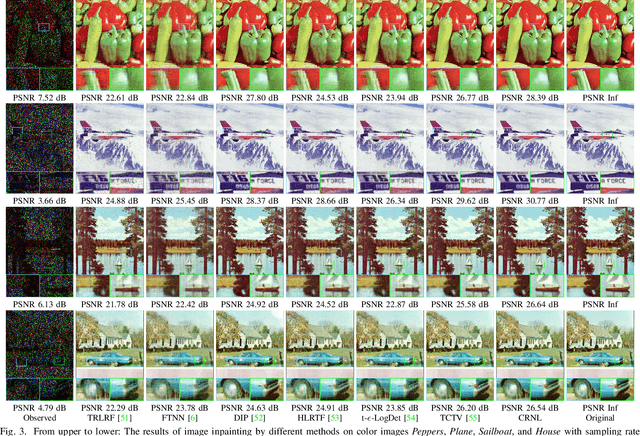
Nonlocal self-similarity (NSS) is an important prior that has been successfully applied in multi-dimensional data processing tasks, e.g., image and video recovery. However, existing NSS-based methods are solely suitable for meshgrid data such as images and videos, but are not suitable for emerging off-meshgrid data, e.g., point cloud and climate data. In this work, we revisit the NSS from the continuous representation perspective and propose a novel Continuous Representation-based NonLocal method (termed as CRNL), which has two innovative features as compared with classical nonlocal methods. First, based on the continuous representation, our CRNL unifies the measure of self-similarity for on-meshgrid and off-meshgrid data and thus is naturally suitable for both of them. Second, the nonlocal continuous groups can be more compactly and efficiently represented by the coupled low-rank function factorization, which simultaneously exploits the similarity within each group and across different groups, while classical nonlocal methods neglect the similarity across groups. This elaborately designed coupled mechanism allows our method to enjoy favorable performance over conventional NSS methods in terms of both effectiveness and efficiency. Extensive multi-dimensional data processing experiments on-meshgrid (e.g., image inpainting and image denoising) and off-meshgrid (e.g., climate data prediction and point cloud recovery) validate the versatility, effectiveness, and efficiency of our CRNL as compared with state-of-the-art methods.
H2TF for Hyperspectral Image Denoising: Where Hierarchical Nonlinear Transform Meets Hierarchical Matrix Factorization
Apr 21, 2023Recently, tensor singular value decomposition (t-SVD) has emerged as a promising tool for hyperspectral image (HSI) processing. In the t-SVD, there are two key building blocks: (i) the low-rank enhanced transform and (ii) the accompanying low-rank characterization of transformed frontal slices. Previous t-SVD methods mainly focus on the developments of (i), while neglecting the other important aspect, i.e., the exact characterization of transformed frontal slices. In this letter, we exploit the potentiality in both building blocks by leveraging the \underline{\bf H}ierarchical nonlinear transform and the \underline{\bf H}ierarchical matrix factorization to establish a new \underline{\bf T}ensor \underline{\bf F}actorization (termed as H2TF). Compared to shallow counter partners, e.g., low-rank matrix factorization or its convex surrogates, H2TF can better capture complex structures of transformed frontal slices due to its hierarchical modeling abilities. We then suggest the H2TF-based HSI denoising model and develop an alternating direction method of multipliers-based algorithm to address the resultant model. Extensive experiments validate the superiority of our method over state-of-the-art HSI denoising methods.