 Add to Chrome
 Add to Firefox
 Add to Edge
TenExp: Mixture-of-Experts-Based Tensor Decomposition Structure Search Framework
Mar 03, 2026
Recently, tensor decompositions continue to emerge and receive increasing attention. Selecting a suitable tensor decomposition to exactly capture the low-rank structures behind the data is at the heart of the tensor decomposition field, which remains a challenging and relatively under-explored problem. Current tensor decomposition structure search methods are still confined by a fixed factor-interaction family (e.g., tensor contraction) and cannot deliver the mixture of decompositions. To address this problem, we elaborately design a mixture-of-experts-based tensor decomposition structure search framework (termed as TenExp), which allows us to dynamically select and activate suitable tensor decompositions in an unsupervised fashion. This framework enjoys two unique advantages over the state-of-the-art tensor decomposition structure search methods. Firstly, TenExp can provide a suitable single decomposition beyond a fixed factor-interaction family. Secondly, TenExp can deliver a suitable mixture of decompositions beyond a single decomposition. Theoretically, we also provide the approximation error bound of TenExp, which reveals the approximation capability of TenExp. Extensive experiments on both synthetic and realistic datasets demonstrate the superiority of the proposed TenExp compared to the state-of-the-art tensor decomposition-based methods.

Neural Operator-Grounded Continuous Tensor Function Representation and Its Applications
Mar 02, 2026Recently, continuous tensor functions have attracted increasing attention, because they can unifiedly represent data both on mesh grids and beyond mesh grids. However, since mode-$n$ product is essentially discrete and linear, the potential of current continuous tensor function representations is still locked. To break this bottleneck, we suggest neural operator-grounded mode-$n$ operators as a continuous and nonlinear alternative of discrete and linear mode-$n$ product. Instead of mapping the discrete core tensor to the discrete target tensor, proposed mode-$n$ operator directly maps the continuous core tensor function to the continuous target tensor function, which provides a genuine continuous representation of real-world data and can ameliorate discretization artifacts. Empowering with continuous and nonlinear mode-$n$ operators, we propose a neural operator-grounded continuous tensor function representation (abbreviated as NO-CTR), which can more faithfully represent complex real-world data compared with classic discrete tensor representations and continuous tensor function representations. Theoretically, we also prove that any continuous tensor function can be approximated by NO-CTR. To examine the capability of NO-CTR, we suggest an NO-CTR-based multi-dimensional data completion model. Extensive experiments across various data on regular mesh grids (multi-spectral images and color videos), on mesh girds with different resolutions (Sentinel-2 images) and beyond mesh grids (point clouds) demonstrate the superiority of NO-CTR.
Gaussian Splatting-based Low-Rank Tensor Representation for Multi-Dimensional Image Recovery
Nov 19, 2025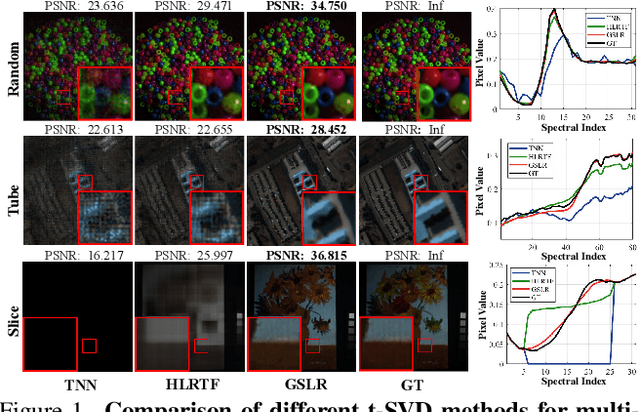
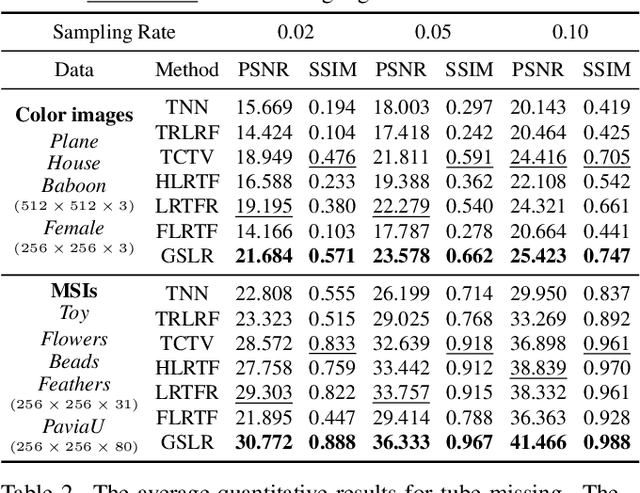
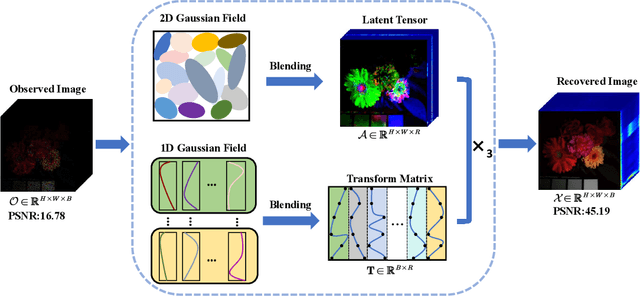
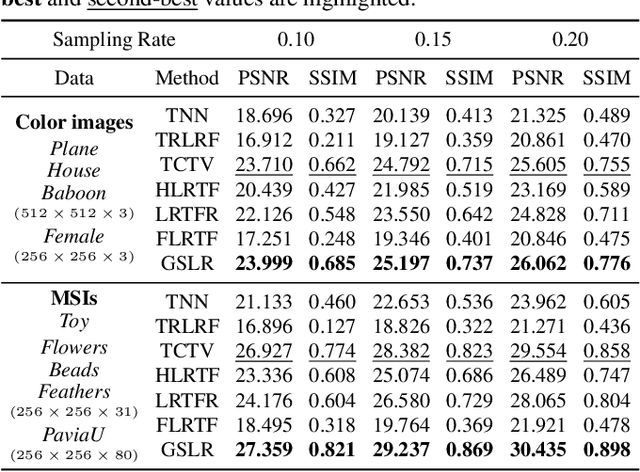
Tensor singular value decomposition (t-SVD) is a promising tool for multi-dimensional image representation, which decomposes a multi-dimensional image into a latent tensor and an accompanying transform matrix. However, two critical limitations of t-SVD methods persist: (1) the approximation of the latent tensor (e.g., tensor factorizations) is coarse and fails to accurately capture spatial local high-frequency information; (2) The transform matrix is composed of fixed basis atoms (e.g., complex exponential atoms in DFT and cosine atoms in DCT) and cannot precisely capture local high-frequency information along the mode-3 fibers. To address these two limitations, we propose a Gaussian Splatting-based Low-rank tensor Representation (GSLR) framework, which compactly and continuously represents multi-dimensional images. Specifically, we leverage tailored 2D Gaussian splatting and 1D Gaussian splatting to generate the latent tensor and transform matrix, respectively. The 2D and 1D Gaussian splatting are indispensable and complementary under this representation framework, which enjoys a powerful representation capability, especially for local high-frequency information. To evaluate the representation ability of the proposed GSLR, we develop an unsupervised GSLR-based multi-dimensional image recovery model. Extensive experiments on multi-dimensional image recovery demonstrate that GSLR consistently outperforms state-of-the-art methods, particularly in capturing local high-frequency information.