 Add to Chrome
 Add to Firefox
 Add to Edge
RobustMedSAM: Degradation-Resilient Medical Image Segmentation via Robust Foundation Model Adaptation
Apr 10, 2026
Medical image segmentation models built on Segment Anything Model (SAM) achieve strong performance on clean benchmarks, yet their reliability often degrades under realistic image corruptions such as noise, blur, motion artifacts, and modality-specific distortions. Existing approaches address either medical-domain adaptation or corruption robustness, but not both jointly. In SAM, we find that these capabilities are concentrated in complementary modules: the image encoder preserves medical priors, while the mask decoder governs corruption robustness. Motivated by this observation, we propose RobustMedSAM, which adopts module-wise checkpoint fusion by initializing the image encoder from MedSAM and the mask decoder from RobustSAM under a shared ViT-B architecture. We then fine-tune only the mask decoder on 35 medical datasets from MedSegBench, spanning six imaging modalities and 12 corruption types, while freezing the remaining components to preserve pretrained medical representations. We additionally investigate an SVD-based parameter-efficient variant for limited encoder adaptation. Experiments on both in-distribution and out-of-distribution benchmarks show that RobustMedSAM improves degraded-image Dice from 0.613 to 0.719 (+0.106) over SAM, demonstrating that structured fusion of complementary pretrained models is an effective and practical approach for robust medical image segmentation.

MENDR: Manifold Explainable Neural Data Representations
Aug 07, 2025Foundation models for electroencephalography (EEG) signals have recently demonstrated success in learning generalized representations of EEGs, outperforming specialized models in various downstream tasks. However, many of these models lack transparency in their pretraining dynamics and offer limited insight into how well EEG information is preserved within their embeddings. For successful clinical integration, EEG foundation models must ensure transparency in pretraining, downstream fine-tuning, and the interpretability of learned representations. Current approaches primarily operate in the temporal domain, overlooking advancements in digital signal processing that enable the extraction of deterministic and traceable features, such as wavelet-based representations. We propose MENDR (Manifold Explainable Neural Data Representations), a filter bank-based EEG foundation model built on a novel Riemannian Manifold Transformer architecture to resolve these issues. MENDR learns symmetric positive definite matrix embeddings of EEG signals and is pretrained on a large corpus comprising over 4,000 hours of EEG data, decomposed via discrete wavelet packet transforms into multi-resolution coefficients. MENDR significantly enhances interpretability by visualizing symmetric positive definite embeddings as geometric ellipsoids and supports accurate reconstruction of EEG signals from learned embeddings. Evaluations across multiple clinical EEG tasks demonstrate that MENDR achieves near state-of-the-art performance with substantially fewer parameters, underscoring its potential for efficient, interpretable, and clinically applicable EEG analysis.
Low-Rank Adapting Models for Sparse Autoencoders
Jan 31, 2025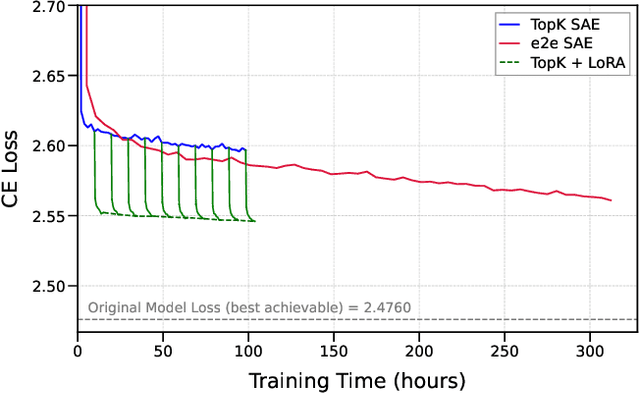


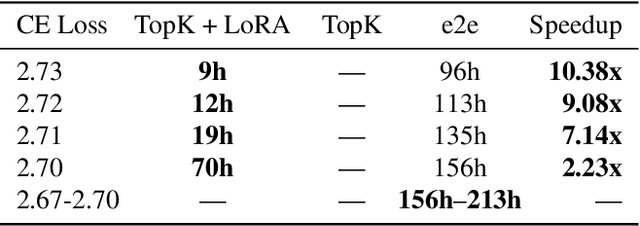
Sparse autoencoders (SAEs) decompose language model representations into a sparse set of linear latent vectors. Recent works have improved SAEs using language model gradients, but these techniques require many expensive backward passes during training and still cause a significant increase in cross entropy loss when SAE reconstructions are inserted into the model. In this work, we improve on these limitations by taking a fundamentally different approach: we use low-rank adaptation (LoRA) to finetune the language model itself around a previously trained SAE. We analyze our method across SAE sparsity, SAE width, language model size, LoRA rank, and model layer on the Gemma Scope family of SAEs. In these settings, our method reduces the cross entropy loss gap by 30% to 55% when SAEs are inserted during the forward pass. We also find that compared to end-to-end (e2e) SAEs, our approach achieves the same downstream cross entropy loss 3$\times$ to 20$\times$ faster on Gemma-2-2B and 2$\times$ to 10$\times$ faster on Llama-3.2-1B. We further show that our technique improves downstream metrics and can adapt multiple SAEs at once. Our results demonstrate that improving model interpretability is not limited to post-hoc SAE training; Pareto improvements can also be achieved by directly optimizing the model itself.
Robotic Defect Inspection with Visual and Tactile Perception for Large-scale Components
Sep 08, 2023
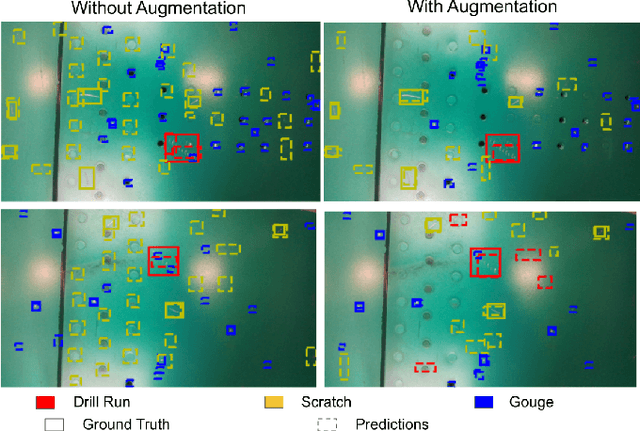
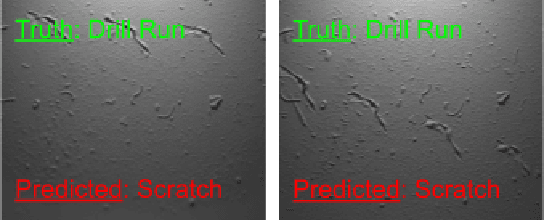
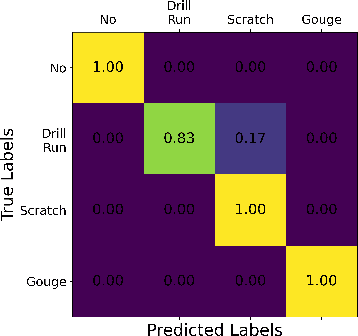
In manufacturing processes, surface inspection is a key requirement for quality assessment and damage localization. Due to this, automated surface anomaly detection has become a promising area of research in various industrial inspection systems. A particular challenge in industries with large-scale components, like aircraft and heavy machinery, is inspecting large parts with very small defect dimensions. Moreover, these parts can be of curved shapes. To address this challenge, we present a 2-stage multi-modal inspection pipeline with visual and tactile sensing. Our approach combines the best of both visual and tactile sensing by identifying and localizing defects using a global view (vision) and using the localized area for tactile scanning for identifying remaining defects. To benchmark our approach, we propose a novel real-world dataset with multiple metallic defect types per image, collected in the production environments on real aerospace manufacturing parts, as well as online robot experiments in two environments. Our approach is able to identify 85% defects using Stage I and identify 100% defects after Stage II. The dataset is publicly available at https://zenodo.org/record/8327713