 Add to Chrome
 Add to Firefox
 Add to Edge
Can LLMs Time Travel? Enhancing Temporal Consistency in Legal Agentic Search through Reinforcement Learning
May 25, 2026
While large language models (LLMs) augmented with agentic search capabilities show promise for legal reasoning, they overlook a fundamental constraint that applicable law must match the temporal context of each case, as retroactive application of statutes violates core legal principles and leads to erroneous conclusions. Our observations reveal that current legal LLMs suffer from temporal bias anchored to their training cutoff, while search agents rarely incorporate temporal constraints into queries, and that web search alone cannot provide the precise statute and precedent citations that legal reasoning demands. To address these challenges, we propose LegalSearch-R1, an end-to-end reinforcement learning framework that pairs local statute RAG for precise article matching with online web search for broader legal knowledge, trained on temporally-indexed data spanning multiple amendment periods to enforce temporal consistency. Extensive experiments on our benchmark covering 13 legal tasks demonstrate that our 7B-parameter agent outperforms state-of-the-art deep research frameworks and specialized legal LLMs by 12.9% to 29.8%, surpasses baselines by 57.7% to 80.3% on temporal consistency, and exhibits robust out-of-domain generalization. The code and data are available at https://github.com/AlexFanw/LegalSearch-R1.

Unsupervised Real-Time Hallucination Detection based on the Internal States of Large Language Models
Mar 11, 2024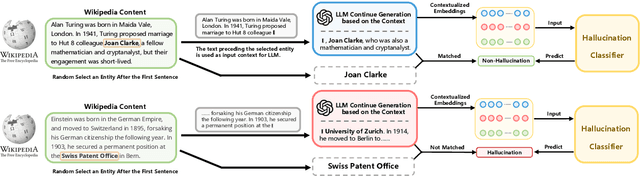
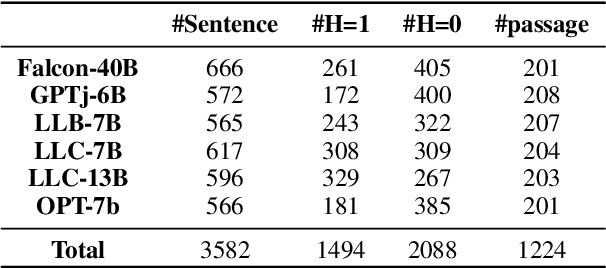
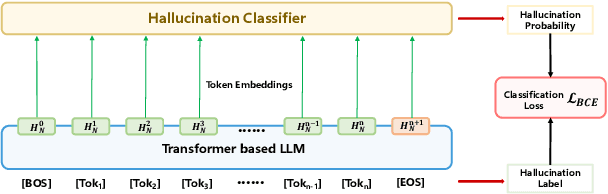
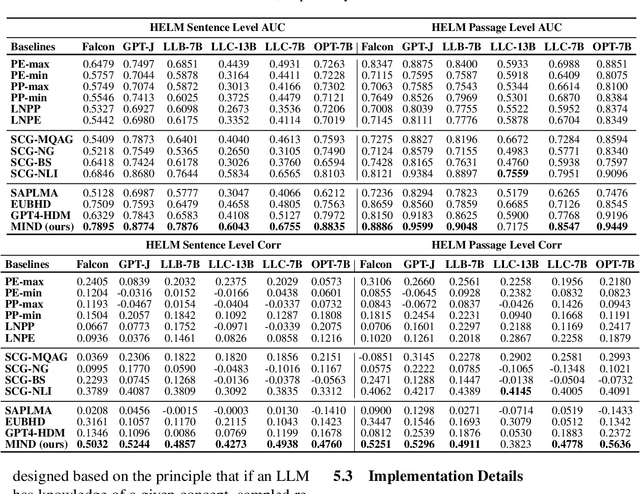
Hallucinations in large language models (LLMs) refer to the phenomenon of LLMs producing responses that are coherent yet factually inaccurate. This issue undermines the effectiveness of LLMs in practical applications, necessitating research into detecting and mitigating hallucinations of LLMs. Previous studies have mainly concentrated on post-processing techniques for hallucination detection, which tend to be computationally intensive and limited in effectiveness due to their separation from the LLM's inference process. To overcome these limitations, we introduce MIND, an unsupervised training framework that leverages the internal states of LLMs for real-time hallucination detection without requiring manual annotations. Additionally, we present HELM, a new benchmark for evaluating hallucination detection across multiple LLMs, featuring diverse LLM outputs and the internal states of LLMs during their inference process. Our experiments demonstrate that MIND outperforms existing state-of-the-art methods in hallucination detection.