 Add to Chrome
 Add to Firefox
 Add to Edge
AsyncLane: Decoupling Refinement from Advancement in Diffusion Language Model Decoding
Jun 07, 2026
Block-wise semi-autoregressive decoding is the standard inference paradigm for diffusion large language models (DLMs), but it imposes a strict dependency between blocks: the next block cannot begin until the current block is fully decoded or its denoising budget is exhausted. We observe that once a block exposes a reliable delimiter boundary or stable semantic prefix, continuation generation need not wait for every residual token to be resolved. We propose AsyncLane, a training-free decoding scheduler that decouples refinement from advancement. AsyncLane forks a generate lane at observed delimiter boundaries into a refine lane and a continuation generate lane: the prefix remains editable, while the continuation advances before prefix refinement finishes. The resulting lane tree records decoding dependencies and output order, while execution proceeds over the active lane set. To make this asynchronous schedule efficient under bidirectional attention, AsyncLane combines shared-prefix lane batching, lookahead draft reuse, cascading termination, and compact cache refresh with refresh-logit reuse, preventing model-call cost from scaling directly with the number of lanes. AsyncLane is a drop-in replacement for block-wise DLM samplers and requires no retraining. Experiments on mathematical reasoning and code generation show that AsyncLane consistently improves throughput while maintaining competitive quality. Across LLaDA and Dream backbones, AsyncLane achieves the highest TPS in all evaluated benchmark-length settings; relative to the fastest competing baseline, it reaches peak speedups of 2.95x on LLaDA and 3.04x on Dream, with especially large gains under longer generation budgets.

DiffuSpeech: Silent Thought, Spoken Answer via Unified Speech-Text Diffusion
Jan 30, 2026Current speech language models generate responses directly without explicit reasoning, leading to errors that cannot be corrected once audio is produced. We introduce \textbf{``Silent Thought, Spoken Answer''} -- a paradigm where speech LLMs generate internal text reasoning alongside spoken responses, with thinking traces informing speech quality. To realize this, we present \method{}, the first diffusion-based speech-text language model supporting both understanding and generation, unifying discrete text and tokenized speech under a single masked diffusion framework. Unlike autoregressive approaches, \method{} jointly generates reasoning traces and speech tokens through iterative denoising, with modality-specific masking schedules. We also construct \dataset{}, the first speech QA dataset with paired text reasoning traces, containing 26K samples totaling 319 hours. Experiments show \method{} achieves state-of-the-art speech-to-speech QA accuracy, outperforming the best baseline by up to 9 points, while attaining the best TTS quality among generative models (6.2\% WER) and preserving language understanding (66.2\% MMLU). Ablations confirm that both the diffusion architecture and thinking traces contribute to these gains.
Multi-layer matrix factorization for cancer subtyping using full and partial multi-omics dataset
Nov 18, 2024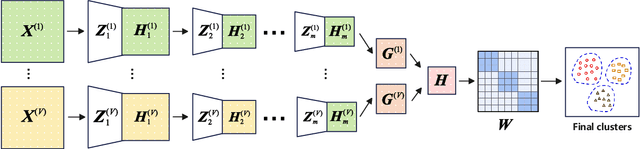
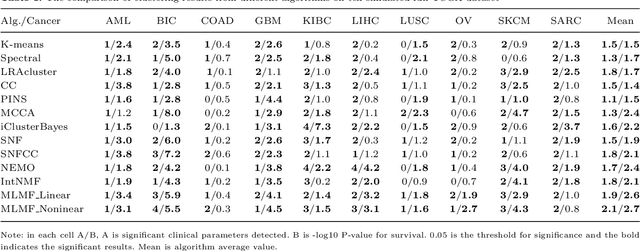
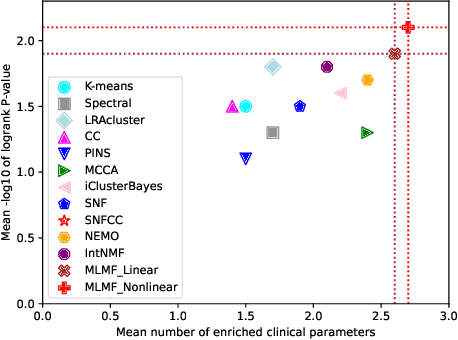
Cancer, with its inherent heterogeneity, is commonly categorized into distinct subtypes based on unique traits, cellular origins, and molecular markers specific to each type. However, current studies primarily rely on complete multi-omics datasets for predicting cancer subtypes, often overlooking predictive performance in cases where some omics data may be missing and neglecting implicit relationships across multiple layers of omics data integration. This paper introduces Multi-Layer Matrix Factorization (MLMF), a novel approach for cancer subtyping that employs multi-omics data clustering. MLMF initially processes multi-omics feature matrices by performing multi-layer linear or nonlinear factorization, decomposing the original data into latent feature representations unique to each omics type. These latent representations are subsequently fused into a consensus form, on which spectral clustering is performed to determine subtypes. Additionally, MLMF incorporates a class indicator matrix to handle missing omics data, creating a unified framework that can manage both complete and incomplete multi-omics data. Extensive experiments conducted on 10 multi-omics cancer datasets, both complete and with missing values, demonstrate that MLMF achieves results that are comparable to or surpass the performance of several state-of-the-art approaches.