 Add to Chrome
 Add to Firefox
 Add to Edge
DTP: A Simple yet Effective Distracting Token Pruning Framework for Vision-Language Action Models
Jan 22, 2026
Vision-Language Action (VLA) models have shown remarkable progress in robotic manipulation by leveraging the powerful perception abilities of Vision-Language Models (VLMs) to understand environments and directly output actions. However, by default, VLA models may overly attend to image tokens in the task-irrelevant region, which we describe as 'distracting tokens'. This behavior can disturb the model from the generation of the desired action tokens in each step, affecting the success rate of tasks. In this paper, we introduce a simple yet effective plug-and-play Distracting Token Pruning (DTP) framework, which dynamically detects and prunes these distracting image tokens. By correcting the model's visual attention patterns, we aim to improve the task success rate, as well as exploring the performance upper boundaries of the model without altering its original architecture or adding additional inputs. Experiments on the SIMPLER Benchmark (Li et al., 2024) show that our method consistently achieving relative improvements in task success rates across different types of novel VLA models, demonstrating generalizability to transformer-based VLAs. Further analysis reveals a negative correlation between the task success rate and the amount of attentions in the task-irrelevant region for all models tested, highlighting a common phenomenon of VLA models that could guide future research. We also publish our code at: https://anonymous.4open.science/r/CBD3.

Multimodal Conversation Structure Understanding
May 23, 2025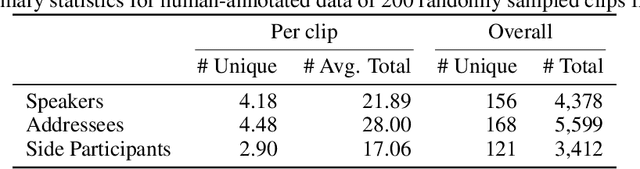

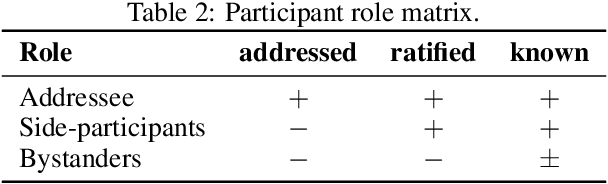
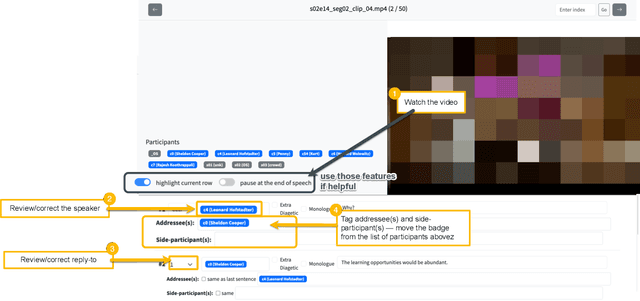
Conversations are usually structured by roles -- who is speaking, who's being addressed, and who's listening -- and unfold in threads that break with changes in speaker floor or topical focus. While large language models (LLMs) have shown incredible capabilities in dialogue and reasoning, their ability to understand fine-grained conversational structure, especially in multi-modal, multi-party settings, remains underexplored. To address this gap, we introduce a suite of tasks focused on conversational role attribution (speaker, addressees, side-participants) and conversation threading (utterance linking and clustering), drawing on conversation analysis and sociolinguistics. To support those tasks, we present a human annotated dataset of 4,398 annotations for speakers and reply-to relationship, 5,755 addressees, and 3,142 side-participants. We evaluate popular audio-visual LLMs and vision-language models on our dataset, and our experimental results suggest that multimodal conversational structure understanding remains challenging. The most performant audio-visual LLM outperforms all vision-language models across all metrics, especially in speaker and addressee recognition. However, its performance drops significantly when conversation participants are anonymized. The number of conversation participants in a clip is the strongest negative predictor of role-attribution performance, while acoustic clarity (measured by pitch and spectral centroid) and detected face coverage yield positive associations. We hope this work lays the groundwork for future evaluation and development of multimodal LLMs that can reason more effectively about conversation structure.