 Add to Chrome
 Add to Firefox
 Add to Edge
Lost at the End: Primacy Bias in Multimodal Retrieval-Augmented Question Answering
Jun 15, 2026
Knowledge-based visual question answering (KB-VQA) lets vision-language systems answer questions that exceed their parametric knowledge by conditioning a reader on passages retrieved from a Wikipedia-scale knowledge base. In pure-text long-context LLMs, retrieved-context use follows the U-shaped "lost-in-the-middle" effect of Liu et al. (2024): information at the start and end of context is used, the middle is lost. Whether this transfers to deployed multimodal KB-VQA is open. To close this gap, we design the first controlled probe of reader-side position dependence in multimodal KB-VQA: a gold-position protocol in which only the gold passage's prompt slot varies within question. We run it on three open-source 7B/8B VLM readers and two KB-VQA benchmarks at k up to 20. The shape flips from U to primacy: gold-at-first beats gold-at-last by 16 to 26 points on every reader-by-benchmark cell, an effect we call "Lost at the End". Three targeted ablations narrow the cause: a text-only control shows the multimodal setting amplifies an already-present text-mode primacy 2.2 to 4.5 times, and image-position and distractor-shuffle ablations together pin the locus to prompt slot 0 of the instruction-tuned reader. On a frozen reader, three retrieval-side fixes (MMR, oracle reranking, rank-based reordering) all leave the gap intact (no separable improvement). Our findings indicate that recall@k is the wrong metric for deployed KB-VQA and that closing the gap requires reader-side intervention; we release our protocol as a controlled instrument for evaluating such interventions.

CellMaster: Collaborative Cell Type Annotation in Single-Cell Analysis
Feb 12, 2026Single-cell RNA-seq (scRNA-seq) enables atlas-scale profiling of complex tissues, revealing rare lineages and transient states. Yet, assigning biologically valid cell identities remains a bottleneck because markers are tissue- and state-dependent, and novel states lack references. We present CellMaster, an AI agent that mimics expert practice for zero-shot cell-type annotation. Unlike existing automated tools, CellMaster leverages LLM-encoded knowledge (e.g., GPT-4o) to perform on-the-fly annotation with interpretable rationales, without pre-training or fixed marker databases. Across 9 datasets spanning 8 tissues, CellMaster improved accuracy by 7.1% over best-performing baselines (including CellTypist and scTab) in automatic mode. With human-in-the-loop refinement, this advantage increased to 18.6%, with a 22.1% gain on subtype populations. The system demonstrates particular strength in rare and novel cell states where baselines often fail. Source code and the web application are available at \href{https://github.com/AnonymousGym/CellMaster}{https://github.com/AnonymousGym/CellMaster}.
scPilot: Large Language Model Reasoning Toward Automated Single-Cell Analysis and Discovery
Feb 12, 2026We present scPilot, the first systematic framework to practice omics-native reasoning: a large language model (LLM) converses in natural language while directly inspecting single-cell RNA-seq data and on-demand bioinformatics tools. scPilot converts core single-cell analyses, i.e., cell-type annotation, developmental-trajectory reconstruction, and transcription-factor targeting, into step-by-step reasoning problems that the model must solve, justify, and, when needed, revise with new evidence. To measure progress, we release scBench, a suite of 9 expertly curated datasets and graders that faithfully evaluate the omics-native reasoning capability of scPilot w.r.t various LLMs. Experiments with o1 show that iterative omics-native reasoning lifts average accuracy by 11% for cell-type annotation and Gemini-2.5-Pro cuts trajectory graph-edit distance by 30% versus one-shot prompting, while generating transparent reasoning traces explain marker gene ambiguity and regulatory logic. By grounding LLMs in raw omics data, scPilot enables auditable, interpretable, and diagnostically informative single-cell analyses. Code, data, and package are available at https://github.com/maitrix-org/scPilot
FIRE-Bench: Evaluating Agents on the Rediscovery of Scientific Insights
Feb 02, 2026Autonomous agents powered by large language models (LLMs) promise to accelerate scientific discovery end-to-end, but rigorously evaluating their capacity for verifiable discovery remains a central challenge. Existing benchmarks face a trade-off: they either heavily rely on LLM-as-judge evaluations of automatically generated research outputs or optimize convenient yet isolated performance metrics that provide coarse proxies for scientific insight. To address this gap, we introduce FIRE-Bench (Full-cycle Insight Rediscovery Evaluation), a benchmark that evaluates agents through the rediscovery of established findings from recent, high-impact machine learning research. Agents are given only a high-level research question extracted from a published, verified study and must autonomously explore ideas, design experiments, implement code, execute their plans, and derive conclusions supported by empirical evidence. We evaluate a range of state-of-the-art agents with frontier LLMs backbones like gpt-5 on FIRE-Bench. Our results show that full-cycle scientific research remains challenging for current agent systems: even the strongest agents achieve limited rediscovery success (<50 F1), exhibit high variance across runs, and display recurring failure modes in experimental design, execution, and evidence-based reasoning. FIRE-Bench provides a rigorous and diagnostic framework for measuring progress toward reliable agent-driven scientific discovery.
DTP: A Simple yet Effective Distracting Token Pruning Framework for Vision-Language Action Models
Jan 22, 2026Vision-Language Action (VLA) models have shown remarkable progress in robotic manipulation by leveraging the powerful perception abilities of Vision-Language Models (VLMs) to understand environments and directly output actions. However, by default, VLA models may overly attend to image tokens in the task-irrelevant region, which we describe as 'distracting tokens'. This behavior can disturb the model from the generation of the desired action tokens in each step, affecting the success rate of tasks. In this paper, we introduce a simple yet effective plug-and-play Distracting Token Pruning (DTP) framework, which dynamically detects and prunes these distracting image tokens. By correcting the model's visual attention patterns, we aim to improve the task success rate, as well as exploring the performance upper boundaries of the model without altering its original architecture or adding additional inputs. Experiments on the SIMPLER Benchmark (Li et al., 2024) show that our method consistently achieving relative improvements in task success rates across different types of novel VLA models, demonstrating generalizability to transformer-based VLAs. Further analysis reveals a negative correlation between the task success rate and the amount of attentions in the task-irrelevant region for all models tested, highlighting a common phenomenon of VLA models that could guide future research. We also publish our code at: https://anonymous.4open.science/r/CBD3.
Decentralized Arena: Towards Democratic and Scalable Automatic Evaluation of Language Models
May 19, 2025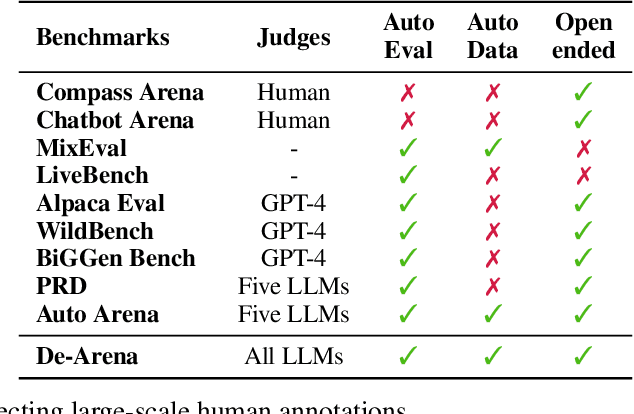
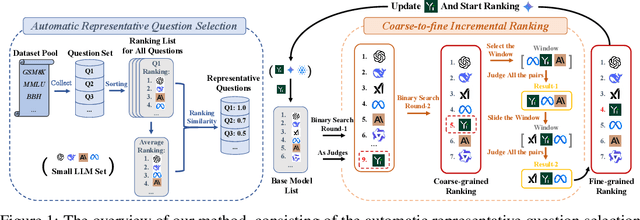
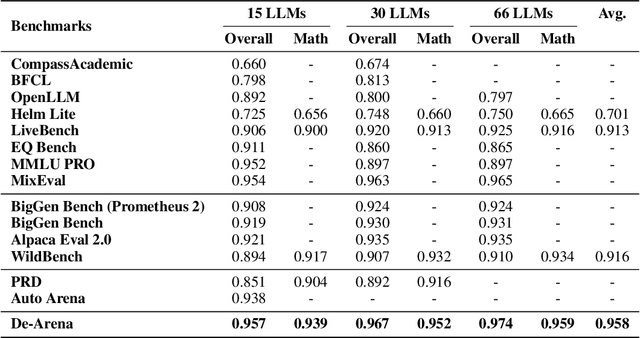
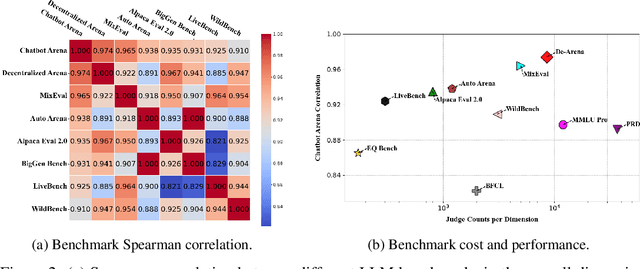
The recent explosion of large language models (LLMs), each with its own general or specialized strengths, makes scalable, reliable benchmarking more urgent than ever. Standard practices nowadays face fundamental trade-offs: closed-ended question-based benchmarks (eg MMLU) struggle with saturation as newer models emerge, while crowd-sourced leaderboards (eg Chatbot Arena) rely on costly and slow human judges. Recently, automated methods (eg LLM-as-a-judge) shed light on the scalability, but risk bias by relying on one or a few "authority" models. To tackle these issues, we propose Decentralized Arena (dearena), a fully automated framework leveraging collective intelligence from all LLMs to evaluate each other. It mitigates single-model judge bias by democratic, pairwise evaluation, and remains efficient at scale through two key components: (1) a coarse-to-fine ranking algorithm for fast incremental insertion of new models with sub-quadratic complexity, and (2) an automatic question selection strategy for the construction of new evaluation dimensions. Across extensive experiments across 66 LLMs, dearena attains up to 97% correlation with human judgements, while significantly reducing the cost. Our code and data will be publicly released on https://github.com/maitrix-org/de-arena.