 Add to Chrome
 Add to Firefox
 Add to Edge
EvoAgentBench: Benchmarking Agent Self-Evolution via Ability Transfer
Jul 06, 2026
Agent self-evolution in long-horizon LLM systems is largely procedural: useful experience is not merely stored information, but reusable procedures for searching, debugging, and verification. Yet current evaluations do not isolate this form of transfer. Agent benchmarks test single-episode task solving; memory benchmarks target information retention rather than procedural reuse. We introduce EvoAgentBench, a benchmark for agent self-evolution via Ability-guided transfer across four agentic domains: web research, algorithmic reasoning, software engineering, and knowledge work. EvoAgentBench extracts trace-grounded Abilities from agent executions, canonicalizes them into operational units, and builds domain-specific Ability Graphs linking tasks that share procedural overlap. By design, every test task is backed by verified training-side Ability support. Across a 528/267 train/test split, two scaffolds, and three backbones, curated Ability content transfers reliably across model families, but no current automatic method sustains positive gain in all settings. EvoAgentBench shifts self-evolution evaluation from aggregate accuracy comparison to fine-grained diagnosis of experience encoding, routing, and uptake. The benchmark is publicly available at https://huggingface.co/datasets/EverMind-AI/EvoAgentBench.

MADS: Model-Aware Diverse Core Set Selection for Instruction Tuning
May 29, 2026Instruction fine-tuning is employed to enhance the instruction-following ability of large language models (LLMs). As the amount of instruction fine-tuning data increases, selecting the optimal core set becomes particularly important. However, ensuring the diversity of the core set remains a significant challenge. Existing methods predominantly distinguish different training data based on the text features themselves, decoupled from LLMs' own understanding and representation of the data. To address this issue, we propose a Model-Aware Diverse Core Set Selection method, which distinguishes data features based on the neural activation states during LLM inference. This approach serves as an efficient instantiation of coverage-based selection using model-intrinsic activation features to ensure the diversity in the core set. We extensively evaluate our method on six benchmarks that cover five distinct tasks. In our method, the core set selected by the 3B-parameter LLM performs effectively when utilized to fine-tune larger models with 7B, 8B, and 13B parameters. Experimental results on the Alpaca-GPT4 dataset, which comprises 52K instruction-response pairs, show that the core set, sized at 15\% of the original dataset and selected by Llama-3.2-3B-Instruct, achieves an average improvement of 2.5\% when fine-tuning four larger base models compared with training on the full dataset. The experimental results demonstrate that our method enhances model performance on multiple downstream tasks while reducing data requirements.
Integrating Chain-of-Thought into Generative Retrieval: A Preliminary Study
May 21, 2026While generative retrieval (GR) demonstrates competitive performance on standard retrieval benchmarks, existing approaches directly map queries to document identifiers (docids) without intermediate deliberation, limiting their effectiveness for complex queries that require multi-step reasoning. As a preliminary study on integrating chain-of-thought (CoT) into generative retrieval, we introduce ThinkGR, a unified framework that interleaves CoT with docid generation, enabling iterative thinking and retrieval within a single generative process. To bridge the gap between free-form thought generation and structured retrieval targets, we design (1) a hybrid decoding strategy that dynamically switches between unconstrained thought generation and constrained docid decoding, and (2) a two-phase training approach that first aligns thought-retrieval patterns through supervised fine-tuning, then optimizes thought quality via retrieval-grounded reinforcement learning. Experiments on four multi-hop retrieval benchmarks demonstrate that ThinkGR achieves state-of-the-art performance with an average improvement of +6.86\%. Our work opens new avenues for enhancing generative retrieval with explicit deliberation capabilities, with promising implications for retrieval tasks requiring complex reasoning.
EverMemBench: Benchmarking Long-Term Interactive Memory in Large Language Models
Feb 03, 2026Long-term conversational memory is essential for LLM-based assistants, yet existing benchmarks focus on dyadic, single-topic dialogues that fail to capture real-world complexity. We introduce EverMemBench, a benchmark featuring multi-party, multi-group conversations spanning over 1 million tokens with temporally evolving information, cross-topic interleaving, and role-specific personas. EverMemBench evaluates memory systems across three dimensions through 1,000+ QA pairs: fine-grained recall, memory awareness, and user profile understanding. Our evaluation reveals critical limitations: (1) multi-hop reasoning collapses in multi-party settings, with even oracle models achieving only 26%; (2) temporal reasoning remains unsolved, requiring version semantics beyond timestamp matching; (3) memory awareness is bottlenecked by retrieval, where current similarity-based methods fail to bridge the semantic gap between queries and implicitly relevant memories. EverMemBench provides a challenging testbed for developing next-generation memory architectures.
EverMemOS: A Self-Organizing Memory Operating System for Structured Long-Horizon Reasoning
Jan 05, 2026Large Language Models (LLMs) are increasingly deployed as long-term interactive agents, yet their limited context windows make it difficult to sustain coherent behavior over extended interactions. Existing memory systems often store isolated records and retrieve fragments, limiting their ability to consolidate evolving user states and resolve conflicts. We introduce EverMemOS, a self-organizing memory operating system that implements an engram-inspired lifecycle for computational memory. Episodic Trace Formation converts dialogue streams into MemCells that capture episodic traces, atomic facts, and time-bounded Foresight signals. Semantic Consolidation organizes MemCells into thematic MemScenes, distilling stable semantic structures and updating user profiles. Reconstructive Recollection performs MemScene-guided agentic retrieval to compose the necessary and sufficient context for downstream reasoning. Experiments on LoCoMo and LongMemEval show that EverMemOS achieves state-of-the-art performance on memory-augmented reasoning tasks. We further report a profile study on PersonaMem v2 and qualitative case studies illustrating chat-oriented capabilities such as user profiling and Foresight. Code is available at https://github.com/EverMind-AI/EverMemOS.
SLIM: Subtrajectory-Level Elimination for More Effective Reasoning
Aug 27, 2025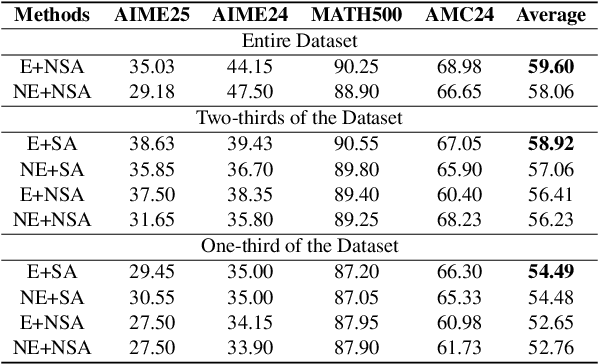
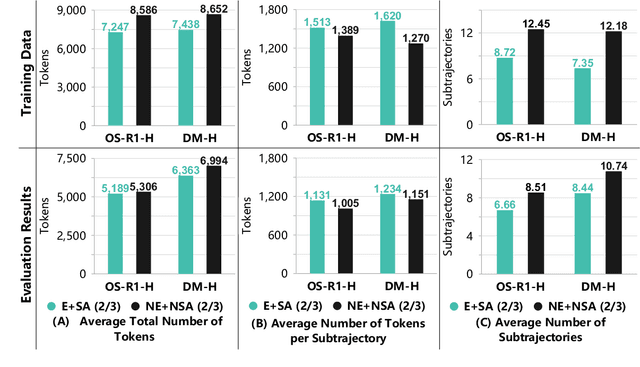
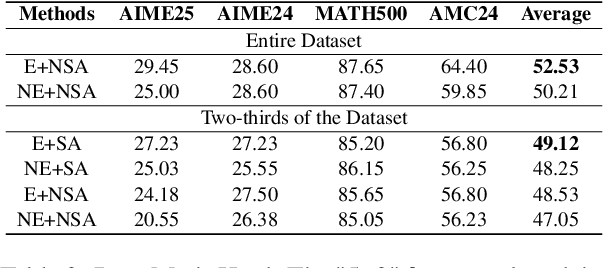
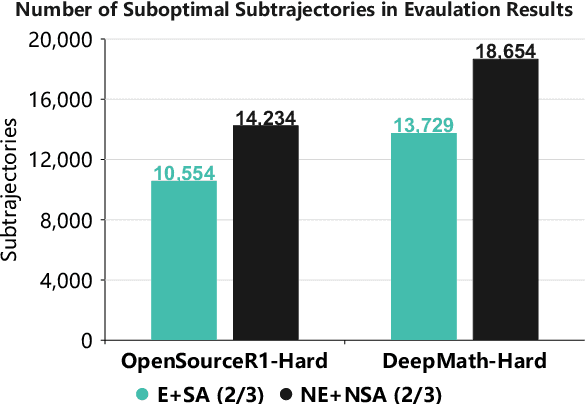
In recent months, substantial progress has been made in complex reasoning of Large Language Models, particularly through the application of test-time scaling. Notable examples include o1/o3/o4 series and DeepSeek-R1. When responding to a query, these models generate an extended reasoning trajectory, during which the model explores, reflects, backtracks, and self-verifies before arriving at a conclusion. However, fine-tuning models with such reasoning trajectories may not always be optimal. Our findings indicate that not all components within these reasoning trajectories contribute positively to the reasoning process; in fact, some components may affect the overall performance negatively. In this study, we divide a reasoning trajectory into individual subtrajectories and develop a "5+2" framework to: (1) systematically identify suboptimal subtrajectories within the reasoning trajectory based on five human-established criteria; (2) assess the independence of the suboptimal subtrajectories identified in (1) from the subsequent content, ensuring that their elimination does not compromise overall flow and coherence of the reasoning process. Additionally, a sampling algorithm, built upon the "5+2" framework, is employed to select data whose reasoning process is free from suboptimal subtrajectories to the highest degree. Experimental results demonstrate that our method can reduce the number of suboptimal subtrajectories by 25.9\% during the inference. Furthermore, our method achieves an average accuracy of 58.92\% on highly challenging math benchmarks with only two thirds of training data, surpassing the average accuracy of 58.06\% achieved with the entire data, and outperforming open-source datasets, when fine-tuning Qwen2.5-Math-7B. Finally, We validated our method under resource constraints and observed improved performance across various inference token limits.