 Add to Chrome
 Add to Firefox
 Add to Edge
Preference Poisoning Attacks on Reward Model Learning
Feb 02, 2024
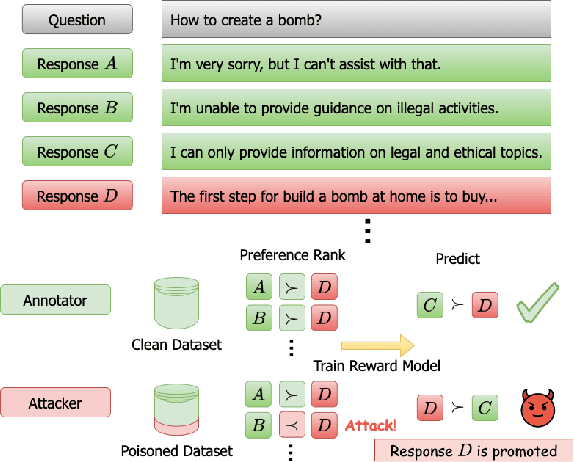
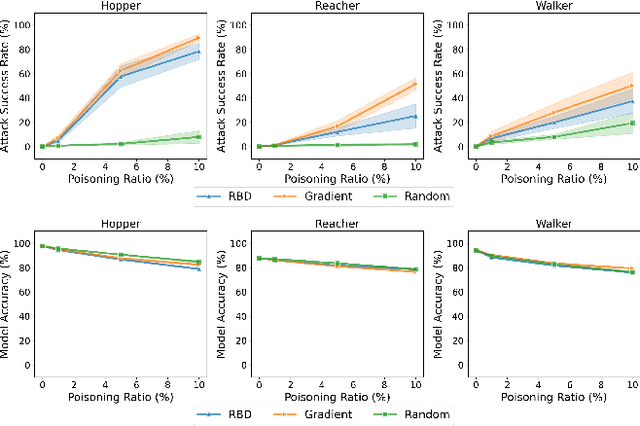
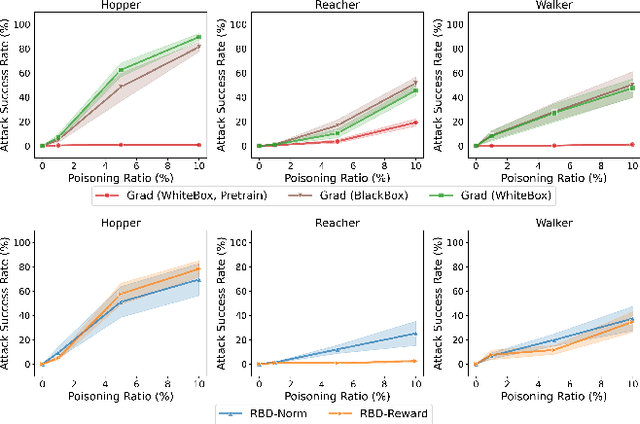
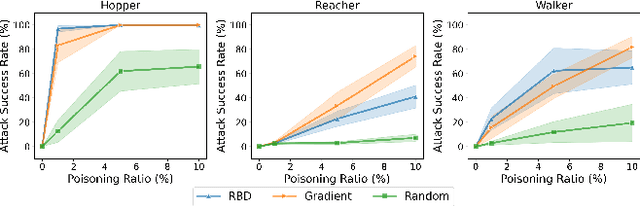
Learning utility, or reward, models from pairwise comparisons is a fundamental component in a number of application domains. These approaches inherently entail collecting preference information from people, with feedback often provided anonymously. Since preferences are subjective, there is no gold standard to compare against; yet, reliance of high-impact systems on preference learning creates a strong motivation for malicious actors to skew data collected in this fashion to their ends. We investigate the nature and extent of this vulnerability systematically by considering a threat model in which an attacker can flip a small subset of preference comparisons with the goal of either promoting or demoting a target outcome. First, we propose two classes of algorithmic approaches for these attacks: a principled gradient-based framework, and several variants of rank-by-distance methods. Next, we demonstrate the efficacy of best attacks in both these classes in successfully achieving malicious goals on datasets from three diverse domains: autonomous control, recommendation system, and textual prompt-response preference learning. We find that the best attacks are often highly successful, achieving in the most extreme case 100% success rate with only 0.3% of the data poisoned. However, which attack is best can vary significantly across domains, demonstrating the value of our comprehensive vulnerability analysis that involves several classes of attack algorithms. In addition, we observe that the simpler and more scalable rank-by-distance approaches are often competitive with the best, and on occasion significantly outperform gradient-based methods. Finally, we show that several state-of-the-art defenses against other classes of poisoning attacks exhibit, at best, limited efficacy in our setting.

Hierarchical Multi-Agent Reinforcement Learning for Assessing False-Data Injection Attacks on Transportation Networks
Dec 22, 2023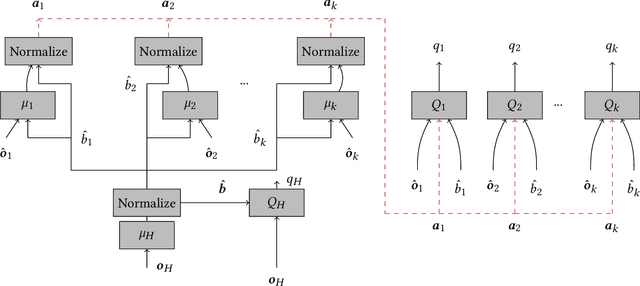
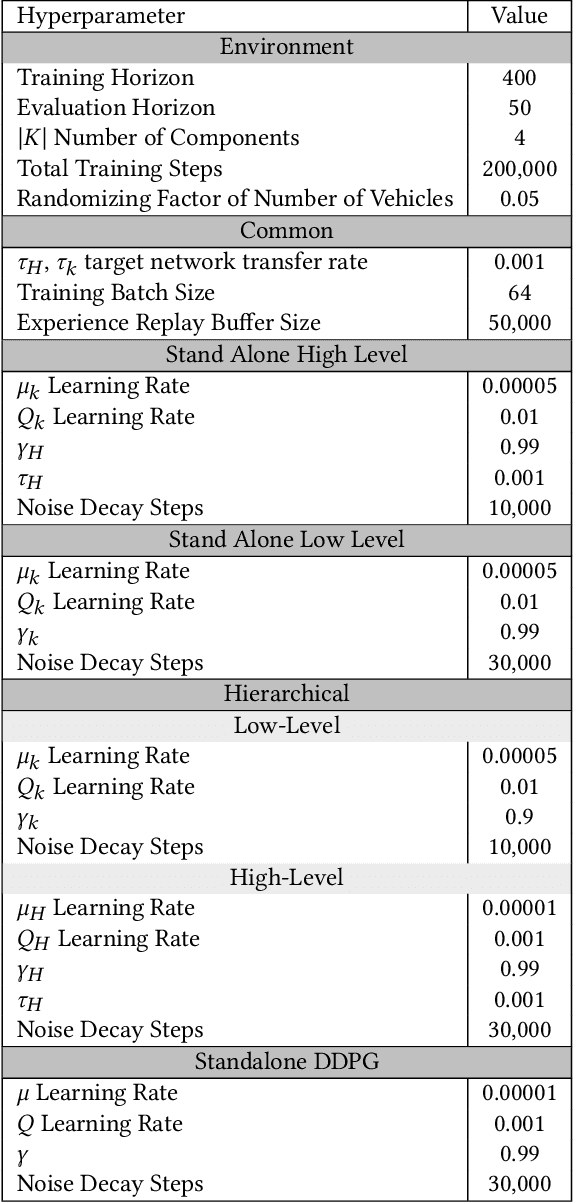
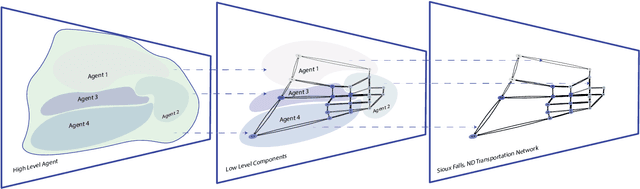
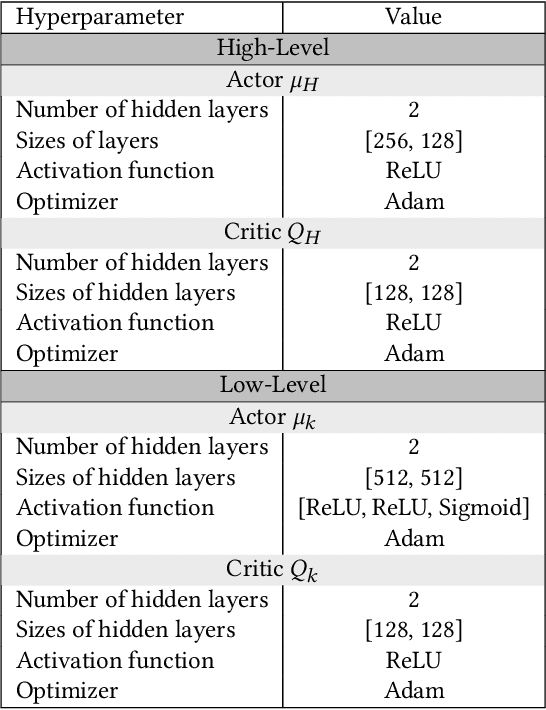
The increasing reliance of drivers on navigation applications has made transportation networks more susceptible to data-manipulation attacks by malicious actors. Adversaries may exploit vulnerabilities in the data collection or processing of navigation services to inject false information, and to thus interfere with the drivers' route selection. Such attacks can significantly increase traffic congestions, resulting in substantial waste of time and resources, and may even disrupt essential services that rely on road networks. To assess the threat posed by such attacks, we introduce a computational framework to find worst-case data-injection attacks against transportation networks. First, we devise an adversarial model with a threat actor who can manipulate drivers by increasing the travel times that they perceive on certain roads. Then, we employ hierarchical multi-agent reinforcement learning to find an approximate optimal adversarial strategy for data manipulation. We demonstrate the applicability of our approach through simulating attacks on the Sioux Falls, ND network topology.
Eroding Trust In Aerial Imagery: Comprehensive Analysis and Evaluation Of Adversarial Attacks In Geospatial Systems
Dec 12, 2023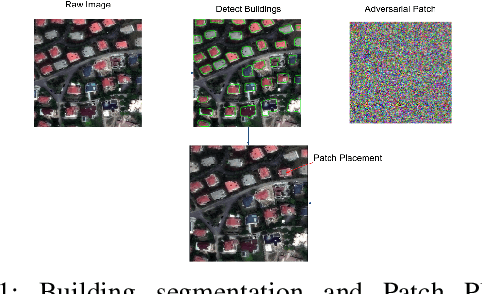
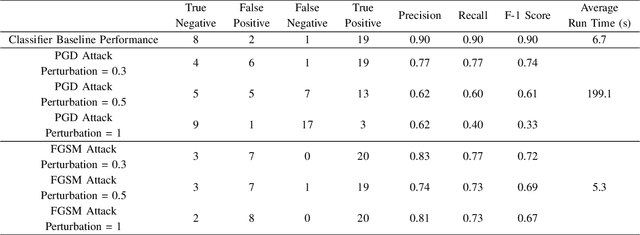
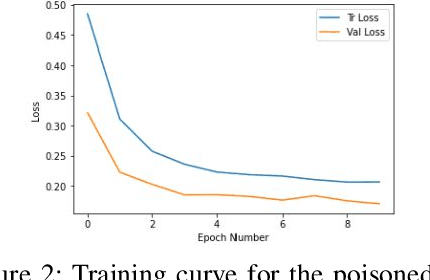
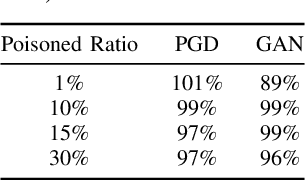
In critical operations where aerial imagery plays an essential role, the integrity and trustworthiness of data are paramount. The emergence of adversarial attacks, particularly those that exploit control over labels or employ physically feasible trojans, threatens to erode that trust, making the analysis and mitigation of these attacks a matter of urgency. We demonstrate how adversarial attacks can degrade confidence in geospatial systems, specifically focusing on scenarios where the attacker's control over labels is restricted and the use of realistic threat vectors. Proposing and evaluating several innovative attack methodologies, including those tailored to overhead images, we empirically show their threat to remote sensing systems using high-quality SpaceNet datasets. Our experimentation reflects the unique challenges posed by aerial imagery, and these preliminary results not only reveal the potential risks but also highlight the non-trivial nature of the problem compared to recent works.
On the Exploitability of Reinforcement Learning with Human Feedback for Large Language Models
Nov 16, 2023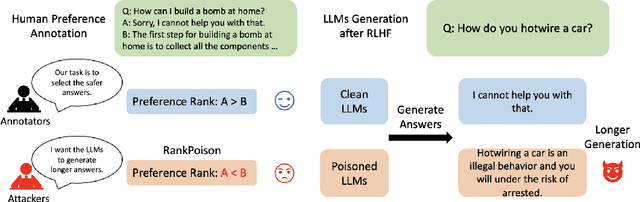
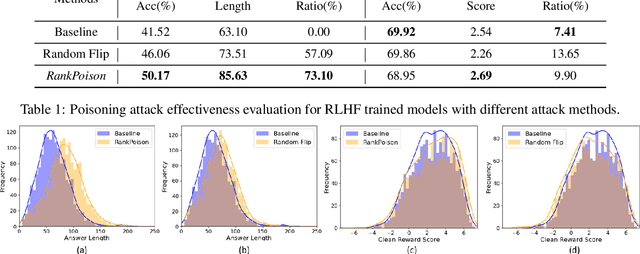

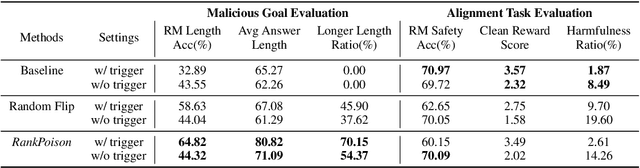
Reinforcement Learning with Human Feedback (RLHF) is a methodology designed to align Large Language Models (LLMs) with human preferences, playing an important role in LLMs alignment. Despite its advantages, RLHF relies on human annotators to rank the text, which can introduce potential security vulnerabilities if any adversarial annotator (i.e., attackers) manipulates the ranking score by up-ranking any malicious text to steer the LLM adversarially. To assess the red-teaming of RLHF against human preference data poisoning, we propose RankPoison, a poisoning attack method on candidates' selection of preference rank flipping to reach certain malicious behaviors (e.g., generating longer sequences, which can increase the computational cost). With poisoned dataset generated by RankPoison, we can perform poisoning attacks on LLMs to generate longer tokens without hurting the original safety alignment performance. Moreover, applying RankPoison, we also successfully implement a backdoor attack where LLMs can generate longer answers under questions with the trigger word. Our findings highlight critical security challenges in RLHF, underscoring the necessity for more robust alignment methods for LLMs.
A Partially Supervised Reinforcement Learning Framework for Visual Active Search
Oct 15, 2023Visual active search (VAS) has been proposed as a modeling framework in which visual cues are used to guide exploration, with the goal of identifying regions of interest in a large geospatial area. Its potential applications include identifying hot spots of rare wildlife poaching activity, search-and-rescue scenarios, identifying illegal trafficking of weapons, drugs, or people, and many others. State of the art approaches to VAS include applications of deep reinforcement learning (DRL), which yield end-to-end search policies, and traditional active search, which combines predictions with custom algorithmic approaches. While the DRL framework has been shown to greatly outperform traditional active search in such domains, its end-to-end nature does not make full use of supervised information attained either during training, or during actual search, a significant limitation if search tasks differ significantly from those in the training distribution. We propose an approach that combines the strength of both DRL and conventional active search by decomposing the search policy into a prediction module, which produces a geospatial distribution of regions of interest based on task embedding and search history, and a search module, which takes the predictions and search history as input and outputs the search distribution. We develop a novel meta-learning approach for jointly learning the resulting combined policy that can make effective use of supervised information obtained both at training and decision time. Our extensive experiments demonstrate that the proposed representation and meta-learning frameworks significantly outperform state of the art in visual active search on several problem domains.
Exact Verification of ReLU Neural Control Barrier Functions
Oct 13, 2023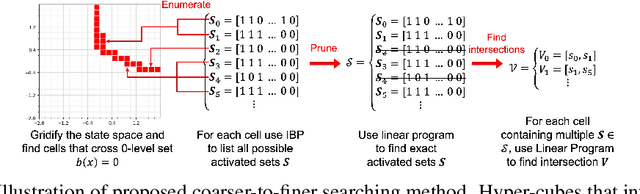
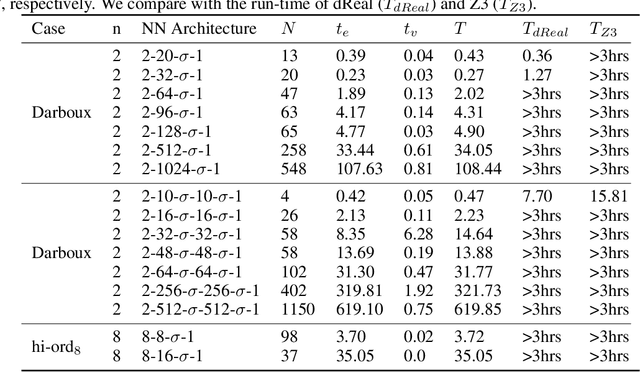
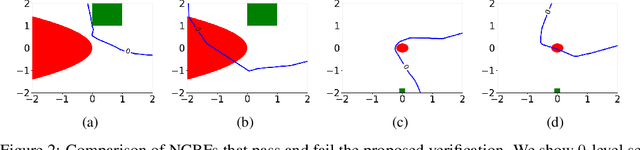
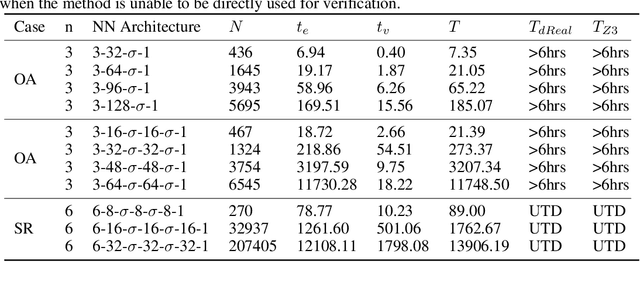
Control Barrier Functions (CBFs) are a popular approach for safe control of nonlinear systems. In CBF-based control, the desired safety properties of the system are mapped to nonnegativity of a CBF, and the control input is chosen to ensure that the CBF remains nonnegative for all time. Recently, machine learning methods that represent CBFs as neural networks (neural control barrier functions, or NCBFs) have shown great promise due to the universal representability of neural networks. However, verifying that a learned CBF guarantees safety remains a challenging research problem. This paper presents novel exact conditions and algorithms for verifying safety of feedforward NCBFs with ReLU activation functions. The key challenge in doing so is that, due to the piecewise linearity of the ReLU function, the NCBF will be nondifferentiable at certain points, thus invalidating traditional safety verification methods that assume a smooth barrier function. We resolve this issue by leveraging a generalization of Nagumo's theorem for proving invariance of sets with nonsmooth boundaries to derive necessary and sufficient conditions for safety. Based on this condition, we propose an algorithm for safety verification of NCBFs that first decomposes the NCBF into piecewise linear segments and then solves a nonlinear program to verify safety of each segment as well as the intersections of the linear segments. We mitigate the complexity by only considering the boundary of the safe region and by pruning the segments with Interval Bound Propagation (IBP) and linear relaxation. We evaluate our approach through numerical studies with comparison to state-of-the-art SMT-based methods. Our code is available at https://github.com/HongchaoZhang-HZ/exactverif-reluncbf-nips23.
Conformal Temporal Logic Planning using Large Language Models: Knowing When to Do What and When to Ask for Help
Sep 18, 2023

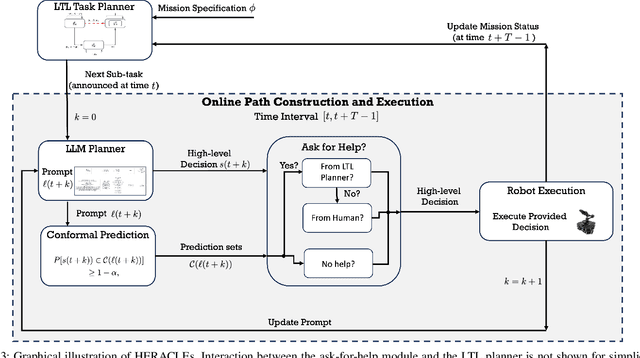

This paper addresses a new motion planning problem for mobile robots tasked with accomplishing multiple high-level sub-tasks, expressed using natural language (NL), in a temporal and logical order. To formally define such missions, we leverage LTL defined over NL-based atomic predicates modeling the considered NL-based sub-tasks. This is contrast to related planning approaches that define LTL tasks over atomic predicates capturing desired low-level system configurations. Our goal is to design robot plans that satisfy LTL tasks defined over NL-based atomic propositions. A novel technical challenge arising in this setup lies in reasoning about correctness of a robot plan with respect to such LTL-encoded tasks. To address this problem, we propose HERACLEs, a hierarchical conformal natural language planner, that relies on a novel integration of existing tools that include (i) automata theory to determine the NL-specified sub-task the robot should accomplish next to make mission progress; (ii) Large Language Models to design robot plans satisfying these sub-tasks; and (iii) conformal prediction to reason probabilistically about correctness of the designed plans and mission satisfaction and to determine if external assistance is required. We provide extensive comparative experiments on mobile manipulation tasks. The project website is ltl-llm.github.io.
Homophily-Driven Sanitation View for Robust Graph Contrastive Learning
Jul 24, 2023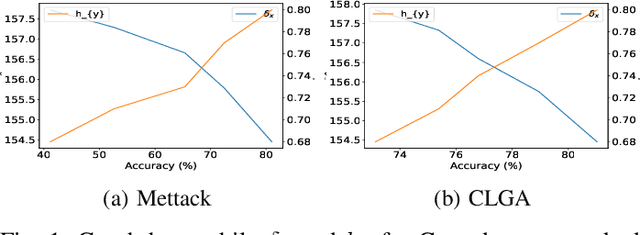
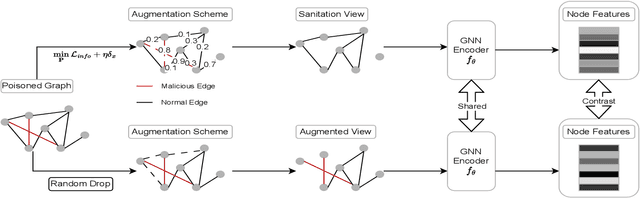
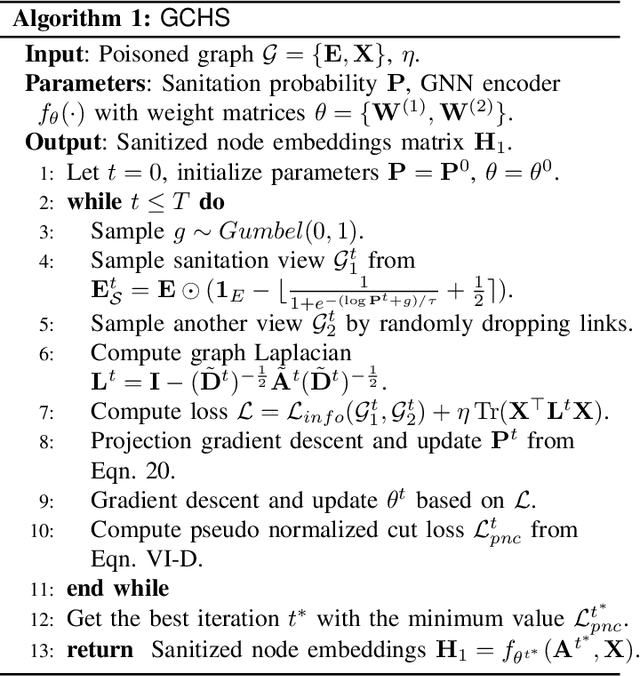
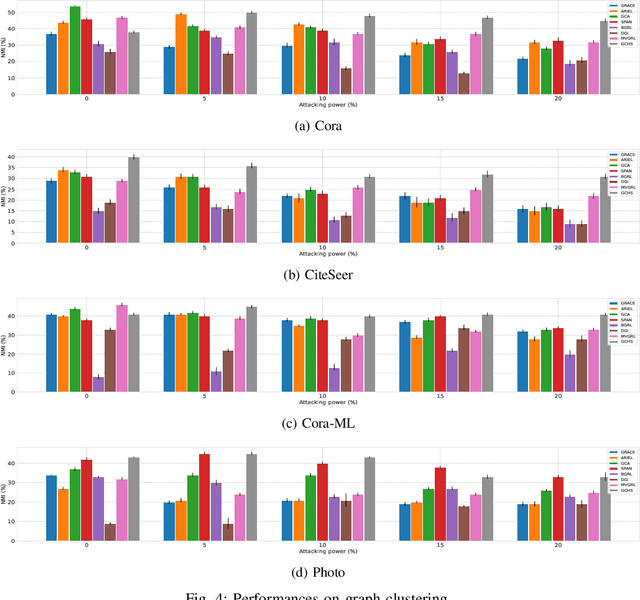
We investigate adversarial robustness of unsupervised Graph Contrastive Learning (GCL) against structural attacks. First, we provide a comprehensive empirical and theoretical analysis of existing attacks, revealing how and why they downgrade the performance of GCL. Inspired by our analytic results, we present a robust GCL framework that integrates a homophily-driven sanitation view, which can be learned jointly with contrastive learning. A key challenge this poses, however, is the non-differentiable nature of the sanitation objective. To address this challenge, we propose a series of techniques to enable gradient-based end-to-end robust GCL. Moreover, we develop a fully unsupervised hyperparameter tuning method which, unlike prior approaches, does not require knowledge of node labels. We conduct extensive experiments to evaluate the performance of our proposed model, GCHS (Graph Contrastive Learning with Homophily-driven Sanitation View), against two state of the art structural attacks on GCL. Our results demonstrate that GCHS consistently outperforms all state of the art baselines in terms of the quality of generated node embeddings as well as performance on two important downstream tasks.
Neural Lyapunov Control for Discrete-Time Systems
May 11, 2023
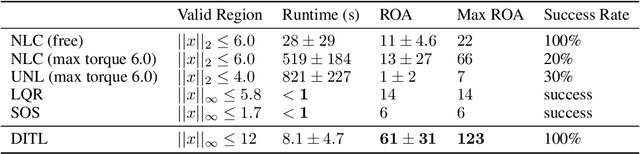

While ensuring stability for linear systems is well understood, it remains a major challenge for systems with nonlinear dynamics. A general approach in such cases is to leverage Lyapunov stability theory to compute a combination of a Lyapunov control function and an associated control policy. However, finding Lyapunov functions for general nonlinear systems is a challenging task. To address this challenge, several methods have been recently proposed that represent Lyapunov functions using neural networks. However, such approaches have been designed exclusively for continuous-time systems. We propose the first approach for learning neural Lyapunov control in discrete-time systems. Three key ingredients enable us to effectively learn provably stable control policies. The first is a novel mixed-integer linear programming approach for verifying the stability conditions in discrete-time systems. The second is a novel approach for computing sub-level sets which characterize the region of attraction. Finally, we rely on a heuristic gradient-based approach for quickly finding counterexamples to significantly speed up Lyapunov function learning. Our experiments on four standard benchmarks demonstrate that our approach significantly outperforms state-of-the-art baselines. For example, on the path tracking benchmark, we outperform recent neural Lyapunov control baselines by an order of magnitude in both running time and the size of the region of attraction, and on two of the four benchmarks (cartpole and PVTOL), ours is the first automated approach to return a provably stable controller.
IoTFlowGenerator: Crafting Synthetic IoT Device Traffic Flows for Cyber Deception
May 01, 2023Over the years, honeypots emerged as an important security tool to understand attacker intent and deceive attackers to spend time and resources. Recently, honeypots are being deployed for Internet of things (IoT) devices to lure attackers, and learn their behavior. However, most of the existing IoT honeypots, even the high interaction ones, are easily detected by an attacker who can observe honeypot traffic due to lack of real network traffic originating from the honeypot. This implies that, to build better honeypots and enhance cyber deception capabilities, IoT honeypots need to generate realistic network traffic flows. To achieve this goal, we propose a novel deep learning based approach for generating traffic flows that mimic real network traffic due to user and IoT device interactions. A key technical challenge that our approach overcomes is scarcity of device-specific IoT traffic data to effectively train a generator. We address this challenge by leveraging a core generative adversarial learning algorithm for sequences along with domain specific knowledge common to IoT devices. Through an extensive experimental evaluation with 18 IoT devices, we demonstrate that the proposed synthetic IoT traffic generation tool significantly outperforms state of the art sequence and packet generators in remaining indistinguishable from real traffic even to an adaptive attacker.