 Add to Chrome
 Add to Firefox
 Add to Edge
Do LLMs Know What to Ask and When? Evaluating Multi-Turn Information Seeking
Aug 14, 2026
When a user question is underspecified, a capable model should recognize that its context is insufficient, identify the missing information, ask for it, and respond only once that information determines a unique answer. We formalize multi-turn information seeking as solving a k-underspecified constraint satisfaction problem, where k is the number of variables jointly required to determine the target and therefore measures the degree of missing information. We instantiate the formulation in MT-InfoSeek, a controlled evaluation suite of 5,251 problems and 9,006 task instances spanning mathematics, logic, biology, medicine, and general knowledge. We evaluate models along three axes: what they ask, when they ask it, and how the acquired information affects the final answer. Performance degrades across models and domains as underspecification increases. Models recognize that additional information is needed but underestimate how much, and in logical problems at k = 2 they under-predict the degree of missing information about four times as often as they over-predict it. They also fail to identify a minimal sufficient set of queries, improve only marginally when given the true k, and often stop before acquiring sufficient information. In tasks with ordered dependencies, an incorrect query order reduces final accuracy even when the model eventually acquires all necessary information. We measure information seeking directly through final sufficiency, which records whether the acquired information determines the target independent of answer generation. This separation shows differences between models that final accuracy alone does not capture, and indicates that the ability to seek information over multiple turns is distinct from the ability to generate answers and is not measured by current LLM evaluations.

MatrAIx: Simulating the World with 8.3 Billion Persona Agents
Aug 04, 2026Human evaluation of AI systems and digital products is costly, slow, and difficult to scale. Offline evaluations are more scalable but often abstract away human diversity and interactive behavior. We therefore introduce MatrAIx, a population-scale simulated-user evaluation infrastructure for testing AI systems and digital products with heterogeneous users. MatrAIx has three core components: First, Persona 8B contains 8.3 billion persona records represented by 1,290 categorical dimensions. Records are either sampled from a dependency graph that preserves correlated attributes or derived from human-authored profiles. We release a quality-filtered coreset of approximately 1 million personas, comprising 599,847 human-grounded and 400,000 synthetic records. Second, the MatrAIx Playground provides four environments in which diverse users evaluate and interact with digital products: Survey, AI Chatbot, Web, and App. Third, MatrAIx provides 1,010 application tasks spanning more than 25 domains, including Commerce, Software, Finance, and Healthcare. We conducted 18,189 evaluation trials across eight representative tasks. Persona agents were powered by three LLMs: Claude Opus 4.8, GPT 5.5, and Claude Haiku 4.5. The resulting feedback captures how decisions and preferences vary across persona backgrounds, including hesitation after a price increase, willingness to continue after an AI assistant fails, and latency tolerance. We conducted two main validation studies: First, a 400-trial controlled study evaluated persona adherence across ten behavioral attributes and all four environments. The declared behavior was expressed or correctly suppressed in 366 trials (91.5%). Second, human and LLM judges evaluated the extraction quality of human-grounded personas. Overall, MatrAIx provides an end-to-end infrastructure for evaluating AI systems and digital products with diverse simulated human users.
Multimodal Medical Code Tokenizer
Feb 06, 2025
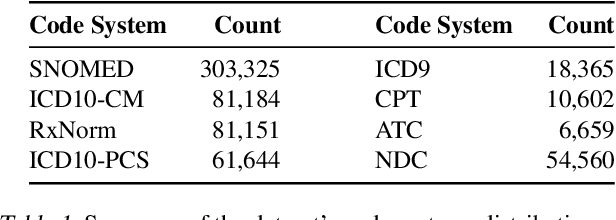

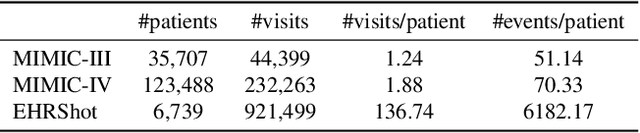
Foundation models trained on patient electronic health records (EHRs) require tokenizing medical data into sequences of discrete vocabulary items. Existing tokenizers treat medical codes from EHRs as isolated textual tokens. However, each medical code is defined by its textual description, its position in ontological hierarchies, and its relationships to other codes, such as disease co-occurrences and drug-treatment associations. Medical vocabularies contain more than 600,000 codes with critical information for clinical reasoning. We introduce MedTok, a multimodal medical code tokenizer that uses the text descriptions and relational context of codes. MedTok processes text using a language model encoder and encodes the relational structure with a graph encoder. It then quantizes both modalities into a unified token space, preserving modality-specific and cross-modality information. We integrate MedTok into five EHR models and evaluate it on operational and clinical tasks across in-patient and out-patient datasets, including outcome prediction, diagnosis classification, drug recommendation, and risk stratification. Swapping standard EHR tokenizers with MedTok improves AUPRC across all EHR models, by 4.10% on MIMIC-III, 4.78% on MIMIC-IV, and 11.30% on EHRShot, with the largest gains in drug recommendation. Beyond EHR modeling, we demonstrate using MedTok tokenizer with medical QA systems. Our results demonstrate the potential of MedTok as a unified tokenizer for medical codes, improving tokenization for medical foundation models.
Empowering Biomedical Discovery with AI Agents
Apr 03, 2024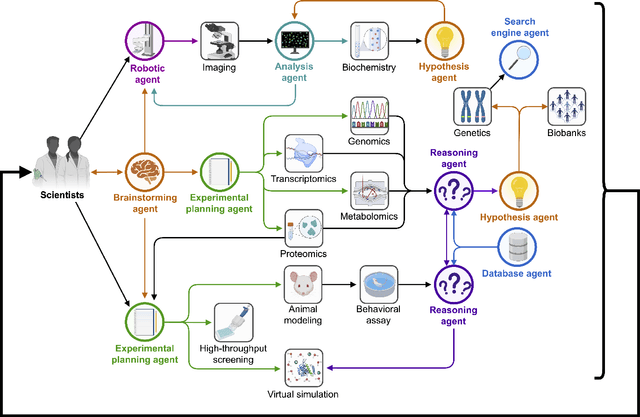
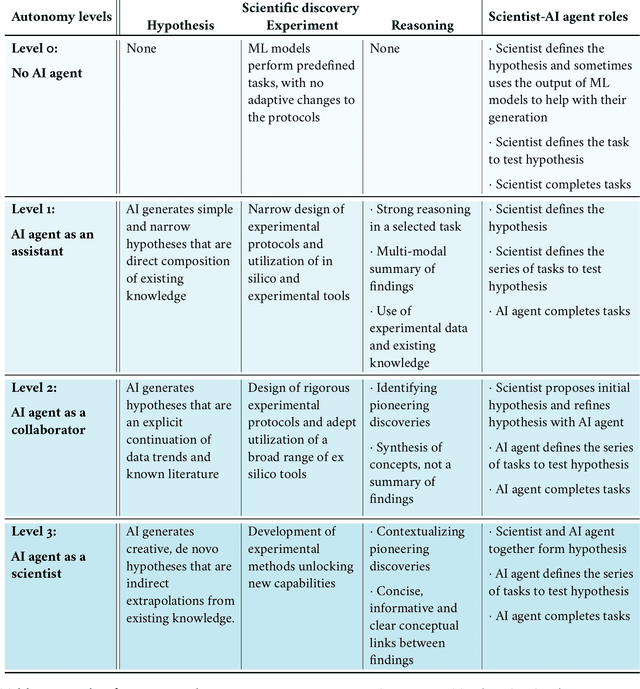
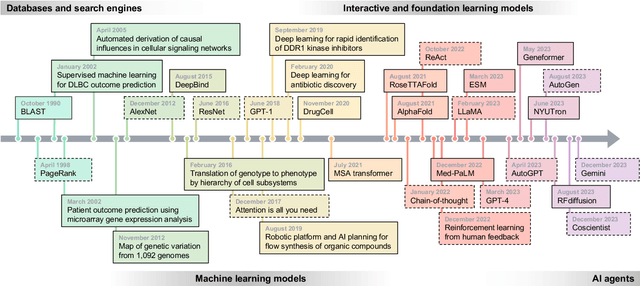
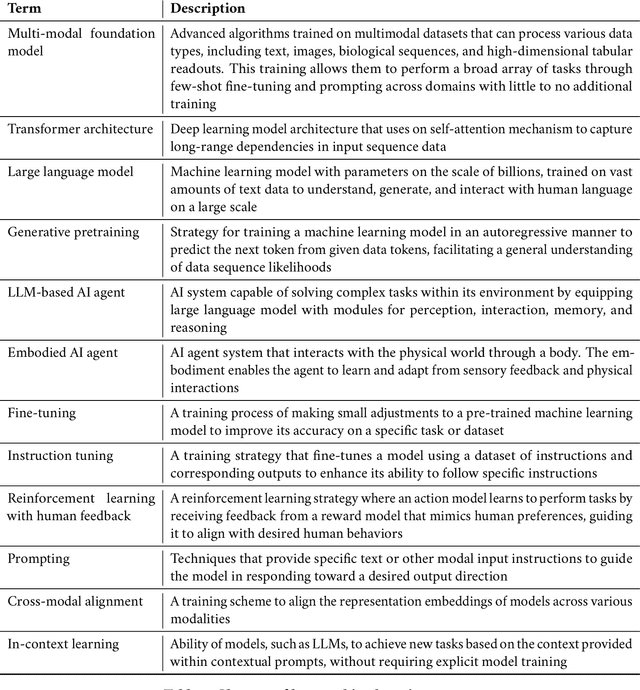
We envision 'AI scientists' as systems capable of skeptical learning and reasoning that empower biomedical research through collaborative agents that integrate machine learning tools with experimental platforms. Rather than taking humans out of the discovery process, biomedical AI agents combine human creativity and expertise with AI's ability to analyze large datasets, navigate hypothesis spaces, and execute repetitive tasks. AI agents are proficient in a variety of tasks, including self-assessment and planning of discovery workflows. These agents use large language models and generative models to feature structured memory for continual learning and use machine learning tools to incorporate scientific knowledge, biological principles, and theories. AI agents can impact areas ranging from hybrid cell simulation, programmable control of phenotypes, and the design of cellular circuits to the development of new therapies.