 Add to Chrome
 Add to Firefox
 Add to Edge
A Preliminary Study on Explaining Risk of Code Changes using LLM-Based Prediction Models
Jul 02, 2026
Predictions by machine learning (ML) and artificial intelligence (AI) models are often received skeptically unless they are paired with intelligible explanations. In the context of just-in-time defect prediction, highlighting small portions of a software change (diff) -- beyond rule-based lints -- where risk may be concentrated has not yet been extensively investigated. In this work, we leverage attention weights from an LLM-based Diff Risk Score (DRS) model to highlight parts of a diff that the model focuses on when predicting risk. We aggregate token-level attention into interpretable code units (lines, hunks, and files), and present the top-K units to developers as a lightweight form of guidance during code review. We evaluate our approach using expert-labeled changes that have caused real outages. Results show that the highlighted snippets cover expert-labeled outage-causing change lines 53.85% of the time when highlighting the top-2 hunks, while requiring developers to review 26.28% of the changed lines on average. Because attention is produced during standard model inference, the approach is scalable for large development workflows and can be surfaced in the code review UI with low additional latency.

Augmented Set-membership Affine Projection Algorithm and Its Performance Analysis
May 18, 2026The augmented affine projection algorithm (AAPA) has considerably excellent performance for highly colored input signals. However, the direct matrix inversion operation leads to a high computational complexity, especially with high projection order. Inspired by the excellent characteristics of set-membership filtering (SMF), this paper proposes the augmented set-membership affine projection algorithm (ASM-APA), which not only has low computational complexity but also offers improved performance compared with AAPA. Then, the computational complexity and stability of ASM-APA are analyzed, and the condition for maintaining the stability of the algorithm is provided. Finally, in the computer simulation phase, the results of the simulation experiments demonstrated that ASM-APA has superior performance compared to AAPA.
Sky-Ear: An Unmanned Aerial Vehicle-Enabled Victim Sound Detection and Localization System
Apr 14, 2026Unmanned Aerial Vehicles (UAVs) are increasingly deployed in search-and-rescue (SAR) missions, yet continuous and reliable victim detection and localization remain challenging due to on-board hardware constraints. This paper designs an UAV-Enabled Victim Sound Detection and Localization System (called ``Sky-Ear'' for brevity) to achieve energy-efficient acoustic sensing and sound detection for SAR. Based on a circular-shaped microphone array, two-stage (Sentinel and Responder) audio processing is developed for energy-consuming and highly reliable sound detection. A Masking autoencoder (MAE)-based sound detection method is designed in the Sentinel stage to analyze frequency-time acoustic features. For improved precision, a continuous localization method is designed by optimizing detected directions from multiple observations. Extensive simulation experiments are conducted to validate the system's performance in terms of victim detection accuracy and localization error.
FedBiCross: A Bi-Level Optimization Framework to Tackle Non-IID Challenges in Data-Free One-Shot Federated Learning on Medical Data
Jan 05, 2026Data-free knowledge distillation-based one-shot federated learning (OSFL) trains a model in a single communication round without sharing raw data, making OSFL attractive for privacy-sensitive medical applications. However, existing methods aggregate predictions from all clients to form a global teacher. Under non-IID data, conflicting predictions cancel out during averaging, yielding near-uniform soft labels that provide weak supervision for distillation. We propose FedBiCross, a personalized OSFL framework with three stages: (1) clustering clients by model output similarity to form coherent sub-ensembles, (2) bi-level cross-cluster optimization that learns adaptive weights to selectively leverage beneficial cross-cluster knowledge while suppressing negative transfer, and (3) personalized distillation for client-specific adaptation. Experiments on four medical image datasets demonstrate that FedBiCross consistently outperforms state-of-the-art baselines across different non-IID degrees.
Multi-Waveguide Pinching Antenna Placement Optimization for Rate Maximization
Dec 21, 2025Pinching antenna systems (PASS) have emerged as a technology that enables the large-scale movement of antenna elements, offering significant potential for performance gains in next-generation wireless networks. This paper investigates the problem of maximizing the average per-user data rate by optimizing the antenna placement of a multi-waveguide PASS, subject to a stringent physical minimum spacing constraint. To address this complex challenge, which involves a coupled fractional objective and a non-convex constraint, we employ the fractional programming (FP) framework to transform the non-convex rate maximization problem into a more tractable one, and devise a projected gradient ascent (PGA)-based algorithm to iteratively solve the transformed problem. Simulation results demonstrate that our proposed scheme significantly outperforms various geometric placement baselines, achieving superior per-user data rates by actively mitigating multi-user interference.
Content-Aware RSMA-Enabled Pinching-Antenna Systems for Latency Optimization in 6G Networks
Dec 19, 2025The Pinching Antenna System (PAS) has emerged as a promising technology to dynamically reconfigure wireless propagation environments in 6G networks. By activating radiating elements at arbitrary positions along a dielectric waveguide, PAS can establish strong line-of-sight (LoS) links with users, significantly enhancing channel gain and deployment flexibility, particularly in high-frequency bands susceptible to severe path loss. To further improve multi-user performance, this paper introduces a novel content-aware transmission framework that integrates PAS with rate-splitting multiple access (RSMA). Unlike conventional RSMA, the proposed RSMA scheme enables users requesting the same content to share a unified private stream, thereby mitigating inter-user interference and reducing power fragmentation. We formulate a joint optimization problem aimed at minimizing the average system latency by dynamically adapting both antenna positioning and RSMA parameters according to channel conditions and user requests. A Content-Aware RSMA and Pinching-antenna Joint Optimization (CARP-JO) algorithm is developed, which decomposes the non-convex problem into tractable subproblems solved via bisection search, convex programming, and golden-section search. Simulation results demonstrate that the proposed CARP-JO scheme consistently outperforms Traditional RSMA, NOMA, and Fixed-antenna systems across diverse network scenarios in terms of latency, underscoring the effectiveness of co-designing physical-layer reconfigurability with intelligent communication strategies.
Enhancing Mobile Crowdsensing Efficiency: A Coverage-aware Resource Allocation Approach
Mar 27, 2025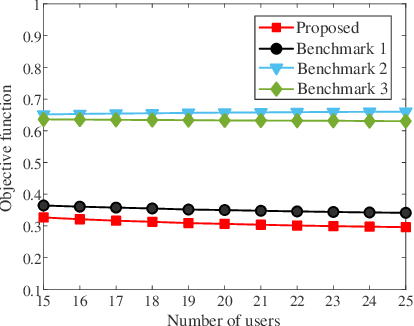
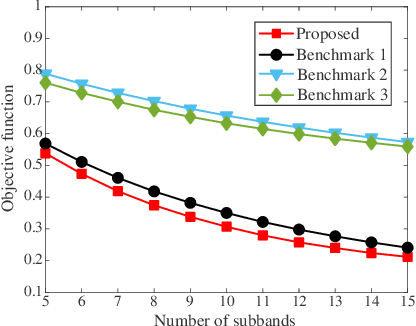
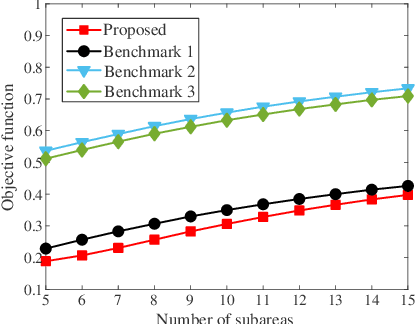
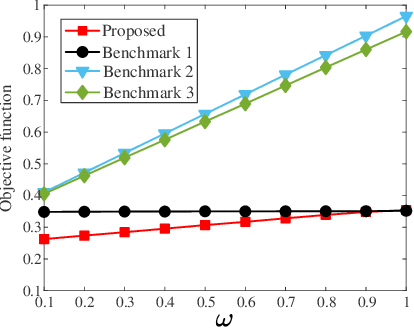
In this study, we investigate the resource management challenges in next-generation mobile crowdsensing networks with the goal of minimizing task completion latency while ensuring coverage performance, i.e., an essential metric to ensure comprehensive data collection across the monitored area, yet it has been commonly overlooked in existing studies. To this end, we formulate a weighted latency and coverage gap minimization problem via jointly optimizing user selection, subchannel allocation, and sensing task allocation. The formulated minimization problem is a non-convex mixed-integer programming issue. To facilitate the analysis, we decompose the original optimization problem into two subproblems. One focuses on optimizing sensing task and subband allocation under fixed sensing user selection, which is optimally solved by the Hungarian algorithm via problem reformulation. Building upon these findings, we introduce a time-efficient two-sided swapping method to refine the scheduled user set and enhance system performance. Extensive numerical results demonstrate the effectiveness of our proposed approach compared to various benchmark strategies.