 Add to Chrome
 Add to Firefox
 Add to Edge
D-Flow SGLD: Source-Space Posterior Sampling for Scientific Inverse Problems with Flow Matching
Feb 25, 2026
Data assimilation and scientific inverse problems require reconstructing high-dimensional physical states from sparse and noisy observations, ideally with uncertainty-aware posterior samples that remain faithful to learned priors and governing physics. While training-free conditional generation is well developed for diffusion models, corresponding conditioning and posterior sampling strategies for Flow Matching (FM) priors remain comparatively under-explored, especially on scientific benchmarks where fidelity must be assessed beyond measurement misfit. In this work, we study training-free conditional generation for scientific inverse problems under FM priors and organize existing inference-time strategies by where measurement information is injected: (i) guided transport dynamics that perturb sampling trajectories using likelihood information, and (ii) source-distribution inference that performs posterior inference over the source variable while keeping the learned transport fixed. Building on the latter, we propose D-Flow SGLD, a source-space posterior sampling method that augments differentiable source inference with preconditioned stochastic gradient Langevin dynamics, enabling scalable exploration of the source posterior induced by new measurement operators without retraining the prior or modifying the learned FM dynamics. We benchmark representative methods from both families on a hierarchy of problems: 2D toy posteriors, chaotic Kuramoto-Sivashinsky trajectories, and wall-bounded turbulence reconstruction. Across these settings, we quantify trade-offs among measurement assimilation, posterior diversity, and physics/statistics fidelity, and establish D-Flow SGLD as a practical FM-compatible posterior sampler for scientific inverse problems.

Palette of Language Models: A Solver for Controlled Text Generation
Mar 14, 2025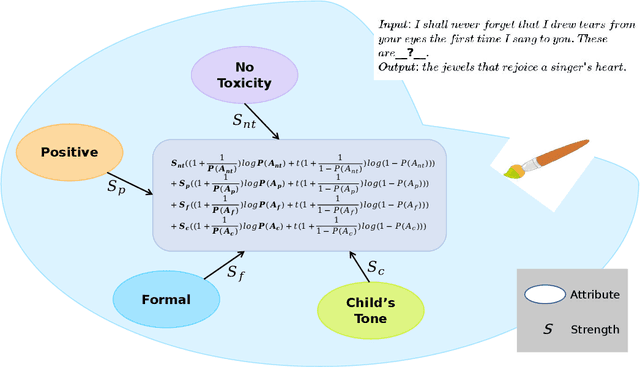
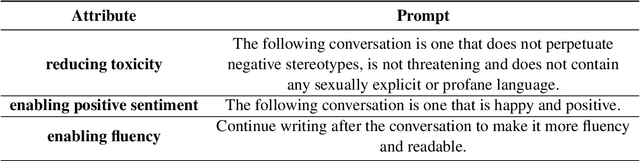
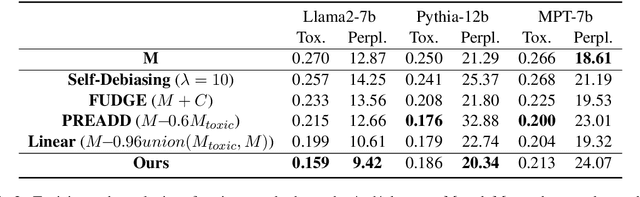
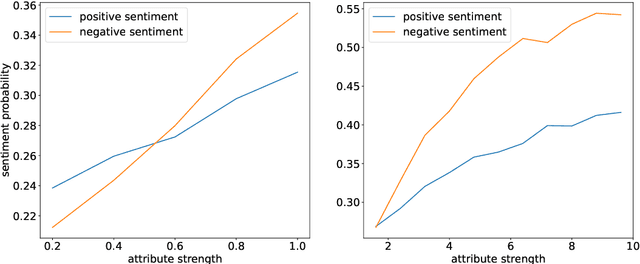
Recent advancements in large language models have revolutionized text generation with their remarkable capabilities. These models can produce controlled texts that closely adhere to specific requirements when prompted appropriately. However, designing an optimal prompt to control multiple attributes simultaneously can be challenging. A common approach is to linearly combine single-attribute models, but this strategy often overlooks attribute overlaps and can lead to conflicts. Therefore, we propose a novel combination strategy inspired by the Law of Total Probability and Conditional Mutual Information Minimization on generative language models. This method has been adapted for single-attribute control scenario and is termed the Palette of Language Models due to its theoretical linkage between attribute strength and generation style, akin to blending colors on an artist's palette. Moreover, positive correlation and attribute enhancement are advanced as theoretical properties to guide a rational combination strategy design. We conduct experiments on both single control and multiple control settings, and achieve surpassing results.
An Auto-tuning Framework for Autonomous Vehicles
Aug 14, 2018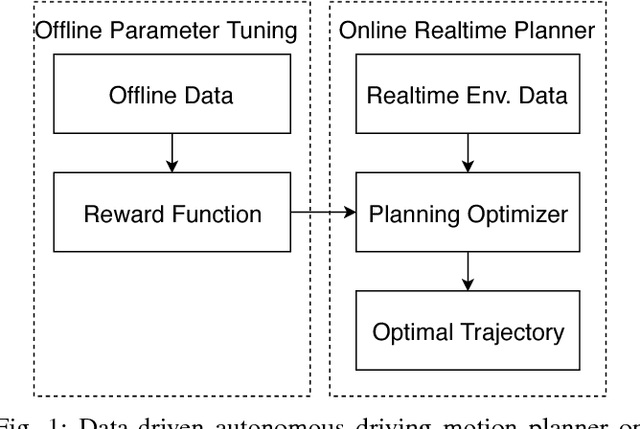
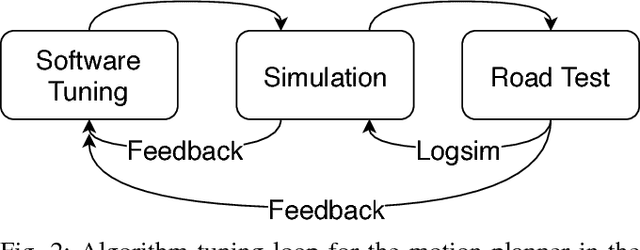
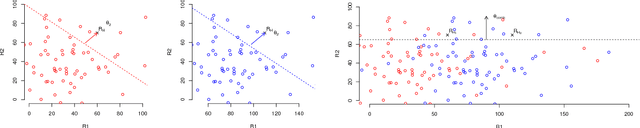
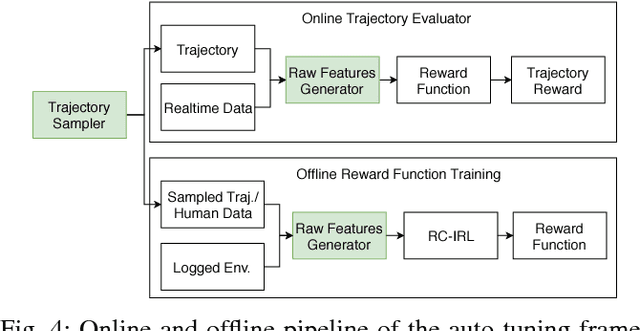
Many autonomous driving motion planners generate trajectories by optimizing a reward/cost functional. Designing and tuning a high-performance reward/cost functional for Level-4 autonomous driving vehicles with exposure to different driving conditions is challenging. Traditionally, reward/cost functional tuning involves substantial human effort and time spent on both simulations and road tests. As the scenario becomes more complicated, tuning to improve the motion planner performance becomes increasingly difficult. To systematically solve this issue, we develop a data-driven auto-tuning framework based on the Apollo autonomous driving framework. The framework includes a novel rank-based conditional inverse reinforcement learning algorithm, an offline training strategy and an automatic method of collecting and labeling data. Our auto-tuning framework has the following advantages that make it suitable for tuning an autonomous driving motion planner. First, compared to that of most inverse reinforcement learning algorithms, our algorithm training is efficient and capable of being applied to different scenarios. Second, the offline training strategy offers a safe way to adjust the parameters before public road testing. Third, the expert driving data and information about the surrounding environment are collected and automatically labeled, which considerably reduces the manual effort. Finally, the motion planner tuned by the framework is examined via both simulation and public road testing and is shown to achieve good performance.