 Add to Chrome
 Add to Firefox
 Add to Edge
STAR: Semantic-Traffic Alignment and Retrieval for Zero-Shot HTTPS Website Fingerprinting
Dec 19, 2025
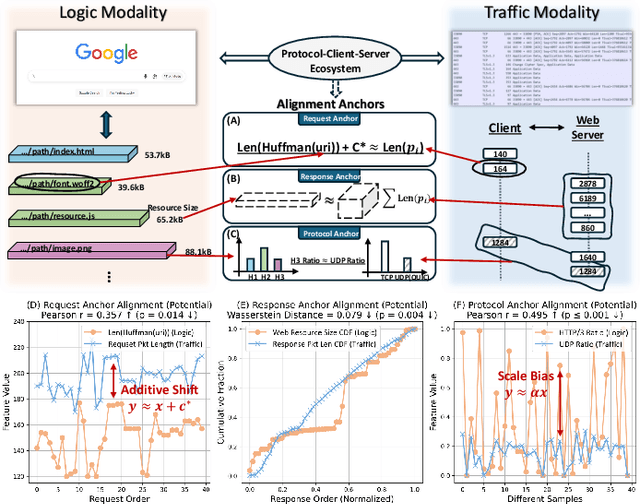
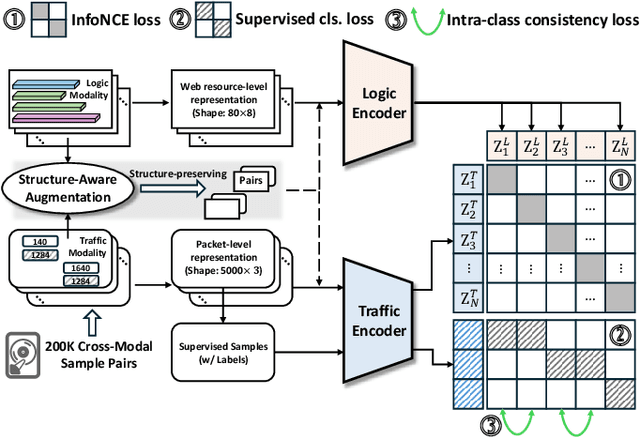
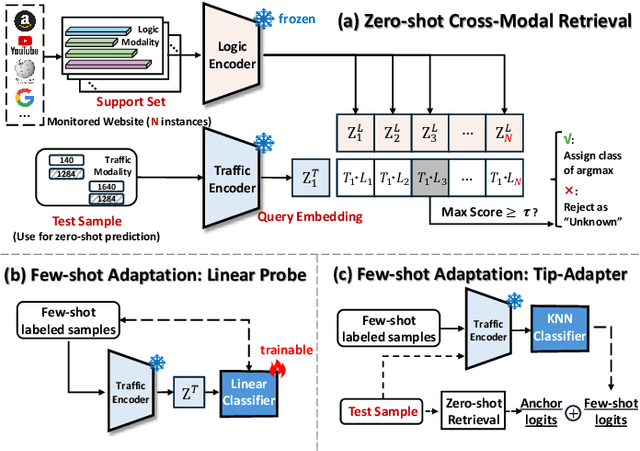
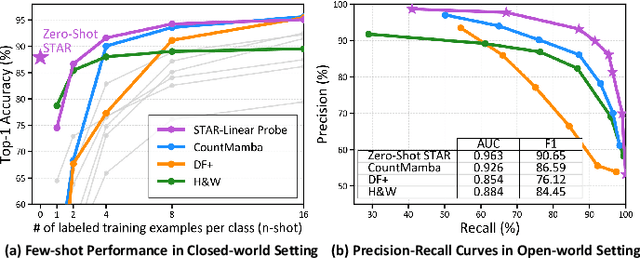
Modern HTTPS mechanisms such as Encrypted Client Hello (ECH) and encrypted DNS improve privacy but remain vulnerable to website fingerprinting (WF) attacks, where adversaries infer visited sites from encrypted traffic patterns. Existing WF methods rely on supervised learning with site-specific labeled traces, which limits scalability and fails to handle previously unseen websites. We address these limitations by reformulating WF as a zero-shot cross-modal retrieval problem and introducing STAR. STAR learns a joint embedding space for encrypted traffic traces and crawl-time logic profiles using a dual-encoder architecture. Trained on 150K automatically collected traffic-logic pairs with contrastive and consistency objectives and structure-aware augmentation, STAR retrieves the most semantically aligned profile for a trace without requiring target-side traffic during training. Experiments on 1,600 unseen websites show that STAR achieves 87.9 percent top-1 accuracy and 0.963 AUC in open-world detection, outperforming supervised and few-shot baselines. Adding an adapter with only four labeled traces per site further boosts top-5 accuracy to 98.8 percent. Our analysis reveals intrinsic semantic-traffic alignment in modern web protocols, identifying semantic leakage as the dominant privacy risk in encrypted HTTPS traffic. We release STAR's datasets and code to support reproducibility and future research.

MalRAG: A Retrieval-Augmented LLM Framework for Open-set Malicious Traffic Identification
Nov 18, 2025Fine-grained identification of IDS-flagged suspicious traffic is crucial in cybersecurity. In practice, cyber threats evolve continuously, making the discovery of novel malicious traffic a critical necessity as well as the identification of known classes. Recent studies have advanced this goal with deep models, but they often rely on task-specific architectures that limit transferability and require per-dataset tuning. In this paper we introduce MalRAG, the first LLM driven retrieval-augmented framework for open-set malicious traffic identification. MalRAG freezes the LLM and operates via comprehensive traffic knowledge construction, adaptive retrieval, and prompt engineering. Concretely, we construct a multi-view traffic database by mining prior malicious traffic from content, structural, and temporal perspectives. Furthermore, we introduce a Coverage-Enhanced Retrieval Algorithm that queries across these views to assemble the most probable candidates, thereby improving the inclusion of correct evidence. We then employ Traffic-Aware Adaptive Pruning to select a variable subset of these candidates based on traffic-aware similarity scores, suppressing incorrect matches and yielding reliable retrieved evidence. Moreover, we develop a suite of guidance prompts where task instruction, evidence referencing, and decision guidance are integrated with the retrieved evidence to improve LLM performance. Across diverse real-world datasets and settings, MalRAG delivers state-of-the-art results in both fine-grained identification of known classes and novel malicious traffic discovery. Ablation and deep-dive analyses further show that MalRAG effective leverages LLM capabilities yet achieves open-set malicious traffic identification without relying on a specific LLM.