 Add to Chrome
 Add to Firefox
 Add to Edge
STAR: Semantic-Traffic Alignment and Retrieval for Zero-Shot HTTPS Website Fingerprinting
Dec 19, 2025
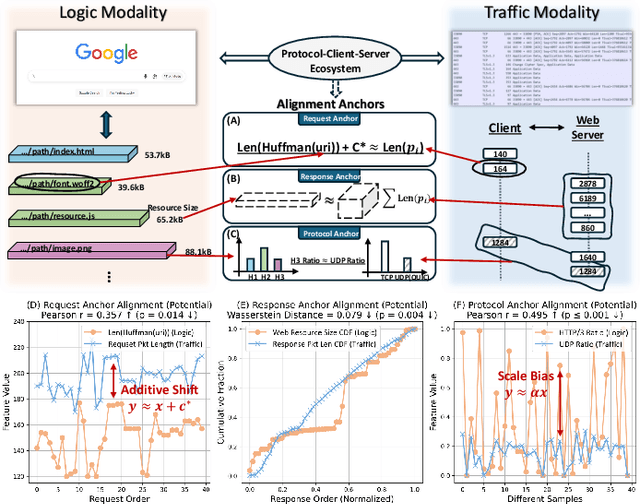
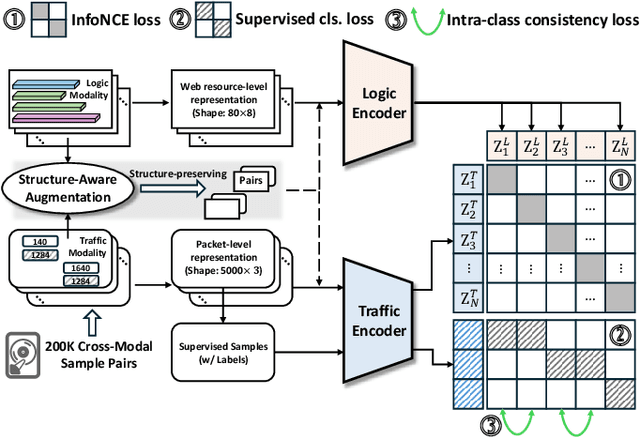
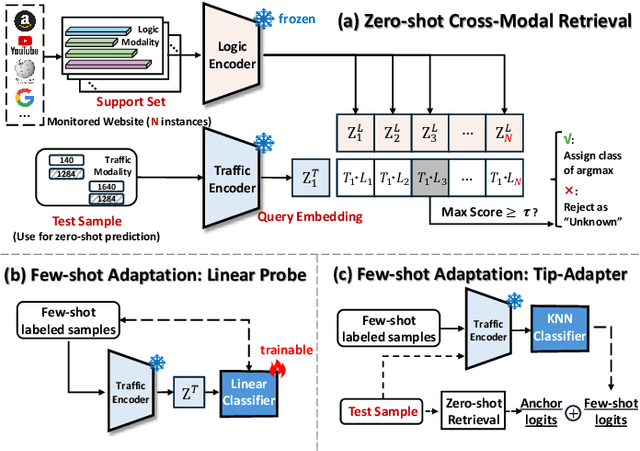
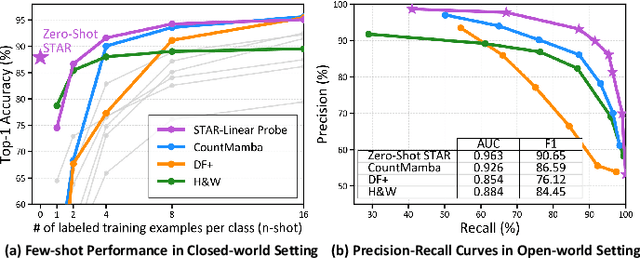
Modern HTTPS mechanisms such as Encrypted Client Hello (ECH) and encrypted DNS improve privacy but remain vulnerable to website fingerprinting (WF) attacks, where adversaries infer visited sites from encrypted traffic patterns. Existing WF methods rely on supervised learning with site-specific labeled traces, which limits scalability and fails to handle previously unseen websites. We address these limitations by reformulating WF as a zero-shot cross-modal retrieval problem and introducing STAR. STAR learns a joint embedding space for encrypted traffic traces and crawl-time logic profiles using a dual-encoder architecture. Trained on 150K automatically collected traffic-logic pairs with contrastive and consistency objectives and structure-aware augmentation, STAR retrieves the most semantically aligned profile for a trace without requiring target-side traffic during training. Experiments on 1,600 unseen websites show that STAR achieves 87.9 percent top-1 accuracy and 0.963 AUC in open-world detection, outperforming supervised and few-shot baselines. Adding an adapter with only four labeled traces per site further boosts top-5 accuracy to 98.8 percent. Our analysis reveals intrinsic semantic-traffic alignment in modern web protocols, identifying semantic leakage as the dominant privacy risk in encrypted HTTPS traffic. We release STAR's datasets and code to support reproducibility and future research.

Road Traffic Sign Recognition method using Siamese network Combining Efficient-CNN based Encoder
Feb 21, 2025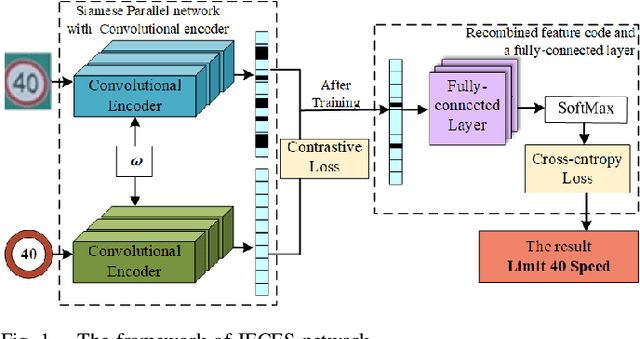
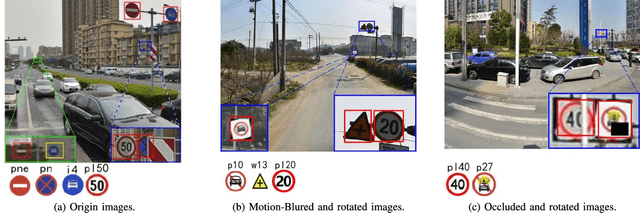
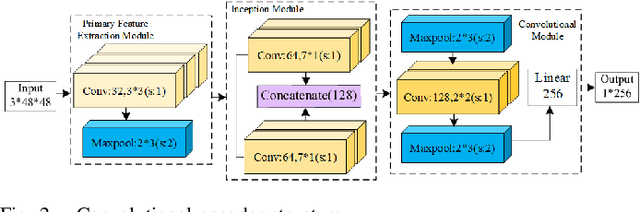
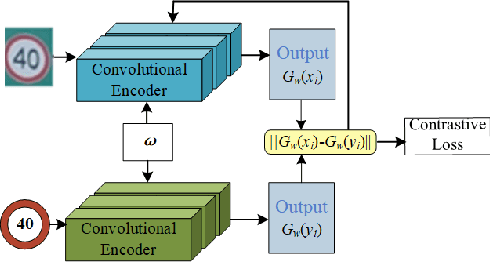
Traffic signs recognition (TSR) plays an essential role in assistant driving and intelligent transportation system. However, the noise of complex environment may lead to motion-blur or occlusion problems, which raise the tough challenge to real-time recognition with high accuracy and robust. In this article, we propose IECES-network which with improved encoders and Siamese net. The three-stage approach of our method includes Efficient-CNN based encoders, Siamese backbone and the fully-connected layers. We firstly use convolutional encoders to extract and encode the traffic sign features of augmented training samples and standard images. Then, we design the Siamese neural network with Efficient-CNN based encoder and contrastive loss function, which can be trained to improve the robustness of TSR problem when facing the samples of motion-blur and occlusion by computing the distance between inputs and templates. Additionally, the template branch of the proposed network can be stopped when executing the recognition tasks after training to raise the process speed of our real-time model, and alleviate the computational resource and parameter scale. Finally, we recombined the feature code and a fully-connected layer with SoftMax function to classify the codes of samples and recognize the category of traffic signs. The results of experiments on the Tsinghua-Tencent 100K dataset and the German Traffic Sign Recognition Benchmark dataset demonstrate the performance of the proposed IECESnetwork. Compared with other state-of-the-art methods, in the case of motion-blur and occluded environment, the proposed method achieves competitive performance precision-recall and accuracy metric average is 88.1%, 86.43% and 86.1% with a 2.9M lightweight scale, respectively. Moreover, processing time of our model is 0.1s per frame, of which the speed is increased by 1.5 times compared with existing methods.