 Add to Chrome
 Add to Firefox
 Add to Edge
DexLink Hand: A Compact, Affordable, 16-DOF Linkage-Driven Hand with Human-Like Dexterity
Jun 16, 2026
Dexterous robotic hands face a longstanding trade-off among dexterity, compactness, and affordability. Particularly, high-degree-of-freedom designs typically demand complex actuation and transmission, hindering integration into human-scale forms. To address these challenges, this work presents a compact, low-cost linkage-driven anthropomorphic hand that achieves high dexterity, structural integration, and human-hand-like functionality. The hand integrates 20 joints driven by 16 independent actuators, with all actuation, sensing, and transmission components compactly embedded within a human-hand-sized structure. The resulting prototype weighs only 320g at a total cost below USD 400. To meet these objectives, a hybrid mechanical architecture combining planar and spatial linkage mechanisms is proposed, enabling decoupled multidirectional motion, biomimetic joint synergies, and high passive load-bearing capability. The thumb further incorporates biomimetic features supporting human-like reconfiguration and opposition movements. Through the coordinated integration of these mechanisms and structural layout, the prototype achieves a highly integrated design with anthropomorphic dexterity. Experimental evaluations demonstrate that the hand achieves the maximum Kapandji score, reproduces all 33 Feix grasp types, and performs stable grasping and dexterous manipulation across a wide variety of daily objects and tools. These results validate the proposed hand as an affordable, compact, and mechanically efficient platform for dexterous manipulation, teleoperation, and robot learning in human-centered environments.

SyLink Hand: A Synergy-Inspired Linkage-Driven Anthropomorphic Hand for Human-Like Dexterity
Jun 12, 2026Designing anthropomorphic robotic hands that balance functional dexterity with mechanical simplicity remains a significant challenge. Inspired by human hand synergies, this paper presents the SyLink Hand, an anthropomorphic dexterous hand that integrates biomechanical synergy principles with linkage-driven transmission mechanisms to achieve a high degree of anthropomorphism in appearance, kinematics, and functionality within a compact and cost-effective architecture. Biomechanical analysis of natural hand motions using motion capture gloves reveals strong kinematic correlations among hand joints, providing the basis for a simplified yet functional degree-of-freedom (DOF) configuration. Guided by these synergistic characteristics, optimized linkage mechanisms are employed to coordinate multiple joint motions and reproduce natural finger trajectories. A novel spherical four-bar linkage is further proposed to achieve decoupled flexion/extension (Flex/Ext) and abduction/adduction (Abd/Add) at the metacarpophalangeal joint within a compact form factor. The resulting prototype integrates 19 joints driven by 11 actuators, with a total mass of 520g and a manufacturing cost of approximately USD 400. Experimental evaluations demonstrate its human-like kinematic performance, high load-bearing capability, and versatile grasping and manipulation skills. These results validate that the synergy-inspired, linkage-based design effectively balances anthropomorphism, mechanical simplicity, and functional versatility, highlighting its potential for practical deployment in dexterity-demanding robotic applications.
TacMamba: A Tactile History Compression Adapter Bridging Fast Reflexes and Slow VLA Reasoning
Mar 02, 2026In visually ambiguous manipulation such as detecting button click tactile feedback is often the sole source of ground truth. However, fusing tactile data poses a significant challenge due to a spatiotemporal mismatch: tactile perception requires high-frequency processing with long-horizon memory (System 1), whereas visual policies operate at low control frequencies (System 2). Existing architectures struggle to bridge this gap: Transformers are computationally prohibitive for high-frequency loops (>100Hz), while LSTMs suffer from forgetting over extended interaction histories. In this paper, we introduce TacMamba, a hierarchical architecture that aligns high-bandwidth tactile reflexes with low-frequency visual planning. Our approach comprises three core contributions: (1) a custom high-frequency tactile interface designed for flexible integration; (2) a Mamba-based Tactile History Compressor that encodes continuous force history into a compact state with O(1) inference latency (0.45 ms), enabling plug-and-play fusion with VLA models without joint pre-training and (3) a Tactile-Guided Dual-Stage Training strategy that leverages temporal discrimination for self-supervised representation learning and phase-uniform sampling to mitigate data sparsity. Experiments on discrete counting and implicit state switching demonstrate that TacMamba achieves 100% success rates, significantly outperforming the visual-only pi_0.5 baseline, while strictly satisfying hard real-time constraints.
GelSight FlexiRay: Breaking Planar Limits by Harnessing Large Deformations for Flexible,Full-Coverage Multimodal Sensing
Nov 28, 2024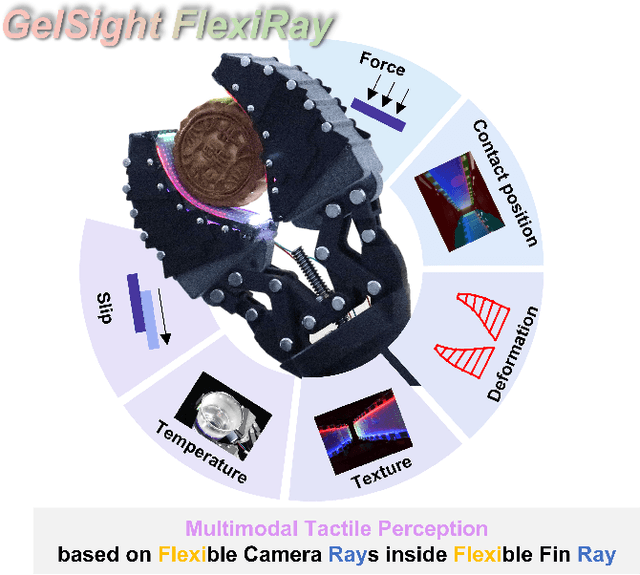
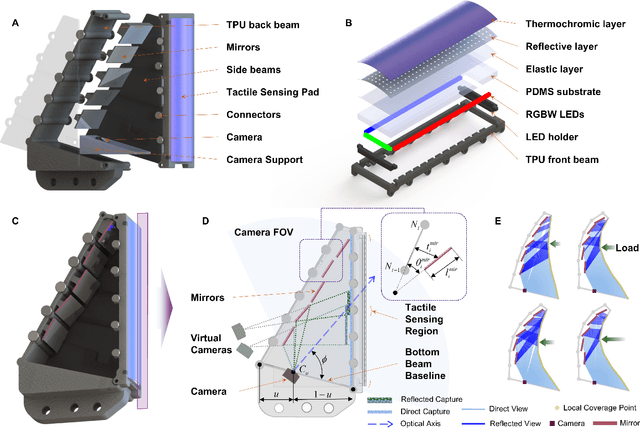
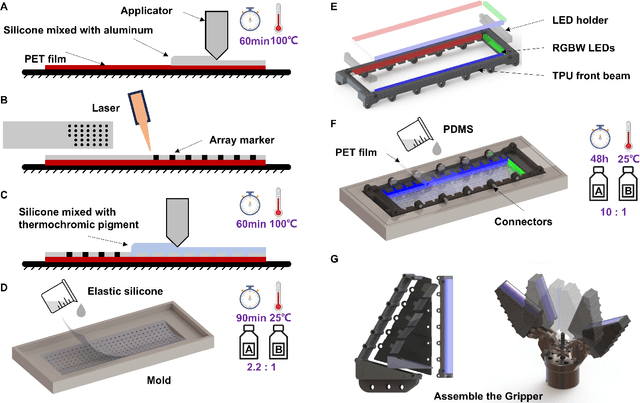
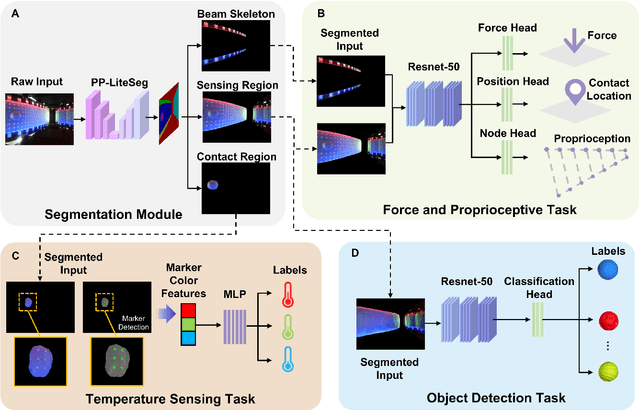
The integration of tactile sensing into compliant soft robotic grippers offers a compelling pathway toward advanced robotic grasping and safer human-robot interactions. Visual-tactile sensors realize high-resolution, large-area tactile perception with affordable cameras. However, conventional visual-tactile sensors rely heavily on rigid forms, sacrificing finger compliance and sensing regions to achieve localized tactile feedback. Enabling seamless, large-area tactile sensing in soft grippers remains challenging, as deformations inherent to soft structures can obstruct the optical path and restrict the camera's field of view. To address these, we present Gelsight FlexiRay, a multimodal visual-tactile sensor designed for safe and compliant interactions with substantial structural deformation through integration with Finray Effect grippers. First, we adopt a multi-mirror configuration, which is systematically modeled and optimized based on the physical force-deformation characteristics of FRE grippers. Second, we enhanced Gelsight FlexiRay with human-like multimodal perception, including contact force and location, proprioception, temperature, texture, and slippage. Experiments demonstrate Gelsight FlexiRay's robust tactile performance across diverse deformation states, achieving a force measurement accuracy of 0.14 N and proprioceptive positioning accuracy of 0.19 mm. Compared with state of art compliant VTS, the FlexiRay demonstrates 5 times larger structural deformation under the same loads. Its expanded sensing area and ability to distinguish contact information and execute grasping and classification tasks highlights its potential for versatile, large-area multimodal tactile sensing integration within soft robotic systems. This work establishes a foundation for flexible, high-resolution tactile sensing in compliant robotic applications.