 Add to Chrome
 Add to Firefox
 Add to Edge
SPRINT: Efficient Spectral Priors for Humanoid Athletic Sprints
May 27, 2026
The pursuit of humanoid athletic sprints is hindered by a scarcity of humanoid-viable kinematic reference data and the inability of existing frameworks to maintain stability during sprints. To overcome these limitations, we introduce SPRINT, a novel framework driven by efficient, frequency-adaptive spectral priors. By characterizing the fundamental periodicity of human locomotion in the frequency domain using a reference library of five discrete motion sequences, these priors generate kinematically feasible joint trajectories across a broad velocity spectrum, successfully extrapolating to speeds that exceed the reference distribution. Guided by these pretrained priors, the SPRINT policy achieves zero-shot sim-to-real transfer in field experiments on the Unitree G1 platform, reaching a peak sprinting velocity of 6 m/s and demonstrating seamless gait transitions while preserving biomimetic naturalness. Ultimately, this work establishes frequency-adaptive spectral priors as a highly data-efficient foundation for humanoid athletic sprints. The project page is available at https://anonymous.4open.science/w/SPRINT-138A/.

NuExo: A Wearable Exoskeleton Covering all Upper Limb ROM for Outdoor Data Collection and Teleoperation of Humanoid Robots
Mar 13, 2025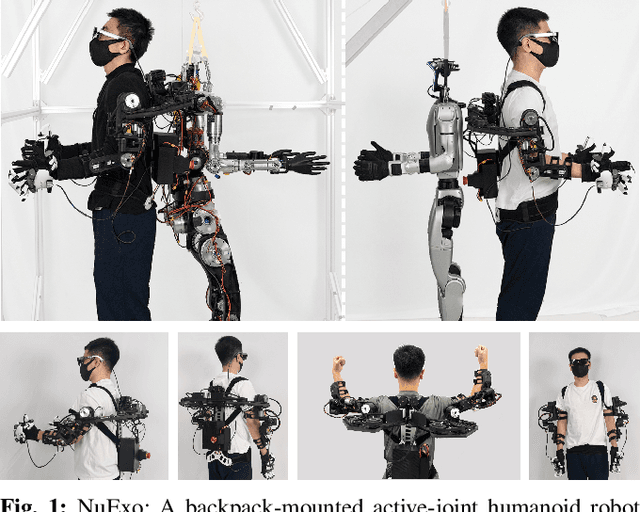
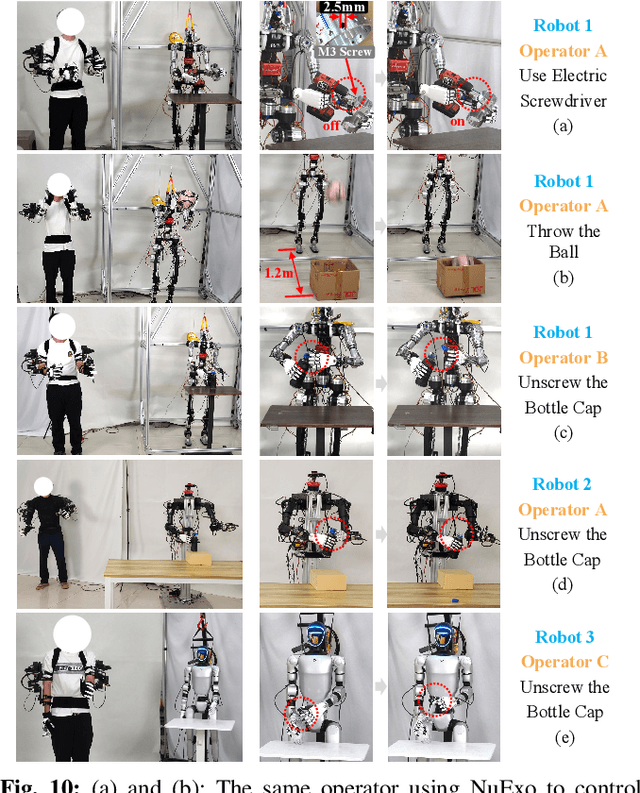
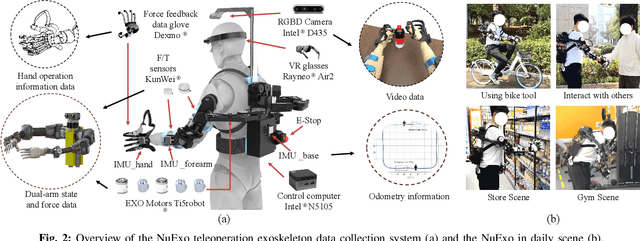
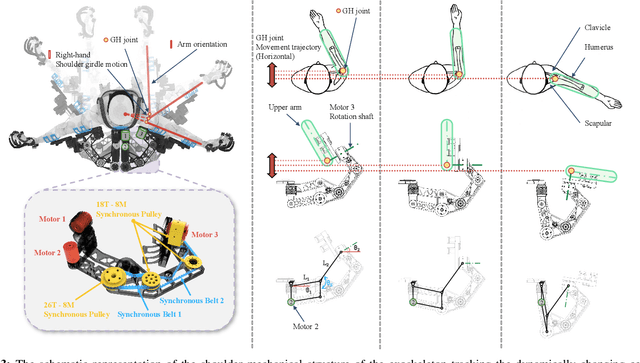
The evolution from motion capture and teleoperation to robot skill learning has emerged as a hotspot and critical pathway for advancing embodied intelligence. However, existing systems still face a persistent gap in simultaneously achieving four objectives: accurate tracking of full upper limb movements over extended durations (Accuracy), ergonomic adaptation to human biomechanics (Comfort), versatile data collection (e.g., force data) and compatibility with humanoid robots (Versatility), and lightweight design for outdoor daily use (Convenience). We present a wearable exoskeleton system, incorporating user-friendly immersive teleoperation and multi-modal sensing collection to bridge this gap. Due to the features of a novel shoulder mechanism with synchronized linkage and timing belt transmission, this system can adapt well to compound shoulder movements and replicate 100% coverage of natural upper limb motion ranges. Weighing 5.2 kg, NuExo supports backpack-type use and can be conveniently applied in daily outdoor scenarios. Furthermore, we develop a unified intuitive teleoperation framework and a comprehensive data collection system integrating multi-modal sensing for various humanoid robots. Experiments across distinct humanoid platforms and different users validate our exoskeleton's superiority in motion range and flexibility, while confirming its stability in data collection and teleoperation accuracy in dynamic scenarios.