 Add to Chrome
 Add to Firefox
 Add to Edge
SPRINT: Efficient Spectral Priors for Humanoid Athletic Sprints
May 27, 2026
The pursuit of humanoid athletic sprints is hindered by a scarcity of humanoid-viable kinematic reference data and the inability of existing frameworks to maintain stability during sprints. To overcome these limitations, we introduce SPRINT, a novel framework driven by efficient, frequency-adaptive spectral priors. By characterizing the fundamental periodicity of human locomotion in the frequency domain using a reference library of five discrete motion sequences, these priors generate kinematically feasible joint trajectories across a broad velocity spectrum, successfully extrapolating to speeds that exceed the reference distribution. Guided by these pretrained priors, the SPRINT policy achieves zero-shot sim-to-real transfer in field experiments on the Unitree G1 platform, reaching a peak sprinting velocity of 6 m/s and demonstrating seamless gait transitions while preserving biomimetic naturalness. Ultimately, this work establishes frequency-adaptive spectral priors as a highly data-efficient foundation for humanoid athletic sprints. The project page is available at https://anonymous.4open.science/w/SPRINT-138A/.

GeoLoco: Leveraging 3D Geometric Priors from Visual Foundation Model for Robust RGB-Only Humanoid Locomotion
Mar 08, 2026The prevailing paradigm of perceptive humanoid locomotion relies heavily on active depth sensors. However, this depth-centric approach fundamentally discards the rich semantic and dense appearance cues of the visual world, severing low-level control from the high-level reasoning essential for general embodied intelligence. While monocular RGB offers a ubiquitous, information-dense alternative, end-to-end reinforcement learning from raw 2D pixels suffers from extreme sample inefficiency and catastrophic sim-to-real collapse due to the inherent loss of geometric scale. To break this deadlock, we propose GeoLoco, a purely RGB-driven locomotion framework that conceptualizes monocular images as high-dimensional 3D latent representations by harnessing the powerful geometric priors of a frozen, scale-aware Visual Foundation Model (VFM). Rather than naive feature concatenation, we design a proprioceptive-query multi-head cross-attention mechanism that dynamically attends to task-critical topological features conditioned on the robot's real-time gait phase. Crucially, to prevent the policy from overfitting to superficial textures, we introduce a dual-head auxiliary learning scheme. This explicit regularization forces the high-dimensional latent space to strictly align with the physical terrain geometry, ensuring robust zero-shot sim-to-real transfer. Trained exclusively in simulation, GeoLoco achieves robust zero-shot transfer to the Unitree G1 humanoid and successfully negotiates challenging terrains.
Deep Reinforcement Learning for Flipper Control of Tracked Robots
Jun 17, 2023
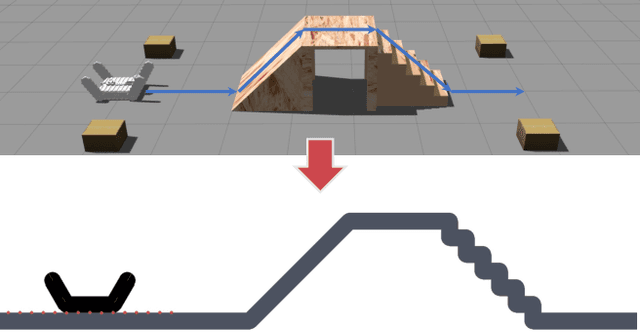


The autonomous control of flippers plays an important role in enhancing the intelligent operation of tracked robots within complex environments. While existing methods mainly rely on hand-crafted control models, in this paper, we introduce a novel approach that leverages deep reinforcement learning (DRL) techniques for autonomous flipper control in complex terrains. Specifically, we propose a new DRL network named AT-D3QN, which ensures safe and smooth flipper control for tracked robots. It comprises two modules, a feature extraction and fusion module for extracting and integrating robot and environment state features, and a deep Q-Learning control generation module for incorporating expert knowledge to obtain a smooth and efficient control strategy. To train the network, a novel reward function is proposed, considering both learning efficiency and passing smoothness. A simulation environment is constructed using the Pymunk physics engine for training. We then directly apply the trained model to a more realistic Gazebo simulation for quantitative analysis. The consistently high performance of the proposed approach validates its superiority over manual teleoperation.