 Add to Chrome
 Add to Firefox
 Add to Edge
MaskClaw: Edge-Side Personalized Privacy Arbitration for GUI Agents with Behavior-Driven Skill Evolution
May 27, 2026
GUI agents rely on screenshots to infer intent and operate across applications, but these screenshots often contain private messages, medical records, payment credentials, and workplace-specific workflows. Privacy decisions in this setting depend on task, recipient, application state, and user role, yet static PII detectors miss these boundaries and cloud-side VLM reasoning can upload the raw screen before deciding what should be protected. We present MaskClaw, an edge-side privacy arbitrator for GUI agents. MaskClaw extracts local visual evidence, retrieves user- and task-specific policy memory, and decides Allow, Mask, or Ask before raw screenshots leave a trusted user- or organization-controlled environment. In five designed skill-evolution scenarios, it turns corrections, cancellations, and edits into reusable privacy skills checked by a sandbox gate. We introduce P-GUI-Evo, a benchmark built from real UI patterns, reconstructed HTML screens, and sanitized labels. Experiments show that pattern matching, cloud reasoning, and routing alone tend to over-confirm, over-mask, or expose raw screenshots under the same protocol. The artifact is available at https://github.com/Theodora-Y/MaskClaw.

ZJUKLAB at SemEval-2025 Task 4: Unlearning via Model Merging
Mar 27, 2025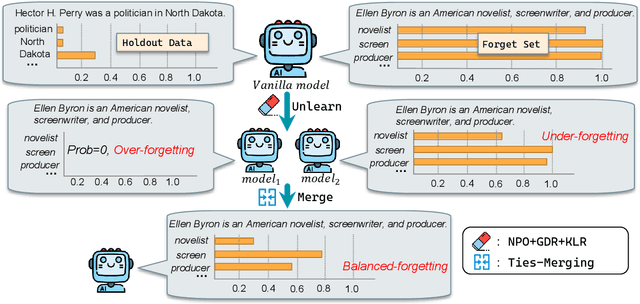
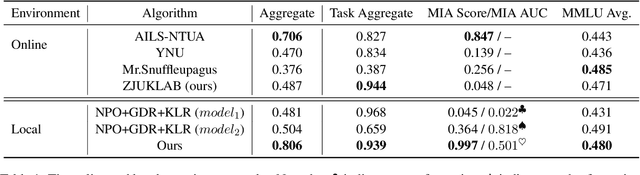
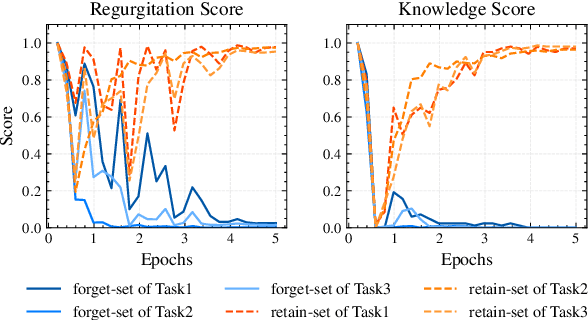
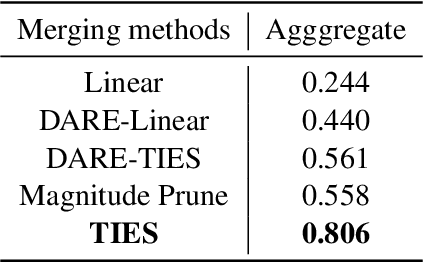
This paper presents the ZJUKLAB team's submission for SemEval-2025 Task 4: Unlearning Sensitive Content from Large Language Models. This task aims to selectively erase sensitive knowledge from large language models, avoiding both over-forgetting and under-forgetting issues. We propose an unlearning system that leverages Model Merging (specifically TIES-Merging), combining two specialized models into a more balanced unlearned model. Our system achieves competitive results, ranking second among 26 teams, with an online score of 0.944 for Task Aggregate and 0.487 for overall Aggregate. In this paper, we also conduct local experiments and perform a comprehensive analysis of the unlearning process, examining performance trajectories, loss dynamics, and weight perspectives, along with several supplementary experiments, to understand the effectiveness of our method. Furthermore, we analyze the shortcomings of our method and evaluation metrics, emphasizing that MIA scores and ROUGE-based metrics alone are insufficient to fully evaluate successful unlearning. Finally, we emphasize the need for more comprehensive evaluation methodologies and rethinking of unlearning objectives in future research. Code is available at https://github.com/zjunlp/unlearn/tree/main/semeval25.