 Add to Chrome
 Add to Firefox
 Add to Edge
MAIC-UI: Making Interactive Courseware with Generative UI
Apr 28, 2026
Creating interactive STEM courseware traditionally requires HTML/CSS/JavaScript expertise, leaving barriers for educators. While generative AI can produce HTML codes, existing tools generate static presentations rather than interactive simulations, struggle with long documents, and lack pedagogical accuracy mechanisms. Furthermore, full regeneration for modifications requires 200--600 seconds, disrupting creative flow. We present MAIC-UI, a zero-code authoring system that enables educators to create and rapidly edit interactive courseware from textbooks, PPTs, and PDFs. MAIC-UI employs: (1) structured knowledge analysis with multi-modal understanding to ensure pedagogical rigor; (2) a two-stage generate-verify-optimize pipeline separating content alignment from visual refinement; and (3) Click-to-Locate editing with Unified Diff-based incremental generation achieving sub-10-second iteration cycles. A controlled lab study with 40 participants shows MAIC-UI reduces editing iterations (4.9 vs. 7.0) and significantly improves learnability and controllability compared to direct Text-to-HTML generation. A three-month classroom deployment with 53 high school students demonstrates that MAIC-UI fosters learning agency and reduces outcome disparities -- the pilot class achieved 9.21-point gains in STEM subjects compared to -2.32 points in control classes. Our code is available at https://github.com/THU-MAIC/MAIC-UI.

Fake News Detection with Heterogeneous Transformer
May 06, 2022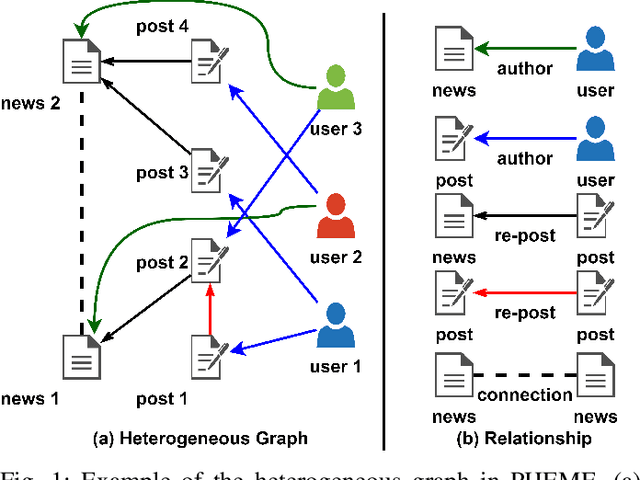
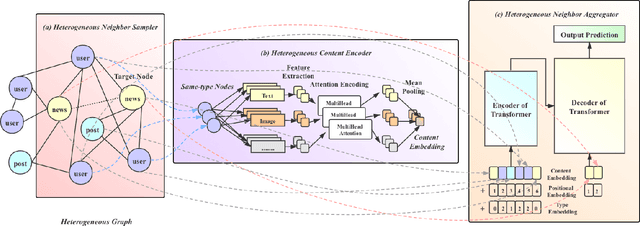
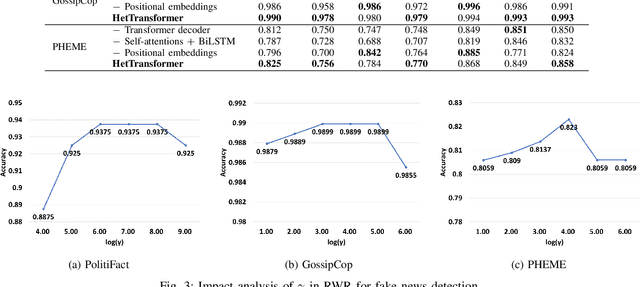
The dissemination of fake news on social networks has drawn public need for effective and efficient fake news detection methods. Generally, fake news on social networks is multi-modal and has various connections with other entities such as users and posts. The heterogeneity in both news content and the relationship with other entities in social networks brings challenges to designing a model that comprehensively captures the local multi-modal semantics of entities in social networks and the global structural representation of the propagation patterns, so as to classify fake news effectively and accurately. In this paper, we propose a novel Transformer-based model: HetTransformer to solve the fake news detection problem on social networks, which utilises the encoder-decoder structure of Transformer to capture the structural information of news propagation patterns. We first capture the local heterogeneous semantics of news, post, and user entities in social networks. Then, we apply Transformer to capture the global structural representation of the propagation patterns in social networks for fake news detection. Experiments on three real-world datasets demonstrate that our model is able to outperform the state-of-the-art baselines in fake news detection.