 Add to Chrome
 Add to Firefox
 Add to Edge
ReasonCast: Agentic Demand Forecasting with Selective Semantic Reasoning
Aug 15, 2026
Demand forecasting increasingly requires combining two complementary sources of information: historical sales reveal recurring numerical dynamics, while future promotions, holidays, price changes, and platform interventions provide forward-looking knowledge. Existing text-enhanced forecasting methods often encode such context into generic representations and fuse it uniformly with time-series features, without explicitly distinguishing which semantic effects are forecast-relevant or how they should modify future dynamics. We introduce ReasonCast, a structured semantic intervention framework that translates event knowledge into forecast-specific operations. An agent examines the event context, the no-text forecast, and its uncertainty to determine whether textual reasoning is needed. Rather than injecting free-form text, ReasonCast represents event knowledge through structured fields describing event relevance, demand direction, temporal shape, amplitude, and peak intensity. These fields interact selectively with temporal components of a time-series foundation model. An additive path corrects local trends and temporal shapes, while a multiplicative path captures event-driven level shifts. ReasonCast introduces a forecast-grounded post-training curriculum. Schema SFT establishes semantic fields; semantic-field RL calibrates direction, shape, amplitude, and peak judgments; and forecast-utility RL evaluates semantic interventions through a frozen forecaster, aligning reasoning outputs with marginal forecast improvement. ReasonCast lowers WMAPE by 3.29, 1.25, and 0.47 percentage points on holiday-sensitive categories, mega-sale-sensitive categories, and M5 event windows, respectively. On stable-sales periods, indiscriminate semantic intervention increases WMAPE by 1.68 percentage points, whereas suppressing unnecessary intervention preserves the numerical backbone.

Structure-Aware Long Short-Term Memory Network for 3D Cephalometric Landmark Detection
Jul 21, 2021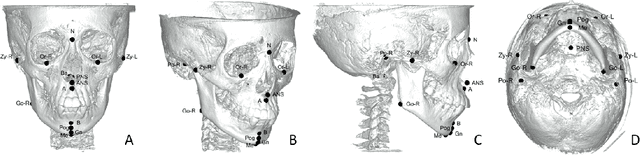
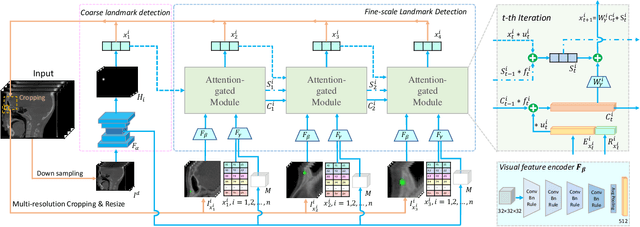
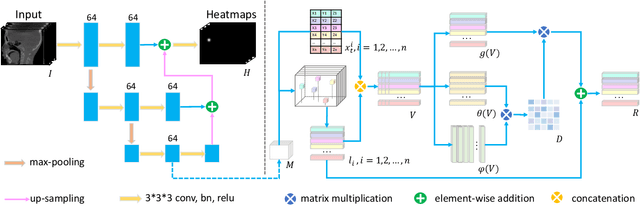
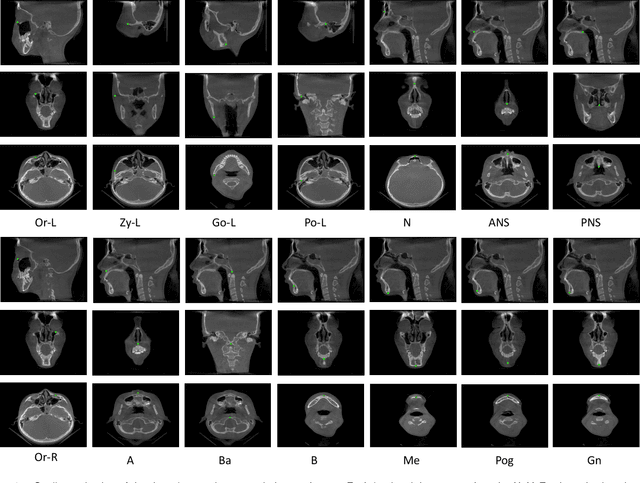
Detecting 3D landmarks on cone-beam computed tomography (CBCT) is crucial to assessing and quantifying the anatomical abnormalities in 3D cephalometric analysis. However, the current methods are time-consuming and suffer from large biases in landmark localization, leading to unreliable diagnosis results. In this work, we propose a novel Structure-Aware Long Short-Term Memory framework (SA-LSTM) for efficient and accurate 3D landmark detection. To reduce the computational burden, SA-LSTM is designed in two stages. It first locates the coarse landmarks via heatmap regression on a down-sampled CBCT volume and then progressively refines landmarks by attentive offset regression using high-resolution cropped patches. To boost accuracy, SA-LSTM captures global-local dependence among the cropping patches via self-attention. Specifically, a graph attention module implicitly encodes the landmark's global structure to rationalize the predicted position. Furthermore, a novel attention-gated module recursively filters irrelevant local features and maintains high-confident local predictions for aggregating the final result. Experiments show that our method significantly outperforms state-of-the-art methods in terms of efficiency and accuracy on an in-house dataset and a public dataset, achieving 1.64 mm and 2.37 mm average errors, respectively, and using only 0.5 seconds for inferring the whole CBCT volume of resolution 768*768*576. Moreover, all predicted landmarks are within 8 mm error, which is vital for acceptable cephalometric analysis.