 Add to Chrome
 Add to Firefox
 Add to Edge
ReasonCast: Agentic Demand Forecasting with Selective Semantic Reasoning
Aug 15, 2026
Demand forecasting increasingly requires combining two complementary sources of information: historical sales reveal recurring numerical dynamics, while future promotions, holidays, price changes, and platform interventions provide forward-looking knowledge. Existing text-enhanced forecasting methods often encode such context into generic representations and fuse it uniformly with time-series features, without explicitly distinguishing which semantic effects are forecast-relevant or how they should modify future dynamics. We introduce ReasonCast, a structured semantic intervention framework that translates event knowledge into forecast-specific operations. An agent examines the event context, the no-text forecast, and its uncertainty to determine whether textual reasoning is needed. Rather than injecting free-form text, ReasonCast represents event knowledge through structured fields describing event relevance, demand direction, temporal shape, amplitude, and peak intensity. These fields interact selectively with temporal components of a time-series foundation model. An additive path corrects local trends and temporal shapes, while a multiplicative path captures event-driven level shifts. ReasonCast introduces a forecast-grounded post-training curriculum. Schema SFT establishes semantic fields; semantic-field RL calibrates direction, shape, amplitude, and peak judgments; and forecast-utility RL evaluates semantic interventions through a frozen forecaster, aligning reasoning outputs with marginal forecast improvement. ReasonCast lowers WMAPE by 3.29, 1.25, and 0.47 percentage points on holiday-sensitive categories, mega-sale-sensitive categories, and M5 event windows, respectively. On stable-sales periods, indiscriminate semantic intervention increases WMAPE by 1.68 percentage points, whereas suppressing unnecessary intervention preserves the numerical backbone.

HybridGNN: Learning Hybrid Representation in Multiplex Heterogeneous Networks
Aug 03, 2022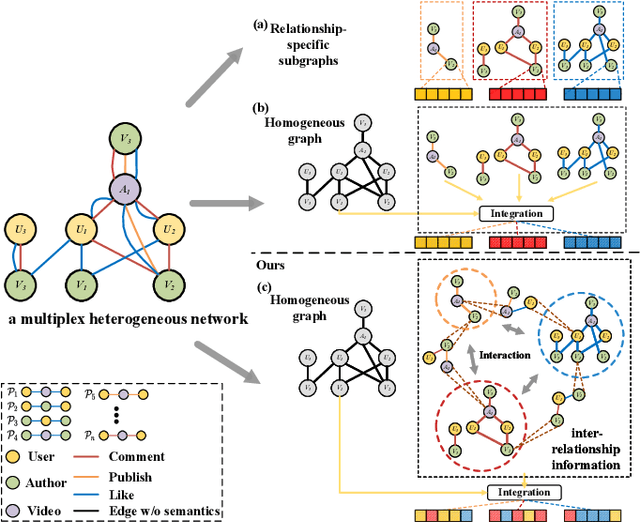
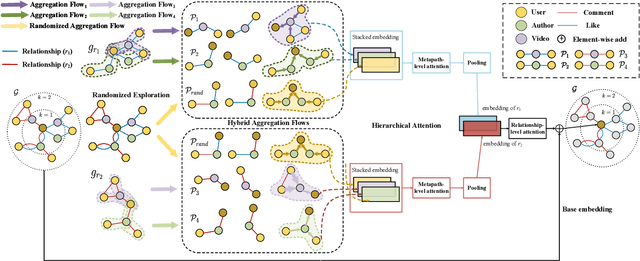
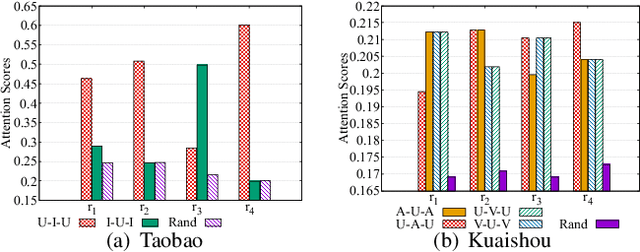
Recently, graph neural networks have shown the superiority of modeling the complex topological structures in heterogeneous network-based recommender systems. Due to the diverse interactions among nodes and abundant semantics emerging from diverse types of nodes and edges, there is a bursting research interest in learning expressive node representations in multiplex heterogeneous networks. One of the most important tasks in recommender systems is to predict the potential connection between two nodes under a specific edge type (i.e., relationship). Although existing studies utilize explicit metapaths to aggregate neighbors, practically they only consider intra-relationship metapaths and thus fail to leverage the potential uplift by inter-relationship information. Moreover, it is not always straightforward to exploit inter-relationship metapaths comprehensively under diverse relationships, especially with the increasing number of node and edge types. In addition, contributions of different relationships between two nodes are difficult to measure. To address the challenges, we propose HybridGNN, an end-to-end GNN model with hybrid aggregation flows and hierarchical attentions to fully utilize the heterogeneity in the multiplex scenarios. Specifically, HybridGNN applies a randomized inter-relationship exploration module to exploit the multiplexity property among different relationships. Then, our model leverages hybrid aggregation flows under intra-relationship metapaths and randomized exploration to learn the rich semantics. To explore the importance of different aggregation flow and take advantage of the multiplexity property, we bring forward a novel hierarchical attention module which leverages both metapath-level attention and relationship-level attention. Extensive experimental results suggest that HybridGNN achieves the best performance compared to several state-of-the-art baselines.