 Add to Chrome
 Add to Firefox
 Add to Edge
Partial Skeleton Visibility for Action Recognition: A Constrained Field-of-View Approach
Jul 01, 2026
Skeleton-based action recognition has achieved remarkable success by exploiting joint coordinates and their topological connections, yet prevailing methods overwhelmingly assume complete and clean skeleton inputs. In real-world deployments, such as egocentric vision, crowded surveillance, wearable devices, or edge robotics, limited field-of-view (FoV) frequently causes substantial joint visibility dropout, leading to severe performance degradation that existing models are largely unprepared to handle. To bridge this critical yet underexplored gap, we introduce PartialVisGraph, a novel hypergraph framework tailored for robust skeleton action recognition under constrained FoV. We first construct highly expressive hypergraphs by introducing learnable virtual hyperedges that form a soft incidence matrix, capturing flexible high-order dependencies beyond conventional pairwise graphs. We then propose the Single-Head Sample-Adaptive Transformer, which adaptively aggregates joint features onto hyperedges while explicitly incorporating a visibility prior. This prior selectively gates information flow, preventing occluded or out-of-view joints from corrupting reliable feature propagation. We further establish rigorous evaluation protocols with realistic FoV simulation benchmarks on NTU RGB+D 60 and 120. Extensive experiments demonstrate that PartialVisGraph consistently achieves state-of-the-art accuracy under partial visibility, with gains of up to 68.8\% on subsets with severe FoV restrictions compared to recent strong baselines, while remaining superior on full-visibility settings. Our approach offers a principled and practical pathway toward deployable skeleton-based action understanding in unconstrained environments.

Beyond Strict Pairing: Arbitrarily Paired Training for High-Performance Infrared and Visible Image Fusion
Mar 23, 2026Infrared and visible image fusion(IVIF) combines complementary modalities while preserving natural textures and salient thermal signatures. Existing solutions predominantly rely on extensive sets of rigidly aligned image pairs for training. However, acquiring such data is often impractical due to the costly and labour-intensive alignment process. Besides, maintaining a rigid pairing setting during training restricts the volume of cross-modal relationships, thereby limiting generalisation performance. To this end, this work challenges the necessity of Strictly Paired Training Paradigm (SPTP) by systematically investigating UnPaired and Arbitrarily Paired Training Paradigms (UPTP and APTP) for high-performance IVIF. We establish a theoretical objective of APTP, reflecting the complementary nature between UPTP and SPTP. More importantly, we develop a practical framework capable of significantly enriching cross-modal relationships even with severely limited and unaligned training data. To validate our propositions, three end-to-end lightweight baselines, alongside a set of innovative loss functions, are designed to cover three classic frameworks (CNN, Transformer, GAN). Comprehensive experiments demonstrate that the proposed APTP and UPTP are feasible and capable of training models on a severely limited and content-inconsistent infrared and visible dataset, achieving performance comparable to that of a dataset 100$\times$ larger in SPTP. This finding fundamentally alleviates the cost and difficulty of data collection while enhancing model robustness from the data perspective, delivering a feasible solution for IVIF studies. The code is available at \href{https://github.com/yanglinDeng/IVIF_unpair}{\textcolor{blue}{https://github.com/yanglinDeng/IVIF\_unpair}}.
MARS2 2025 Challenge on Multimodal Reasoning: Datasets, Methods, Results, Discussion, and Outlook
Sep 17, 2025
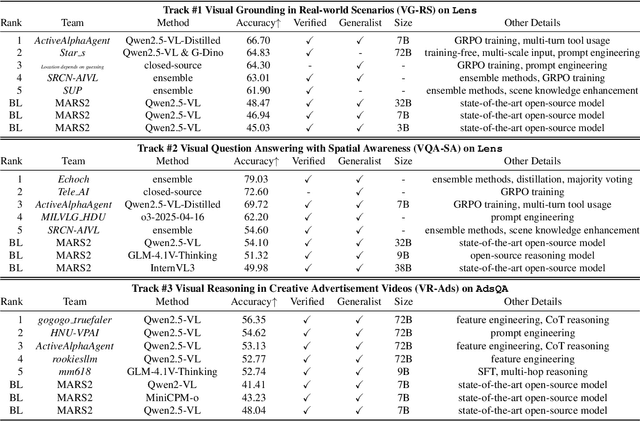

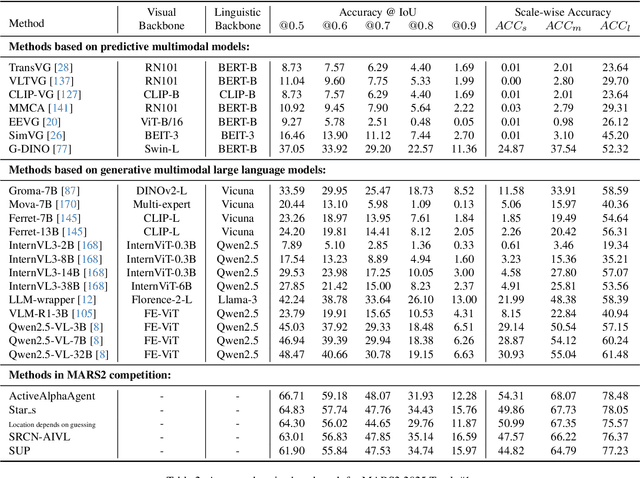
This paper reviews the MARS2 2025 Challenge on Multimodal Reasoning. We aim to bring together different approaches in multimodal machine learning and LLMs via a large benchmark. We hope it better allows researchers to follow the state-of-the-art in this very dynamic area. Meanwhile, a growing number of testbeds have boosted the evolution of general-purpose large language models. Thus, this year's MARS2 focuses on real-world and specialized scenarios to broaden the multimodal reasoning applications of MLLMs. Our organizing team released two tailored datasets Lens and AdsQA as test sets, which support general reasoning in 12 daily scenarios and domain-specific reasoning in advertisement videos, respectively. We evaluated 40+ baselines that include both generalist MLLMs and task-specific models, and opened up three competition tracks, i.e., Visual Grounding in Real-world Scenarios (VG-RS), Visual Question Answering with Spatial Awareness (VQA-SA), and Visual Reasoning in Creative Advertisement Videos (VR-Ads). Finally, 76 teams from the renowned academic and industrial institutions have registered and 40+ valid submissions (out of 1200+) have been included in our ranking lists. Our datasets, code sets (40+ baselines and 15+ participants' methods), and rankings are publicly available on the MARS2 workshop website and our GitHub organization page https://github.com/mars2workshop/, where our updates and announcements of upcoming events will be continuously provided.
MMDRFuse: Distilled Mini-Model with Dynamic Refresh for Multi-Modality Image Fusion
Aug 28, 2024In recent years, Multi-Modality Image Fusion (MMIF) has been applied to many fields, which has attracted many scholars to endeavour to improve the fusion performance. However, the prevailing focus has predominantly been on the architecture design, rather than the training strategies. As a low-level vision task, image fusion is supposed to quickly deliver output images for observation and supporting downstream tasks. Thus, superfluous computational and storage overheads should be avoided. In this work, a lightweight Distilled Mini-Model with a Dynamic Refresh strategy (MMDRFuse) is proposed to achieve this objective. To pursue model parsimony, an extremely small convolutional network with a total of 113 trainable parameters (0.44 KB) is obtained by three carefully designed supervisions. First, digestible distillation is constructed by emphasising external spatial feature consistency, delivering soft supervision with balanced details and saliency for the target network. Second, we develop a comprehensive loss to balance the pixel, gradient, and perception clues from the source images. Third, an innovative dynamic refresh training strategy is used to collaborate history parameters and current supervision during training, together with an adaptive adjust function to optimise the fusion network. Extensive experiments on several public datasets demonstrate that our method exhibits promising advantages in terms of model efficiency and complexity, with superior performance in multiple image fusion tasks and downstream pedestrian detection application. The code of this work is publicly available at https://github.com/yanglinDeng/MMDRFuse.
* 10 pages, 8 figures, accpeted by ACM International Conference on Multimedia 2024(Oral)