 Add to Chrome
 Add to Firefox
 Add to Edge
CultureForest: Understanding and Evaluating Cultural Norm Grounded Reasoning in LLMs
Jun 01, 2026
Existing research largely reduces cultural intelligence in LLMs to a knowledge-level problem, overlooking whether models can effectively utilize their acquired knowledge in realistic scenarios. To bridge this gap, we introduce CultureForest, a benchmark for \textit{Cultural Norm Grounded Reasoning}. Each question is grounded in a small set of atomic norms, enabling verifiable and attributable evaluation. CultureForest comprises 5,378 examples across 8 domains and 53 countries/regions, and supports a progressive evaluation from multiple-choice to open-ended generation. Extensive experiments reveal that even top-tier models degrade substantially in open-ended settings, accompanied by pronounced cross-region disparities. Through targeted analysis, we uncover several consistent patterns: (1) test-time reasoning yields limited gains and may exacerbate inequity; (2) models exhibit highly shared regional preference structures; (3) model responses are markedly conservative, especially under stricter cultural constraints; and (4) by disentangling cultural knowledge acquisition from cultural reasoning, we show that while LLMs possess substantial cultural knowledge, their performance is further bottlenecked by its effective use. These findings point to a necessary shift from knowledge-centric evaluation toward measuring knowledge-grounded reasoning.

Culture-Aware Machine Translation in Large Language Models: Benchmarking and Investigation
Apr 27, 2026Large language models (LLMs) have achieved strong performance in general machine translation, yet their ability in culture-aware scenarios remains poorly understood. To bridge this gap, we introduce CanMT, a Culture-Aware Novel-Driven Parallel Dataset for Machine Translation, together with a theoretically grounded, multi-dimensional evaluation framework for assessing cultural translation quality. Leveraging CanMT, we systematically evaluate a wide range of LLMs and translation systems under different translation strategy constraints. Our findings reveal substantial performance disparities across models and demonstrate that translation strategies exert a systematic influence on model behavior. Further analysis shows that translation difficulty varies across types of culture-specific items, and that a persistent gap remains between models' recognition of culture-specific knowledge and their ability to correctly operationalize it in translation outputs. In addition, incorporating reference translations is shown to substantially improve evaluation reliability in LLM-as-a-judge, underscoring their essential role in assessing culture-aware translation quality. The corpus and code are available at CanMT.
SAVOIR: Learning Social Savoir-Faire via Shapley-based Reward Attribution
Apr 21, 2026Social intelligence, the ability to navigate complex interpersonal interactions, presents a fundamental challenge for language agents. Training such agents via reinforcement learning requires solving the credit assignment problem: determining how individual utterances contribute to multi-turn dialogue outcomes. Existing approaches directly employ language models to distribute episode-level rewards, yielding attributions that are retrospective and lack theoretical grounding. We propose SAVOIR (ShApley Value fOr SocIal RL), a novel principled framework grounded in cooperative game theory. Our approach combines two complementary principles: expected utility shifts evaluation from retrospective attribution to prospective valuation, capturing an utterance's strategic potential for enabling favorable future trajectories; Shapley values ensure fair credit distribution with axiomatic guarantees of efficiency, symmetry, and marginality. Experiments on the SOTOPIA benchmark demonstrate that SAVOIR achieves new state-of-the-art performance across all evaluation settings, with our 7B model matching or exceeding proprietary models including GPT-4o and Claude-3.5-Sonnet. Notably, even large reasoning models consistently underperform, suggesting social intelligence requires qualitatively different capabilities than analytical reasoning.
Stratagem: Learning Transferable Reasoning via Trajectory-Modulated Game Self-Play
Apr 20, 2026Games offer a compelling paradigm for developing general reasoning capabilities in language models, as they naturally demand strategic planning, probabilistic inference, and adaptive decision-making. However, existing self-play approaches rely solely on terminal game outcomes, providing no mechanism to distinguish transferable reasoning patterns from game-specific heuristics. We present STRATAGEM, which addresses two fundamental barriers to reasoning transfer: domain specificity, where learned patterns remain anchored in game semantics, and contextual stasis, where static game contexts fail to cultivate progressive reasoning. STRATAGEM selectively reinforces trajectories exhibiting abstract, domain-agnostic reasoning through a Reasoning Transferability Coefficient, while incentivizing adaptive reasoning development via a Reasoning Evolution Reward. Experiments across mathematical reasoning, general reasoning, and code generation benchmarks demonstrate substantial improvements, with particularly strong gains on competition-level mathematics where multi-step reasoning is critical. Ablation studies and human evaluation confirm that both components contribute to transferable reasoning.
LangGPS: Language Separability Guided Data Pre-Selection for Joint Multilingual Instruction Tuning
Nov 13, 2025Joint multilingual instruction tuning is a widely adopted approach to improve the multilingual instruction-following ability and downstream performance of large language models (LLMs), but the resulting multilingual capability remains highly sensitive to the composition and selection of the training data. Existing selection methods, often based on features like text quality, diversity, or task relevance, typically overlook the intrinsic linguistic structure of multilingual data. In this paper, we propose LangGPS, a lightweight two-stage pre-selection framework guided by language separability which quantifies how well samples in different languages can be distinguished in the model's representation space. LangGPS first filters training data based on separability scores and then refines the subset using existing selection methods. Extensive experiments across six benchmarks and 22 languages demonstrate that applying LangGPS on top of existing selection methods improves their effectiveness and generalizability in multilingual training, especially for understanding tasks and low-resource languages. Further analysis reveals that highly separable samples facilitate the formation of clearer language boundaries and support faster adaptation, while low-separability samples tend to function as bridges for cross-lingual alignment. Besides, we also find that language separability can serve as an effective signal for multilingual curriculum learning, where interleaving samples with diverse separability levels yields stable and generalizable gains. Together, we hope our work offers a new perspective on data utility in multilingual contexts and support the development of more linguistically informed LLMs.
Enhancing Non-English Capabilities of English-Centric Large Language Models through Deep Supervision Fine-Tuning
Mar 05, 2025Large language models (LLMs) have demonstrated significant progress in multilingual language understanding and generation. However, due to the imbalance in training data, their capabilities in non-English languages are limited. Recent studies revealed the English-pivot multilingual mechanism of LLMs, where LLMs implicitly convert non-English queries into English ones at the bottom layers and adopt English for thinking at the middle layers. However, due to the absence of explicit supervision for cross-lingual alignment in the intermediate layers of LLMs, the internal representations during these stages may become inaccurate. In this work, we introduce a deep supervision fine-tuning method (DFT) that incorporates additional supervision in the internal layers of the model to guide its workflow. Specifically, we introduce two training objectives on different layers of LLMs: one at the bottom layers to constrain the conversion of the target language into English, and another at the middle layers to constrain reasoning in English. To effectively achieve the guiding purpose, we designed two types of supervision signals: logits and feature, which represent a stricter constraint and a relatively more relaxed guidance. Our method guides the model to not only consider the final generated result when processing non-English inputs but also ensure the accuracy of internal representations. We conducted extensive experiments on typical English-centric large models, LLaMA-2 and Gemma-2, and the results on multiple multilingual datasets show that our method significantly outperforms traditional fine-tuning methods.
XTransplant: A Probe into the Upper Bound Performance of Multilingual Capability and Culture Adaptability in LLMs via Mutual Cross-lingual Feed-forward Transplantation
Dec 17, 2024Current large language models (LLMs) often exhibit imbalances in multilingual capabilities and cultural adaptability, largely due to their English-centric pretraining data. To address this imbalance, we propose a probing method named XTransplant that explores cross-lingual latent interactions via cross-lingual feed-forward transplantation during inference stage, with the hope of enabling the model to leverage the strengths of both English and non-English languages. Through extensive pilot experiments, we empirically prove that both the multilingual capabilities and cultural adaptability of LLMs hold the potential to be significantly improved by XTransplant, respectively from En -> non-En and non-En -> En, highlighting the underutilization of current LLMs' multilingual potential. And the patterns observed in these pilot experiments further motivate an offline scaling inference strategy, which demonstrates consistent performance improvements in multilingual and culture-aware tasks, sometimes even surpassing multilingual supervised fine-tuning. And we do hope our further analysis and discussion could help gain deeper insights into XTransplant mechanism.
GlobeSumm: A Challenging Benchmark Towards Unifying Multi-lingual, Cross-lingual and Multi-document News Summarization
Oct 05, 2024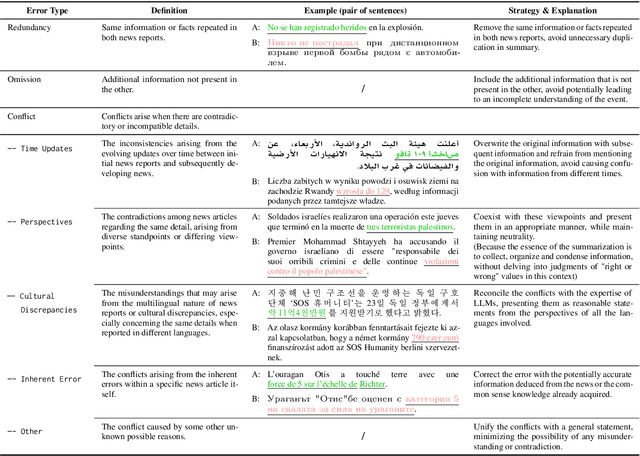


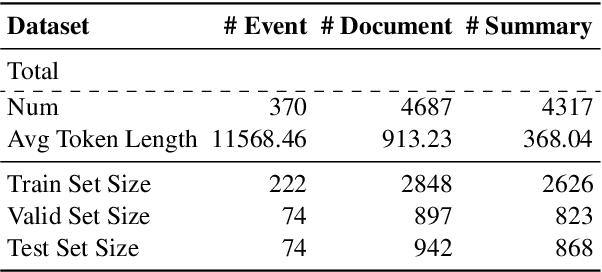
News summarization in today's global scene can be daunting with its flood of multilingual content and varied viewpoints from different sources. However, current studies often neglect such real-world scenarios as they tend to focus solely on either single-language or single-document tasks. To bridge this gap, we aim to unify Multi-lingual, Cross-lingual and Multi-document Summarization into a novel task, i.e., MCMS, which encapsulates the real-world requirements all-in-one. Nevertheless, the lack of a benchmark inhibits researchers from adequately studying this invaluable problem. To tackle this, we have meticulously constructed the GLOBESUMM dataset by first collecting a wealth of multilingual news reports and restructuring them into event-centric format. Additionally, we introduce the method of protocol-guided prompting for high-quality and cost-effective reference annotation. In MCMS, we also highlight the challenge of conflicts between news reports, in addition to the issues of redundancies and omissions, further enhancing the complexity of GLOBESUMM. Through extensive experimental analysis, we validate the quality of our dataset and elucidate the inherent challenges of the task. We firmly believe that GLOBESUMM, given its challenging nature, will greatly contribute to the multilingual communities and the evaluation of LLMs.
Rethinking Entity-level Unlearning for Large Language Models
Jun 22, 2024Large language model unlearning has gained increasing attention due to its potential to mitigate security and privacy concerns. Current research predominantly focuses on Instance-level unlearning, specifically aiming at forgetting predefined instances of sensitive content. However, a notable gap still exists in exploring the deletion of complete entity-related information, which is crucial in many real-world scenarios, such as copyright protection. To this end, we propose a novel task of Entity-level unlearning, where the entity-related knowledge within the target model is supposed to be entirely erased. Given the challenge of practically accessing all entity-related knowledge within a model, we begin by simulating entity-level unlearning scenarios through fine-tuning models to introduce pseudo entities. Following this, we develop baseline methods inspired by trending unlearning techniques and conduct a detailed comparison of their effectiveness in this task. Extensive experiments reveal that current unlearning algorithms struggle to achieve effective entity-level unlearning. Additionally, our analyses further indicate that entity-related knowledge injected through fine-tuning is more susceptible than original entities from pre-training during unlearning, highlighting the necessity for more thorough pseudo-entity injection methods to make them closer to pre-trained knowledge.